

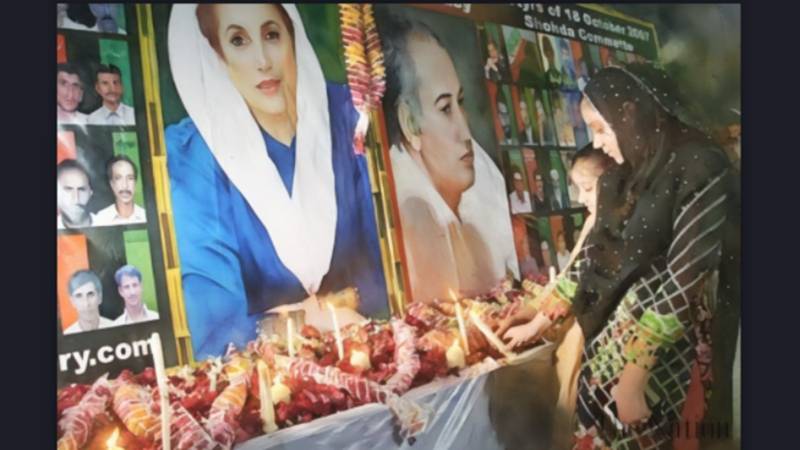
On the 16th of October 1951, the first Prime Minister of Pakistan, Liaquat Ali Khan, was assassinated in Liaquat Bagh Rawalpindi and the same gruesome spectacle was repeated 76 years later on the 27th of December 2007. Benazir Bhutto, the former Prime Minister of Pakistan the then leader of the opposition and head of the Pakistan People’s party, was brutally killed by the shots fired after a political rally in Liaquat Bagh and a suicide bomb was detonated immediately after the shooting – 23 other people lost their lives in the bombing alongside her. She had previously survived a similar attempt on her life at Karsaz in Karachi that had killed about 180 people, after her return from abroad two months earlier.
On that very day, the 27th of December 2007, the Director General of the ISI Lt Gen Nadeem Taj met Benazir and delivered a chilling warning that suicide bombers were going to target her. Benazir was suspicious that they were tricking her into cancelling her public meeting in Liaquat Bagh, so she refused to heed the warning and told Gen Taj that providing her security was the responsibility of the state – and so they should just tighten security and she will not cancel the event that day.
A Taliban handler, Nasrullah, had arrived in Rawalpindi shortly after midnight, bringing with him two 15-year-old boys, Bilal and Ikramullah. According to the rituals they had learned in the suicide bomb facility where they had been trained, the boys had to bathe to ensure they were clean for when they entered paradise. As they prepared for martyrdom, two more handlers, named in the eventual trial as Husnain Gul and Rafaqat Hussain, went to Rawalpindi’s Liaquat Park, where the Pakistan People’s Party (PPP) rally was due to be held, to check that nothing would upset their plans. The police were already setting up metal detectors at each of the three gates to the park, but since the plan was to attack her as she left the rally, that did not matter.
Benazir Bhutto's real strength was her intellectual versatility. She understood Western democratic concepts and was also familiar with the psychology of Eastern societies
Satisfied that they could do it, the two young men returned and gave a pistol with live rounds to Bilal and a hand grenade to Ikramullah. As Bilal put his suicide jacket on, he took off a shawl and cap, which he left at Husnain Gul’s house. Although the state would later ignore the evidence, the clothes and the DNA left on them would provide what could be considered irrefutable proof about the identities of the conspirators. Husnain then advised Bilal to wear something other than training shoes, as the security forces had the idea that jihadis wore trainers and might pick him up. He put on some sandals and left his trainers behind as well.
After some prayers, Husnain took Bilal to the exit gate that they thought Benazir would use, while Rafaqat took Ikramullah to another gate in case she used a different route. Shortly after she got up, Benazir phoned her family in Dubai. “Your voice is going hoarse,” her son Bilawal told her. “You have to make sure you drink your lemon and honey.”
She then spoke to her husband Asif Zardari. “I told her not to go out. She said, you know, some things I have to do,” he later recalled. It was the last time she would speak to either of them. Her attitude was in part a reflection of her fatalism. “I believe that the time is written and when it comes it will come,” she once said. “I used to be scared of death but after my father’s death I was no longer scared. The body is just the clothing and it is the soul that is important and the soul is free and with God and not under six feet of earth.”
In the political history of Pakistan, there are some names that will live till eternity for their dedication to democracy and human values and the name of Benazir Bhutto is definitely one such name. She was a shining example of an icon of democracy and resistance. In spite of the brutal dictatorships and numerous threats to her life she continued her relentless struggle for democracy, the people’s right to rule, the rule of the constitution, women’s rights and human rights. She displayed immense courage fortitude and determination in her march for democracy and her struggle for the rights of the common man and she ultimately sacrificed her life for the ideals she believed in.
She was born on the 21st of June 1953 as the eldest in the house of Zulfikar Ali Bhutto and grew up in family steeped in politics and public service. After school, she went on to get degrees from Harvard and Oxford, and combined with academic excellence and global exposure she blossomed into a mature, well informed and dedicated political leader. She managed very well to present Pakistan as a soft democratic state believing in international obligations and human rights, and she was respected internationally as a political leader and an intellectual stateswoman. Renowned American historian and journalist Stanley Wolpert writes in his book Zulfi Bhutto of Pakistan that, "Benazir Bhutto's political training was in Western universities, but her politics were rooted in the people and Eastern society, which set her apart from other leaders."
Renowned British author and journalist Christina Lamb writes in her book Waiting for Allah, "Benazir Bhutto's real strength was her intellectual versatility. She understood Western democratic concepts and was also familiar with the psychology of Eastern societies, which is why world leaders regarded her as a serious and articulate politician.”
Mark Juergensmeyer, author of the well-known book on world politics, The New Cold War? Religious Nationalism Confronts the Secular State, counts Benazir Bhutto among those Muslim leaders who argued for a democratic and secular state in the face of religious extremism. According to him, Shaheed Benazir Bhutto represented a rare combination of Muslim identity and democratic conviction.
Similarly, in her autobiography Daughter of Destiny, published in Urdu as Dukhtar-e-Mashriq, Benazir Bhutto herself wrote, "My goal was not to gain power but to establish Pakistan as a responsible, democratic and peaceful state on the world stage. Pakistan's survival is linked to the Constitution, public participation and international respect, not to unelected centres of power."
Shaheed Benazir Bhutto was not confined to Pakistani politics alone. She was a global democratic voice whose thinking, education and political insight earned her credibility on the international stage. After the imposition of martial law in 1977 and the subsequent judicial martyrdom of Zulfikar Ali Bhutto, Benazir Bhutto's political trials began. Long periods of imprisonment, house arrest and exile strengthened her resolve rather than weakening it. Had she chosen the path of expediency at that stage, life might have been easier for her personally. However, she refused to bow down to dictatorship. This decision made her a symbol of democracy in the hearts of the people.
In 1988, Benazir Bhutto was elected the first female Prime Minister of Pakistan and the Muslim world. This marked a turning point not only in political history but also in social history. It was a major milestone. Her rise to power sent a clear message about women's political participation, that leadership is based on ability and vision, not gender. During her first term, she focused on the release of political prisoners, freedom of the press, the revival of student unions and the development of social sectors. At the same time, she faced intense political pressure, institutional resistance and instability. During her second term in 1993, she took several initiatives in social security, health and women's welfare. Programs such as the Lady Health Worker Program and financial facilities for women were part of this vision. The central focus of Bibi Shaheed's politics was always the common person. She believed that the true responsibility of the state was to empower the weak, not to further entrench the powerful.
Benazir Bhutto's return to Pakistan in 2007 after a long exile breathed new life into national politics. Her reception in Karachi made it clear that the people still saw her as their hope. Despite a terrorist attack on the same day, she did not withdraw from the political arena. Bibi Shaheed fully understood the risks of returning, but believed that the restoration of democracy was more important than personal security. On December 27, 2007, Mohtarma Benazir Bhutto was martyred in a terrorist attack in Rawalpindi. The incident shook not only Pakistan but the entire world. International leaders termed it an attack on democracy, while domestically, it was seen as an irreparable loss. Her martyrdom immortalised Shaheed Bibi in history as a leader who stood firm on her ideology to the last.
Shaheed Bibi's famous saying, "Democracy is the best revenge," continues to resonate as a moral principle in Pakistani politics. Today, the discourse on democratic continuity, the supremacy of Parliament and the sanctity of the vote in Pakistan is rooted in the struggle and sacrifice of Mohtarma Benazir Bhutto. Her sacrifice proved that ideologies can be suppressed through force, not eliminated. Bibi Shaheed's politics is a standard for future generations that power is temporary, but principles are permanent.
The life of Shaheed Mohtarma Benazir Bhutto remains a luminous yet painful chapter in Pakistan's political history. She was a leader who taught the nation how to live and die for democracy.