

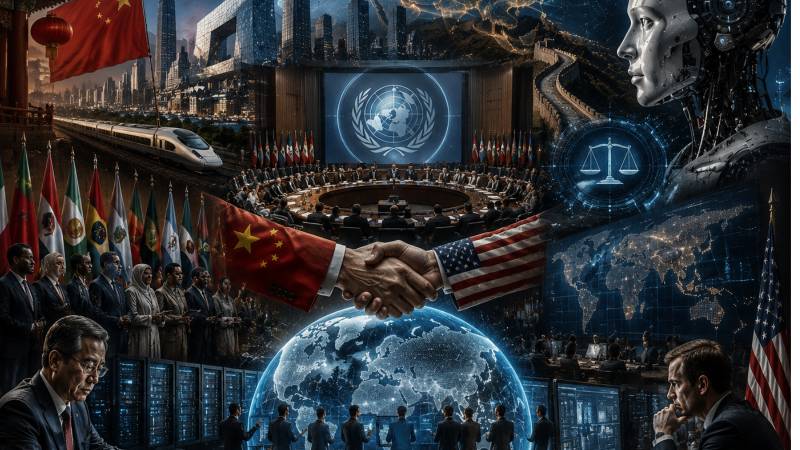
When 29 countries gathered in Shanghai on July 16 to sign the founding charter of the World Artificial Intelligence Cooperation Organization (WAICO), the story wasn’t really about a new building or a new logo. It was about who gets to write the rulebook for the technology that will define this century. A day later, President Xi Jinping opened the World Artificial Intelligence Conference by declaring that AI development “should not be a solo performance by a single country, but a symphony of international cooperation”, a line aimed, unmistakably, at Washington.
For three decades, the United States has been the world’s chief institution-builder: the Bretton Woods system, NATO, the WTO, the internet’s own governing bodies. China’s bet with WAICO is that in the AI era, the same institutional strategy can be turned against its author. Headquartered in Shanghai and built around a 13-point Global AI Governance Action Plan first floated by Premier Li Qiang in 2025, WAICO brings together a founding bloc heavy with Global South and non-Western states like Russia, Pakistan, Indonesia, Brazil, Kazakhstan, and more than a dozen African and Asian nations, alongside outliers like Cuba and Venezuela. UN Secretary-General Antonio Guterres attended the signing. No major American AI firm did.
The question here is that why does this race matter? Washington’s approach to AI has, for several years, run through export controls, chip bans, and trusted partner arrangements rather than universal institutions. That strategy has real teeth: the US still leads in the most advanced semiconductors, and Commerce Department restrictions this spring reaffirmed limits on AI chip shipments to Chinese-linked firms worldwide. But it has also left a vacuum in global AI governance Guterres himself has noted that no binding multilateral framework yet exists for the technology's fastest-moving risks. WAICO is a bid to fill that vacuum on Chinese terms.
Analysts at the renowned US based thinktank have observed that with Washington retreating from global cyber and AI norms-setting and pulling back financial support for cyber diplomacy, Beijing sees an opening to demonstrate global leadership and win Global South buy-in for a more state-centric vision of technology governance. That’s a shrewd read of the moment. It doesn’t require China to out-innovate Silicon Valley; it only requires the US to keep treating AI diplomacy as an afterthought while China treats it as statecraft.
The sci-tech race itself remains genuinely contested. China still lags the US in access to the most cutting-edge chips, but it holds real advantages in the sheer scale of data-centre power and the cheap electricity needed to run it, and it dominates the rare-earth supply chains chips depend on. Beijing generates more than double America’s electricity output, a gap state investment is widening. That energy edge, paired with an aggressive open-source release strategy for Chinese models, is precisely what lets Beijing market itself abroad as the AI patron of countries priced out of the US ecosystem.
If WAICO matures from paperwork into practice funded joint labs, shared compute, common technical standards, the payoff for Beijing would be layered.
Diplomatically, China becomes the convening power for AI governance among a bloc that includes much of the Global South. Rules written in Shanghai rather than Geneva or Brussels would carry Chinese assumptions about state sovereignty over data and speech into dozens of national legal systems, exactly as one Asian diplomat told Reuters China is already doing through AI capacity-building in Southeast Asia.
Economically, standard-setting is market-making. Countries that adopt WAICO-aligned technical protocols become natural customers for Chinese chips, cloud infrastructure, and models, much as the Digital Silk Road has already bundled telecom and surveillance exports with Belt and Road financing. Owning the standard is often worth more than owning the fastest chip.
The question here is that why does this race matter? Washington’s approach to AI law, for several years, run through export controls, chip bans, and trusted-partner arrangements rather than universal institutions.
Politically and culturally, Beijing gets to reframe the entire AI narrative away from a bipolar US-China contest and toward a story of Chinese-led inclusion versus American-led exclusion the “symphony,” in Xi’s words, versus the “solo performance.” That framing is aimed squarely at the roughly 130 countries that are neither chip designers nor chip fabricators but will be AI’s biggest user base within a decade.
Militarily, the stakes are murkier but real. AI governance forums rarely touch weapons directly, but a China-centered standards bloc could normalize dual-use technology transfers among member states precisely the kind of transfers Washington's export controls are designed to choke off. Beijing has already retaliated against US chip restrictions by curbing exports of critical minerals and dual-use technology of its own, showing both sides understand the military stakes embedded in ostensibly civilian technology.
None of this is guaranteed. The Diplomat magazines’ own analysis is blunt: WAICO “matters less as a headline announcement than for what it represents,” and its real influence depends entirely on whether members actually build shared tools and rely on the institution rather than merely endorsing it on paper. Plenty of Chinese-led multilateral bodies have underdelivered before. And the Global Times’ framing that Western media are “smearing” China’s AI cooperation, is itself a reminder that Beijing is running an information campaign alongside an institutional one, which is worth reading with the same skepticism applied to any government’s self-description.
For Washington, the lesson isn’t that China has won the AI race. Chip design, frontier model performance, and private capital still tilt toward the US, and America’s alliance system like Japan, South Korea, the Netherlands, Taiwan, still controls the choke points of the most advanced fabrication. The lesson is narrower and more uncomfortable: institution-building is a form of power the US pioneered and is now ceding by default. Washington’s “trusted partner” model of AI cooperation, built on bilateral deals and export controls, is effective at slowing a rival but does little to offer the developing world a seat at the table. WAICO, whatever its limits, at least offers one.
That gap is the real vulnerability. Every country that signs onto Chinese-built AI infrastructure, adopts Chinese-shaped technical standards, or looks to Shanghai rather than Washington for capacity-building is a data point in a much longer contest over whose version of the digital future becomes the default. The US does not need to match WAICO seat for seat to compete, but it does need an affirmative offer for the countries it currently only talks to through the lens of restriction. If the next decade’s AI rules end up written largely in Shanghai, it will be less because China out-built American technology, and more because it out-organized American diplomacy.