

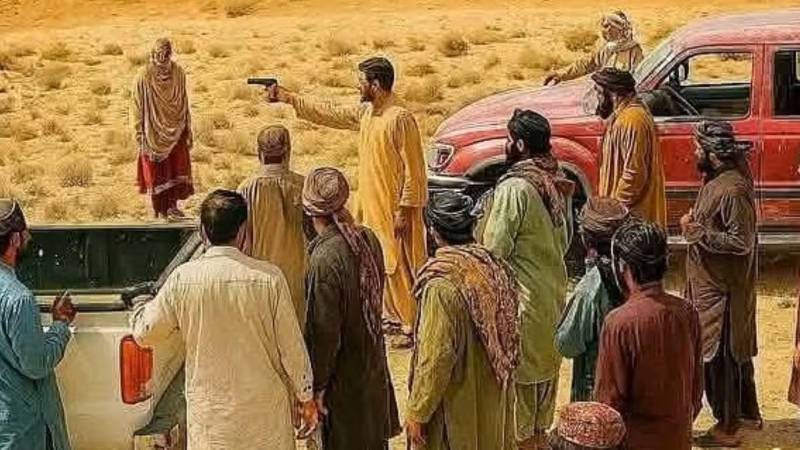
On a July evening in 2025, under the vast, unyielding sky of Balochistan, a woman and a man — Bano Bibi and Ehsan Samalani — were executed not by state order, but by the ruthless will of a tribal jirga. Their crime: choosing love over lineage. Their punishment: death by decree of tradition, meted out in the name of “honour.” The case sparked viral outrage, international headlines, and promises of reform. But now, weeks later, the dust is settling — and with it, the country’s resolve.
In 2016, following the honour killing of Qandeel Baloch, a social media icon whose unapologetic defiance unsettled Pakistan’s moral orthodoxy, the state passed legislation to close the qisas loophole, which had long permitted families to pardon their own daughters’ murderers. It was hailed as a turning point, a symbolic triumph of law over custom. And yet, nearly a decade later, the machinery of impunity grinds on, unimpeded. Another woman lies buried, another digital outrage erupts and recedes, and the architecture of patriarchal violence remains firmly intact — too embedded, too convenient, and far too endemic to dismantle through law alone.
What, then, is honour in a nation where the law genuflects before the gun?
Jirgas: The Shadow Judiciary
In many parts of Pakistan — especially rural Balochistan, Sindh, and Khyber Pakhtunkhwa — the tribal jirga is not merely a relic of the past; it is the de facto justice system. These male-only councils, operating outside the constitution, wield immense power, delivering verdicts based on centuries-old codes of tribal honour. While the Supreme Court of Pakistan declared jirgas and panchayats unconstitutional in 2004 for violating Article 25 (Equality of Citizens), the state has largely turned a blind eye to their continuing operation.
The case of Bano Bibi and Ehsan Samalani is harrowing not for its rarity, but for its devastating familiarity. According to local sources, the couple had eloped and sought protection from the state — a plea that went unanswered. Before legal intervention could be mobilised, a tribal jirga was convened in Mastung District, assuming the authority of both judge and executioner. Their verdict was delivered not in a courtroom, but in a barren field — a space untouched by the law, where its silence was not incidental, but complicit.
According to the UN Population Fund, an estimated 5,000 women fall victim to so-called honour killings each year across the globe — with Pakistan alone accounting for nearly one-fifth of this harrowing figure
What passes as tribal justice is in fact deeply gendered repression — ritualised in all-male forums that claim to speak for communities but speak only for the powerful.
The Law vs. The Lore
The Criminal Law (Amendment) Act 2016 was lauded globally as a major reform. Under it, honour killings became punishable by life imprisonment, even if the victim’s family forgave the murderer. But like most legislation in Pakistan, implementation remains patchy and politicised.
405 honour killings were reported across Pakistan in 2024, according to the Human Rights Commission of Pakistan (HRCP). Most of the victims were women, and the actual number is likely higher due to underreporting — especially in rural areas — due to tribal pressure, patriarchal policing, and the deep entanglement of local politicians with jirga elders, which makes legal recourse nearly impossible.
Despite legislative progress on paper, justice remains elusive for most victims. In countless cases, law enforcement refuses to classify deaths as honour killings — opting instead to record them as suicides or domestic disputes. This not only obstructs justice in practice but also obscures the true scale of the crisis. Human rights observers argue that this institutional reluctance is one of the greatest barriers to accountability in Pakistan.
The Spectacle of Outrage
In a country where attention is short and outrage shorter, the murder of Bano Bibi briefly punctured the noise. Her name surfaced across social media timelines. Statements were issued. Newsrooms ran segments. For a moment, it seemed the nation had paused to reckon with its conscience.
But reckoning requires more than visibility.
Arrests were made, yes — but the jirga that ordered her death still operates in shadows the law refuses to enter. The police, though present in the district, failed to prevent an execution that was neither hidden nor hurried. And beyond a flurry of headlines, the provincial machinery has offered little more than procedural optics.
No extraordinary measures. No structural reforms. No disruption of the impunity that enables this machinery of murder. And in that, the message is clear: some lives are grieved, few are defended.
The Myth of Honour
Let us dispense with illusions: there is no honour in homicide, no heritage in humiliation, no custom that absolves the collective silencing of women’s agency. And yet, the language of “honour” persists — weaponised as a cultural shield for systemic patriarchal domination. According to the UN Population Fund, an estimated 5,000 women fall victim to so-called honour killings each year across the globe — with Pakistan alone accounting for nearly one-fifth of this harrowing figure. This is not the preservation of tradition; it is the institutionalised annihilation of female autonomy.
Where Do We Go From Here?
The murder of Bano and Ehsan should have marked a national reckoning. Instead, if precedent prevails, it risks fading into the ever-expanding archive of gendered atrocities — briefly grieved, rarely redressed.
Systemic transformation, not symbolic outrage, is the only acceptable path forward:
- The tribal jirga system must be criminalised in letter and in enforcement. So long as extrajudicial bodies are allowed to function with impunity, they remain an affront to constitutional supremacy and a parallel architecture of patriarchal repression.
- Comprehensive police reform is imperative. Law enforcement personnel must be equipped with gender-sensitive training, not only to identify violence masquerading as tradition but to resist communal pressure and enforce the rule of law without prejudice.
- State-funded protection mechanisms for at-risk couples must be institutionalised. Reliance on under-resourced NGOs reflects a dereliction of duty. The state cannot delegate its fundamental obligation to safeguard those most vulnerable.
- Media coverage must evolve beyond performative sensationalism. Honour killings should not be reduced to viral moments. Sustained investigative journalism must hold perpetrators and the systems that shield them publicly accountable.
A Final Word
Bano Bibi’s name ought to be canonised in legal scholarship and echoed within the chambers of Parliament — not merely as an emblem of victimhood, but as a beacon of unyielding dissent.
She dared to choose love in a land consecrated to lineage. She envisioned liberty in a society enslaved by custom. And for that, she was not only consigned to the earth but entombed in a deafening, deliberate silence. Yet memory, if wielded with conviction, can be an act of resistance. If we refuse to reduce her to a transient trend, if we inscribe her legacy not in hashtags but in institutional reform — then perhaps this time, the narrative need not follow its tragic arc.
Perhaps, this time, honour will not be measured in blood.