

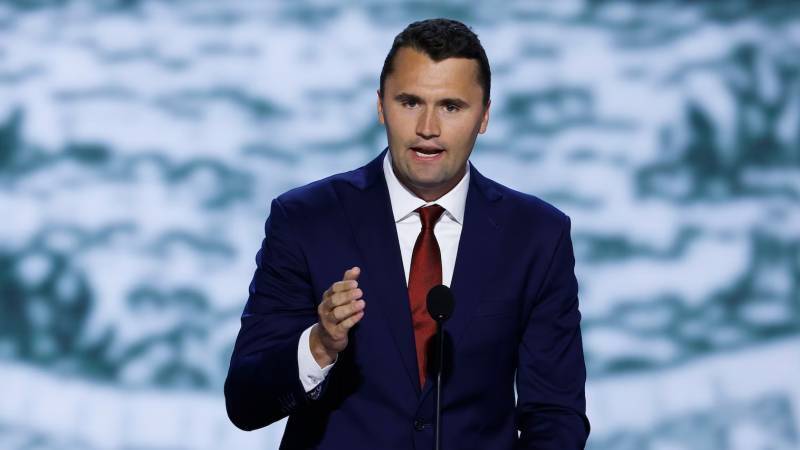
It once seemed a given that murder was universally wrong and an unequivocally immoral act. It was a principle so foundational that you could count on even the most morally bankrupt to at least pretend to agree. But the sickening response to the tragic assassination of American right-wing activist Charles James Kirk has cast a pall over the notion that the immorality of murder is a universal axiom, and it’s clear that many have dropped the charade.
Much of the commentary swirling around Kirk’s death has fixated on his provocative stance on gun control, where he once declared, “I think it’s worth having a cost of, unfortunately, some gun deaths every single year so that we can have the Second Amendment to protect our other God-given rights. That is a prudent deal. It is rational.” While such views invite sharp disagreement, and I personally disagree with much of his rhetoric, the more insidious issue is the reluctance of many to unequivocally condemn his murder.
This bleak turn in public sentiment was most evident in the gleeful commentary circulating on social media. Influencers like OGBlackRedGuard, with a following of nearly 44,000 on Twitter, openly celebrated the event, tweeting, “Well, guess he lost the debate.” That tweet wasn’t just tolerated; it was applauded, racking up more than 120,000 likes from a digital mob that delights in violence against those they disagree with.
When violence is allowed to percolate, rationalised and relativised, there are no winners, only targets, and eventually everyone, everywhere becomes a potential one
In his New York Post article, Chadwick Moore also documented that several educators jubilated and celebrated his murder, including a special education teacher at King Elementary School in Framingham, a teacher at the Department of Defence Education Activity at Fort Bragg, a social studies teacher at Southside High School in Greenville, an art teacher at Oskaloosa High School in Iowa and an unnamed maths and religion teacher at St. Josaphat Catholic School in Chicago.
The apologists, wittingly or not, are endorsing a toxic belief that the value of life is no longer seen as intrinsic but contingent upon political or ideological affiliation and that the morality of an act hinges on the victim’s ideology, not the act itself.
The normalisation of political violence in the United States is not a new phenomenon, but its increasing acceptance signals a disturbing shift. We need look no further than the events surrounding the 6 January Capitol Hill insurrection, or the two assassination attempts on President Donald Trump, to see how violent rhetoric has permeated the political discourse. These acts of violence are no longer seen as anomalies or tragedies but, to a frightening degree, as legitimate expressions of political frustration.
We can disagree on politics. We can argue over policy. Differences, however profound and irreconcilable they may seem, can be hashed out through discourse. But the line between discourse and violence must never be blurred. When violence is allowed to percolate, rationalised and relativised, there are no winners, only targets, and eventually everyone, everywhere becomes a potential one.