

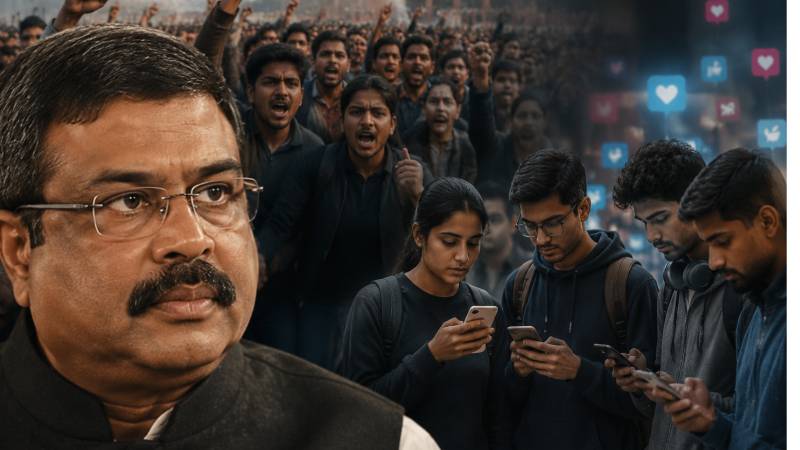
Gen Z has achieved another success through protest, forcing Indian Education Minister Dharmendra Pradhan to resign. Before this, they led similar protests in Sri Lanka in 2022, Bangladesh in 2024, and Nepal in 2025. In these three South Asian countries, they brought down governments that had been ruled by leaders for more than a decade. In South Asia, they have achieved significant success. So far, they have changed three regimes and forced the world's largest democracy to meet their demands. We have not witnessed this level of success in other parts of the world. In Sudan, they removed Omar al-Bashir from power, but the country is now in civil war and the situation is worse than ever before. Across every continent, Gen Z has shown its power by staging protests against the status quo. In some places, they achieved the desired results, while in others the situation became even worse. In Kenya in 2024, France in 2024, and Niger in 2020, they did not overthrow the governments, but they forced them to introduce major reforms.
Gen Z makes up 25% of the world's population, and Asia is home to more than 50% of them. They are not only playing a dominant role in protests and bringing down governments, but they are also playing a key role in shaping public opinion and influencing policymaking. According to Tufts University's Circle research, 75% of voters aged 18–29 supported Democratic Socialist Zohran Mamdani in the New York mayoral election. Pew Research, on 7 April 2026, showed that Gen Z in the United States has more negative views of Israel than older generations. NBC polls also show that 74% of Gen Z sympathizes with Palestine. Gen Z has put traditional American politicians on the defensive over the Palestine issue. In Europe, they are generally less anti-immigration and are more supportive of legal immigration for skilled workers. In Africa, they are largely anti-corruption and anti-establishment, although so far, they have not played a major political role in countries.
In Asia, as discussed earlier, they make up more than half of the population. They have played a significant role in bringing down three governments in Sri Lanka, Bangladesh, and Nepal, while forcing governments in Hong Kong and India to respond to their demands. Meanwhile, Iran is a country where they neither brought down the government nor forced major reforms, but they attracted intense international attention. In December 2025, protests erupted in Iran against inflation, and demonstrators began demanding the end of the Ayatollah regime. However, they did not achieve major success as the conflict involving the United States and Israel shifted attention away from the movement. Around the world, we are witnessing Gen Z's growing role in politics and its impact on the political landscape.
Gen Z is not relying on traditional forms of media such as television, radio, and newspapers. Instead, they use social media platforms such as Instagram, TikTok, Facebook, YouTube, and X (formerly Twitter). They live in a sea of information, surrounded by endless digital content. They have access to the fastest means of communication, allowing them to share ideas with others and mobilize quickly. Digital mobilization is one of the key elements behind Gen Z's protests. They have learned from the mistakes of the Arab Spring and now record every moment, producing short videos that create a huge impact. They often begin with smaller demands before moving on to larger ones. They also communicate through encrypted platforms such as WhatsApp and Telegram, which provide greater protection from government surveillance. However, this digital world is also a major challenge for them. Much of their political knowledge comes from short Instagram Reels and TikTok videos, content that is often unverified, filled with misinformation, and driven by propaganda. These platforms are frequently manipulated by political actors as tools in their own power struggles.
Whether Gen Z will play a meaningful role in future power politics and policymaking or simply become part of political chaos while following social media trends.
Furthermore, information available on social media lacks standard editorial oversight, and there is often no effective mechanism to verify information before it goes viral. This will continue to shape future public opinion and public perception. Their attention span is also shorter than that of previous generations, and they generally have less exposure to books and history. During protests, many appear more interested in recording events and creating social media content than in developing long-term political strategies. It often seems that they know how to bring down governments or force them to their knees, but not necessarily how to build stable political systems afterwards. Nepal, Bangladesh, and Sri Lanka continue to face political uncertainty, partly because of the absence of a clear long-term vision after regime change. They are deeply interested in change, but what happens after that change often receives far less attention. Gen Z is frequently criticized for laziness, changing jobs easily, weak leadership, burnout, and shorter attention spans. Given these criticisms, whether they can deliver meaningful political change remains an open question.
There is no doubt that inflation, unemployment, poverty, wealth inequality, and the unchecked expansion of technology are genuine problems facing the modern world. However, there are also challenges within Gen Z itself. They often support populist politicians as solutions to these problems. Figures such as Donald Trump, Narendra Modi, Jair Bolsonaro, and Imran Khan have attracted significant support because they offer simple solutions and present themselves as anti-establishment leaders. Many young people begin supporting them without fully examining their populist beliefs or narcissistic behavior. We often praise Gen Z for being progressive and unapologetic. However, it also appears that they can be politically influenced if a leader becomes popular on social media, benefits from platform algorithms, and produces viral content. They have also helped non-traditional politicians rise to prominence, including businessman Donald Trump, former comedian and actor Volodymyr Zelenskyy, and actor Joseph Vijay.
It remains to be seen whether Gen Z will play a meaningful role in future power politics and policymaking or simply become part of political chaos while following social media trends. This is only the beginning of Gen Z's political journey. Today, they are challenging governments and reshaping politics through protest. The real question is whether they will play a constructive role in addressing the major challenges facing the world, such as climate change, artificial intelligence, rising wealth inequality, and political polarization. Are they capable of making the world a more livable place for all human beings and every other living creature? Let us hope for the best.