

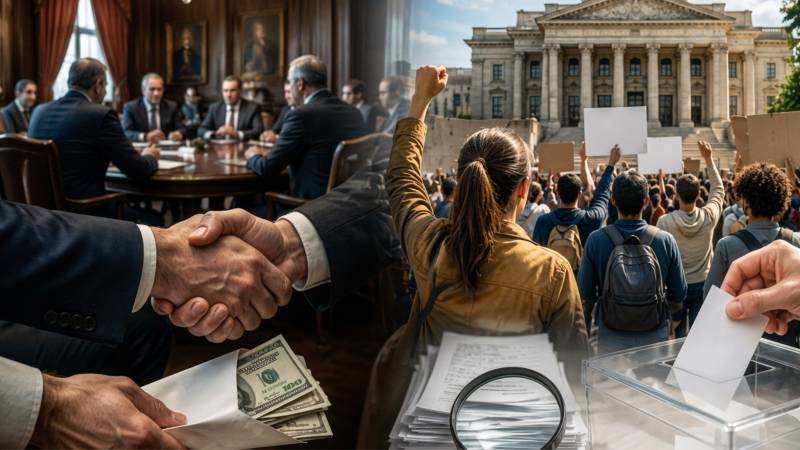
President Trump has gained $ 2.2 billion in the first year of his second term, mostly in cryptocurrency. Many commentators regard it as a misuse of his office .Yet it has not been contested in the courts. It may not be illegal by the letter of the law. But it goes against the long-established convention that an office may not be used for personal gains, including for family members.
Corruption is manipulation of laws and moral conventions for private gains. Broadly, it is the misuse of laws, norms and responsibilities for personal benefits. Most common is bribery, but manipulation of markets for the same purpose, such as adulteration, producing fake products or hoarding to create scarcity, are also forms of corruption.
There has been a theme of associating corruption with the non-western countries, waving away western infractions as exceptions, largely acts of individuals. Whereas, the non-western corruption is regarded as a structural condition. The western media, scholars and policy-makers have long lectured the non-western societies about their culture of corruption.
A form of white-washed corruption occurs in western countries, to varying degrees, that remains unacknowledged. President Trump’s actions have brought it in the limelight, though it is still being described as the character flaw of a known self-serving person. At this point , a closer look at various forms of corruption and their social bases will clarify the differences.
First is a garden variety of corruption , namely bribery, cheating and black marketing. Paying an official to get one’s entitlements , such as health and welfare services ,is a common form of corruption . In the private sector, selling fake products, adulterated commodities or black marketing are corrupt practices. These forms of corruption have direct bearing on the quality of people’s daily life. They create uncertainty and make daily routines burdensome. In one sense, such corruption is most insidious for social life. They are the most common in southern countries, though not unknown in the west.
Second is bending rules or allowing exceptions by political/administrative authorities for someone’s private benefits. It requires access to officials in the form of personal connections or bribes. Examples include practices such as getting a job without competition, avoiding taxes or even a small transaction of fixing a traffic ticket.
A form of white-washed corruption occurs in western countries, to varying degrees, that remains unacknowledged.
Third are lobbying to get favourable rules, a common practice of corporate businesses. They fund the political campaigns of potentially successful elected legislators and leaders. Who in turn make policies favourable to the funders. This is the white-washed corruption, whose practices conform to the letter of the law, but violate its purpose. It is quite common in western countries. It may not be illegal, but by convention and morality it is an unfair use of the power and authority of an office. It is a corruption that is white washed with favourable policies. President Trump’s cryptocurrency carried the aura of encashment of his authority. It is he who has been the primary beneficiary of that enterprise. Most other investors suffered losses.
Corruption occurs in both authoritarian and democratic countries. In authoritarian countries, the beneficiaries are friends, relatives and supporters of rulers. In democratic countries, the need for funds to carry out election campaigns is a stimulus to be obliged to funders, individuals as well as corporations. Thus, elected officials have to reciprocate with easy access and favoured treatment. This is an implicit but well understood bargain.
Corruption is widespread, almost no country is entirely clean. According to the global corruption perception index, in 2025 Denmark, Finland and Singapore were the top three at low- level of corruption, Canada was 16th, the USA 29th, China 71st, India 91st, Pakistan 136th and Bangladesh 150th. Societies that are open, have individual rights appropriately safeguarded, enact transparency in public affairs are relatively free from corruption. Also, norm-based relations also have an edge over personalized dealings.
Whatever the form of corruption is, it has invidious effects on social as well as economic structures of society. It erodes trust, reliability and rewards of conforming to social norms. Instead of consistency and predictability of social roles, it introduces personalized dealings individually negotiated. In democratic countries, funds needed for elections, more often than not, obliges elected representative to lobbyist and the way to reduce corruption is to open access to information, about oneself particularly, and transparency of public and private actions. It also require individual and community rights. A common description of corruption is that it is dealing under the table, an effective way is to make so called table transparent. This is what transparency properly legislated and enacted safeguards against the misuse of authority.