

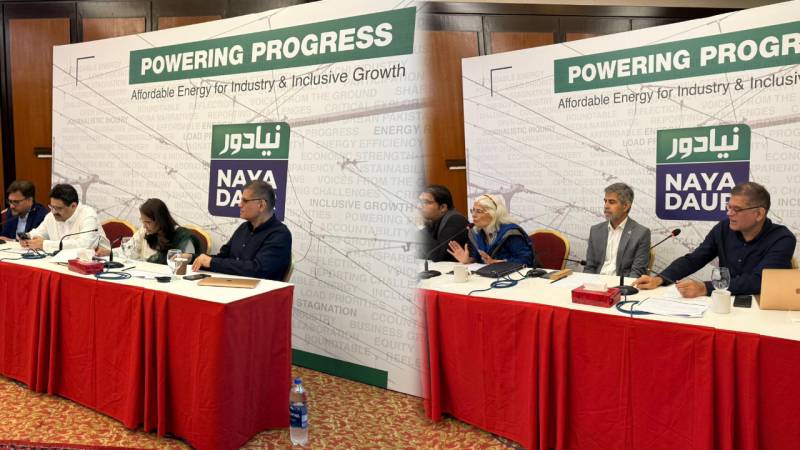
“Power supply is a hyper-regulated area and needs urgent reform,” said former Finance Minister Miftah Ismail at the conference Powering Progress: Affordable Energy for Industry & Inclusive Growth, held on Sunday. He emphasised that privatisation alone is not enough and that the energy sector requires pro-people regulation and improved governance at both national and local levels.
The conference brought together leading voices from industry, energy utilities, policy institutions, and media to chart a path toward affordable, reliable power and inclusive economic growth in Pakistan. Organised by Naya Daur Media as a platform for constructive dialogue, the day-long event featured two interactive sessions:
1) Urban Power Supply – Access, Affordability & Accountability
2) Industrial Energy Needs – Unlocking Low-Cost Power for Growth
Miftah Ismail was critical of Karachi Electric (KE) and its performance, noting that despite being privatised, KE has failed to meet the city’s needs. However, he pointed out that other energy companies across the country are “even more inefficient,” undermining both economic growth and citizen welfare.
Urban Power and Citizen Concerns
The first session examined Karachi’s power supply challenges, highlighting persistent issues of tariff hikes, customer service failures, and frequent load shedding. Participants stressed the need for transparent tariff structures, improved customer relations, and modernised distribution systems to address citizen grievances.
Climate change activist Afia Salam urged the mainstream media to spotlight energy poverty and its impact on communities in Karachi suffering long hours of load shedding. She questioned why Karachi pays adjustment charges at par with other areas despite facing unique urban challenges and called for a review of how electricity charges are calculated.
MQM-P MPA Taha Ahmed Khan noted that KE had effectively lost its monopoly last year following joint efforts by political and civil society stakeholders in response to its “intractable inefficiencies.” He recommended introducing prepaid meters to prevent fraudulent meter readings, called for public-private partnerships to combat electricity theft through the “kunda” system, and criticised the practice of classifying areas into “high recovery” and “low recovery” zones—arguing it unfairly penalises entire communities. He also advocated reducing taxes on solar energy and highlighted his party’s campaign against NEPRA’s delayed Fuel Cost Adjustments (FCAs), which withheld Rs 3 billion in April and May.
“Karachi’s residents deserve fair pricing and dependable service. Trust can only be rebuilt through transparency and accountability,” said Aneel Mumtaz, who criticised KE for overcharging consumers while regulatory institutions like NEPRA and the courts failed to enforce effective oversight. He recalled that Younus Dagha, former federal secretary, was swiftly removed after pointing out KE’s inefficiencies.
Industrial Energy and Governance
Speakers noted that circular debt, transmission losses, and reliance on expensive imported fuels continue to erode industrial competitiveness. Solutions discussed included diversifying energy sources, integrating renewables, and incentivising efficiency improvements. Zeenia Shaukat of The Knowledge Forum linked the climate crisis to Karachi’s energy problems and called for transparency and investment in green energy. “These failures are why Karachi now ranks among the least liveable cities in the world,” she said.
Junaid Naqi of KATI stated, “Energy reform is not just about cost—it’s about ensuring our industries can compete globally without being held back by power shortages or unpredictable tariffs.” He suggested awareness sessions for traders, industry representatives, and citizen groups to develop coordinated solutions.
Imran Shahid of Jamaat-e-Islami (JI) alleged that JI had been labelled “the biggest enemy” by KE management because of its consistent advocacy for citizens’ rights and protests against load shedding and inequitable power distribution. He called for greater accountability of KE, saying “the management of Karachi’s power sector is inefficient and oversight by responsible institutions is missing.”
A Call for Reform
The conference concluded with strong consensus that collaboration between government, private sector, and citizens is critical to resolving Pakistan’s energy challenges. Participants agreed that KE’s management needed urgent reform, with its current corporate governance described as “flawed and untenable.”
Raza Rumi, editor of Naya Daur Media and moderator of the conference, said: “This conference marks the beginning of a continuous dialogue. Today’s discussions reaffirmed that affordable and reliable energy is not just an economic priority—it is a social imperative.”
The organisers announced plans to publish a summary report with detailed recommendations and to engage policymakers and stakeholders to advance the outcomes of the conference.