

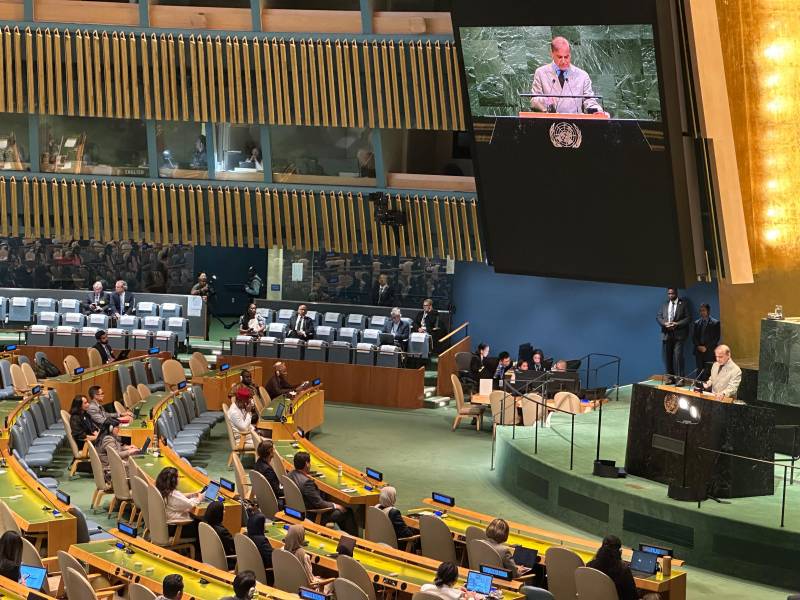
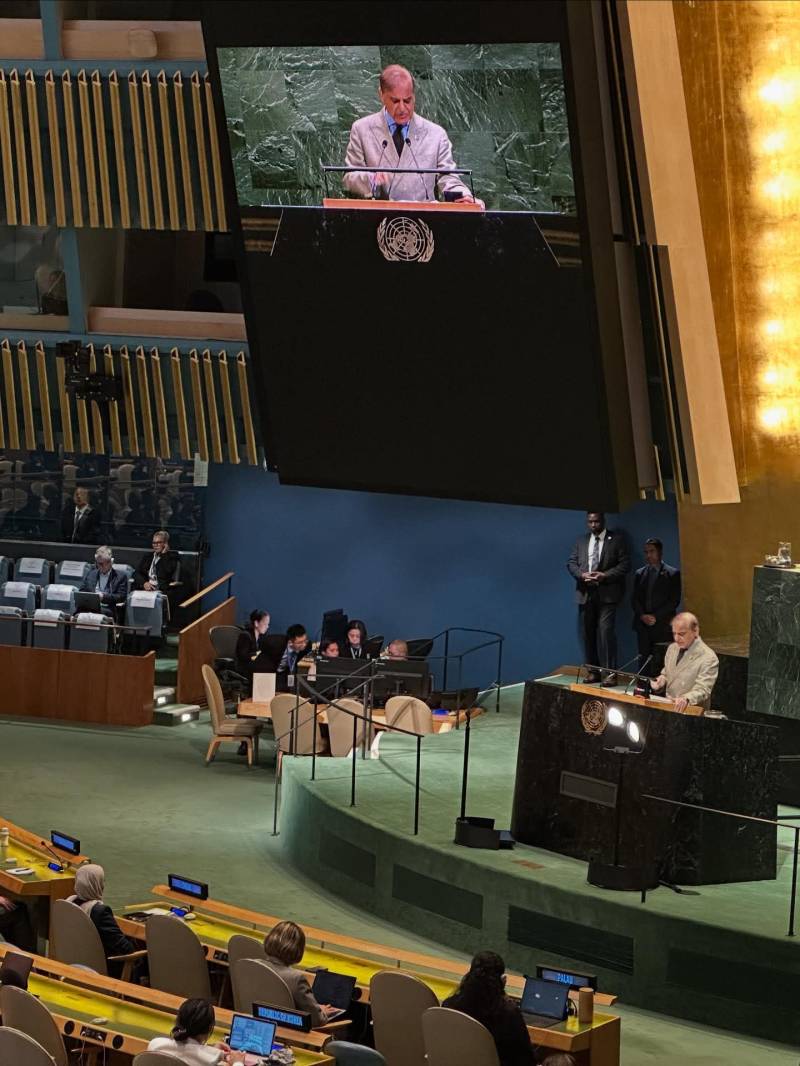
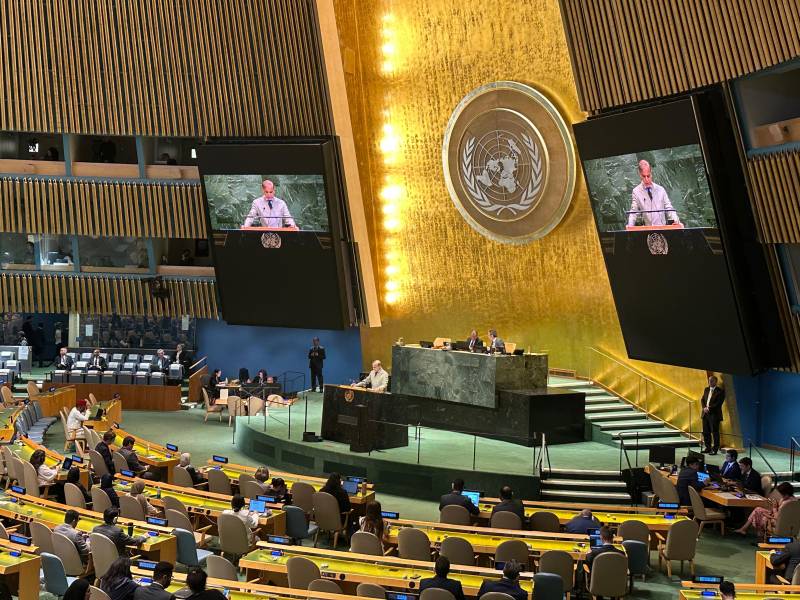
New York: Prime Minister Shehbaz Sharif used his address to the 80th session of the United Nations General Assembly to defend Pakistan’s recent military actions against India, call for dialogue on Kashmir, back Palestinian statehood, and urge collective action on climate change.
Shehbaz Sharif said Pakistan had responded in line with the UN Charter after what he described as “unprovoked aggression” from India in May. He credited the country’s armed forces for repelling the attacks and argued that Pakistan’s decision to agree to a ceasefire showed restraint. He thanked former U.S. President Donald Trump for brokering the truce, calling his role decisive in preventing a wider conflict, and expressed appreciation to countries including China, Turkey, Saudi Arabia, Qatar, Iran, the UAE and Azerbaijan for supporting Pakistan diplomatically.
While acknowledging Pakistan’s military response, Sharif stressed the need to “win peace” through a comprehensive dialogue with India. He warned that attempts to suspend the Indus Waters Treaty would be seen as a direct threat to Pakistan’s survival, and reiterated calls for a UN-mandated plebiscite in Jammu and Kashmir.
The prime minister also focused heavily on the conflict in Gaza, describing the humanitarian toll as intolerable. He said Pakistan continued to support the establishment of a sovereign Palestinian state based on pre-1967 borders with East Jerusalem as its capital.
Shehbaz Sharif's remarks came just minutes after Israeli Prime Minister Benjamin Netanyahu addressed the Assembly, a speech that saw Pakistan join several Arab and Muslim delegations in staging a walkout. The coordinated boycott was aimed at signaling outrage over Israel’s ongoing military offensive in Gaza, which has left thousands dead and displaced millions.
PM Sharif also raised concerns about terrorism, urging the Afghan interim government to prevent militant groups from using its soil against Pakistan and stressing the importance of regional stability. On the climate front, he recalled the devastating floods of 2022 and 2025, declared a climate emergency at home, and urged developed nations to meet their commitments on climate finance.
Economically, he pointed to reforms in taxation, digitization and investment, and highlighted partnerships with China under the China-Pakistan Economic Corridor. He also emphasized Pakistan’s commitment to the UN’s 2030 Agenda for Sustainable Development.
Shehbaz Sharif called for a more effective and representative UN Security Council, rejecting the idea of expanding permanent membership. He urged leaders to move beyond commemorations and instead chart a course for global cooperation, declaring: “Let us truly strive to become better together.”
During his trip to the United States, Pakistani Prime Minister Shehbaz Sharif has held several high-profile meetings on the sidelines of UNGA, including with Donald Trump, where he invited American investment in sectors such as agriculture, mining and energy. He also met Bill Gates to discuss cooperation on health and humanitarian initiatives.