

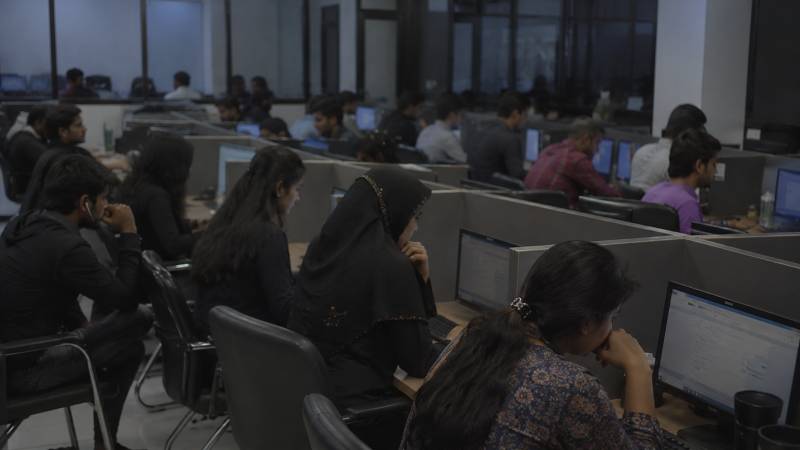
A few days ago, the National Cyber Crime Investigation Agency (NCCIA) conducted a raid at a call centre in Karachi that sections of the media quickly turned into a content-creation exercise — a familiar pattern that has increasingly accompanied many such high-profile operations in recent years.
Having closely followed and reported on similar raids over the past few years, one thing has become hard to ignore: many such high-profile operations struggle to produce convictions matching the sensational claims initially presented to the public. More often than not, they end with institutions failing to substantiate the dramatic allegations made immediately after the raids.
In this latest raid, the raiding party alleged that the particular company was involved in scamming foreign citizens and transferring their funds — a scam commonly referred to in Karachi as “Dabba” or “Box”.
Curious, I made a few calls and found that, contrary to the allegations circulating publicly, the company itself did not directly charge clients for the services in question. Its operations, according to individuals familiar with the matter, were primarily limited to lead generation for overseas companies that had outsourced portions of their customer acquisition work.
The company also appeared to be operating legally and was registered with the relevant authorities, including the Pakistan Software Export Board (PSEB), which licenses companies only after conducting physical office verification. Registered IT companies are subsequently facilitated through dedicated IP allocations that remain subject to regulatory oversight mechanisms involving both PSEB and PTA.
More importantly, the company appeared to have a visible and structured operation, unlike many scam setups that traditionally function quietly and underground.
Nonetheless, the raid, according to reports, was carried out alongside the media — a practice reminiscent of an earlier era in Karachi policing when crime reporters were often informed beforehand in order to maximise spectacle.
But instead of filming the alleged fraud itself — the computer screens, financial trails, or the supposed banking applications through which foreigners were allegedly being scammed — cameras focused almost entirely on employees.
We have reached a point where many channels no longer invite actual representatives of political parties, but rather analysts who unofficially function as their defenders and spokespersons from the very outset
Young workers were filmed and presented like criminals. The most uncomfortable visuals were those of women attempting to cover their faces while officials, in other clips, could allegedly be heard hurling obscene abuse at employees.
Only days earlier, in similar raids on call centres, employees and detainees had at least been blurred by television channels. This time, however, even the most basic ethical considerations appeared absent, not only from the authorities conducting the raid but also from sections of the media that enthusiastically amplified official claims.
Some reporters even attempted to draw parallels between the owner of the call centre and Armaghan, merely because the latter had once operated a scam call centre before eventually being exposed after committing a gruesome murder in January 2025. Until then, his operations had reportedly continued for years without disruption.
Still, I expected that even with their visible bias and content-oriented reporting, some journalists would eventually attempt to verify the other side of the story — perhaps by contacting the management, speaking to employees off the record, or independently examining the claims made by authorities.
But that never happened. Then again, why do the legwork when sensationalism already guarantees digital engagement?
In one video, a reporter pointed to an email address bearing the name “Jeffrey Lake” from documents shown to the media during the raid.
The reporter appeared more interested in manufacturing a sensational parallel with Jeffrey Epstein merely because the recipient happened to share the first name “Jeffrey”, while theatrically twisting the surname “Lake” into “Leaks” to garner more public attention, hinting as though he had exposed massive documents akin to the Panama Papers, Dubai Leaks, or WikiLeaks — conveniently forgetting that behind those actual leaks were journalists who invested years of hard work, verification, and personal risk, unlike the content creators or YouTubers masquerading as reporters these days.
But perhaps this is exactly what the Pakistani media has now become.
Reporting remains the foundation of journalism; once reporting collapses, journalism collapses with it. That, in many ways, is how television itself has slowly begun to die.
Even political talk shows now feel painfully predictable. We have reached a point where many channels no longer invite actual representatives of political parties, but rather analysts who unofficially function as their defenders and spokespersons from the very outset.
It has been a few years since I worked in formal reporting for mainstream publications, though I have continued writing analysis and opinion pieces from time to time. Yet the transformation in Pakistan’s media culture remains impossible to ignore.
One serious complaint to PEMRA or a defamation suit can potentially destroy careers built more on sensationalism than journalism
During my undergraduate years studying journalism at the University of Karachi, we were taught that the media serves as a watchdog — a firewall between power and the public. I realised that this was not merely classroom theory during my early days at The Express Tribune, where I remain grateful to my editors and mentors for trusting a young trainee reporter with responsibility. The newsroom of The Express Tribune remained a true nursery for an entire generation of journalists who today continue to excel across Pakistan’s media landscape, carrying with them a culture of reporting, verification, and editorial discipline that increasingly feels endangered.
Back then, reporting itself raised public issues. Ministers, senior politicians, and bureaucrats were often accessible even to an ordinary trainee reporter earning Rs40,000 a month because credibility still mattered, and they understood the power carried by a reporter’s byline.
Today, however, institutional response appears increasingly driven not by reporting but by whatever goes viral on social media before eventually being picked up and amplified by television channels.
The contradiction becomes even more striking when viewed alongside other recent episodes involving law enforcement conduct in Karachi. In one high-profile case, alleged narcotics suspect “Pinky” was seen receiving unusual police protocol and guarded treatment during court appearances, sparking public criticism and raising questions about selective standards within the system. In another incident, videos from an FIA raid at a jewellery shop in Karachi triggered outrage after officials were seen allegedly misbehaving with traders and physically assaulting a shop owner during the operation.
Ironically, it was not institutional reporting or investigative journalism that brought these incidents into serious public discussion, but the virality of clips on social media. Had these videos not spread online, only a rare breed of reporters might have pursued the story independently, while much of the beat reporting fraternity would have waited for the next WhatsApp-fed assignment in the endless cycle of content creation disguised as journalism.
Against this backdrop, the humiliation and public exposure of ordinary young call-centre employees during media-accompanied raids appear even more disturbing, reinforcing the perception that spectacle has increasingly begun to overshadow professionalism, consistency, and due process in Pakistan’s enforcement culture.
I still remember how senior journalists at The Express Tribune would insist that we ask individuals how they spelt their names. It was not enough to assume “Nawaz Sharif” could simply be written as “Nawaz Shareef”.
Accuracy itself was treated as a matter of professional ethics and legal responsibility. We were trained to be careful with even the smallest details, let alone allegations capable of damaging reputations.
Looking at many of today’s content-driven television reporters, one wonders whether they are inadequately trained in PECA laws, PEMRA’s code of conduct, and defamation law, or whether editorial leadership within these channels has itself collapsed.
One serious complaint to PEMRA or a defamation suit can potentially destroy careers built more on sensationalism than journalism.
Coming back to the raid itself, all arrested individuals are now on bail. In three consecutive hearings, the state failed to present any convincing evidence before the court, resulting in the rejection of its demand for physical remand.
But by then, the cameras had already delivered their verdict.
The faces of young employees had already circulated across television screens and social media timelines, their dignity compromised long before any court could determine guilt or innocence.
This, perhaps, is the real tragedy of Pakistan’s collapsing media culture and performative enforcement culture: investigations no longer begin with evidence and end in accountability; they begin with spectacle, trend charts, and content creation, while reputational punishment becomes immediate and, in many cases, irreversible.