

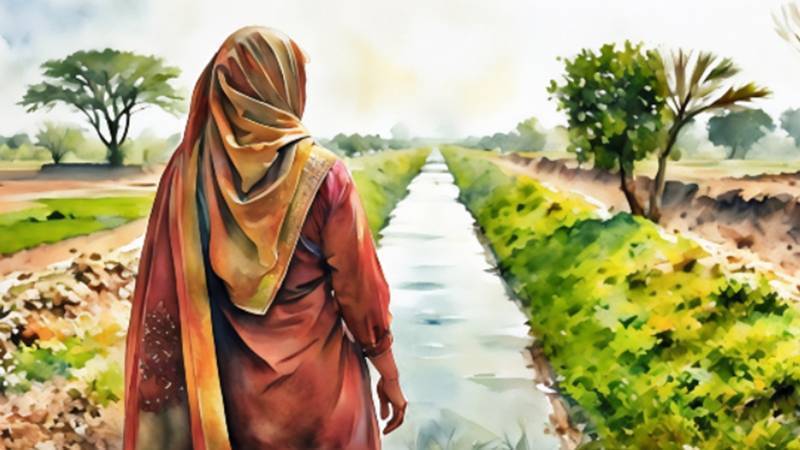
The Agriculture Conference 2025, held in Peshawar and organised by the Agriculture Department of Khyber Pakhtunkhwa, brought together a diverse range of voices to reimagine the future of Pakistan’s agricultural landscape. Among the high-level discussions on land digitisation, climate-smart farming and renewable energy, Session III, titled “Investing in Women – Key to Pakistan’s Agricultural Growth”, stood out as a timely reminder that no agricultural revolution can be complete without gender equity at its core.
As a panellist in this session, I drew upon my experiences in academia, agriculture, and food and environmental policy to highlight the transformative impact of investing in rural women. Despite constituting nearly 49.2 per cent of Pakistan’s population, women remain under-represented in economic data and invisible in formal agricultural structures. This invisibility comes at a cost—not just to women themselves, but to our food systems, environmental health and national GDP.
Pakistan’s gender data paints a troubling picture: women comprise 49.2 per cent of the population (2023 Census), yet only 48 per cent are literate, compared with 71 per cent of men. Female labour-force participation stands at just 21 per cent, and although 68 per cent of working women are engaged in agriculture, 76 per cent of them are unpaid. These figures help explain why Pakistan ranks 145th out of 146 countries on the Global Gender Gap Index 2024.
According to the Food and Agriculture Organization (FAO), closing the gender gap in agriculture could raise yields by up to 30 per cent. For Pakistan, this would translate into a 1.5–2 per cent boost in GDP—a compelling case for reform. It would also advance several Sustainable Development Goals (SDGs), including No Poverty (SDG 1), Gender Equality (SDG 5) and Climate Action (SDG 13).
Investing in women is not charity— it is Pakistan’s smartest and most overdue development strategy
Regional examples illustrate the benefits. In Bangladesh, organisations such as BRAC and Grameen Bank have empowered women through microloans and training in poultry and kitchen gardening, markedly improving nutrition, education and rural incomes. In China, reforms that included women’s names on land titles allowed them access to credit and management of seed banks and co-operatives. India’s Mahila Kisan Sashaktikaran Pariyojana (MKSP) has supported more than four million women through organic-farming training and self-help groups, transforming them into economic agents.
These cases show that women’s empowerment is not a social luxury but an economic imperative. When women farmers have equitable access to finance, land and knowledge, entire communities benefit. Their involvement also enhances climate resilience, as women are often the first to adopt innovative practices to mitigate drought, water scarcity and soil degradation.
By training women in areas such as water conservation, climate adaptation, food security, energy use and greenhouse-gas reduction, the impact can be exponential. Women’s role in both domestic water use and irrigation decisions means their knowledge directly influences water savings and aquifer recharge. For instance, domestic practices—such as re-using grey water from kitchens or minimising excessive water in laundry and cleaning—can be optimised through behavioural change led by informed women. They thus become agents of environmental stewardship and community well-being.
The benefits ripple outward: fewer water-borne diseases, reduced malnutrition and healthier children—all of which ease the strain on public hospitals funded by taxpayers. Economically empowered women also make wiser choices about nutrition, health and education for their families, instilling stronger values of environmental conservation and social responsibility in the next generation.
Beyond agriculture, women’s education improves hygiene, maternal and child health, and informed family planning. It also enables women to advocate for safe marital decisions, helping to prevent genetically inherited diseases such as thalassaemia. This knowledge gap can be bridged through targeted awareness programmes reaching women at the grassroots.
Inspired by these examples, our panel proposed five key reforms for Pakistan:
- Legal land rights for women, ensuring their names appear on land titles and tenancy contracts.
- Gender-inclusive finance and market access, including dedicated agricultural credit lines, insurance products and digital platforms tailored to women.
- Education and female extension services, such as recruiting and training more female extension agents attuned to women’s needs in rural contexts.
- Safe infrastructure, including women-friendly marketplaces, storage facilities, sanitation and transport.
- Recognition of women’s broader social contributions in national statistics, policy documents and budget allocations.
We also advocated integrating gender-sensitive indicators into agricultural monitoring systems and including women in climate-smart agriculture pilots and farmer-field schools.
Economically empowered women are more likely to invest in climate-smart inputs—such as high-yield seed varieties, organic fertilisers and resilient cropping systems. Their detail-oriented approach and long-term perspective complement the energetic drive often seen in their male counterparts, forming a balanced agricultural workforce. Recognising and valuing these complementary strengths is about collaboration, not comparison.
The advantages extend beyond agriculture. Empowered women lead to healthier families, higher literacy and better household resource management. This means fewer cases of child abuse, reduced drug addiction and less strain on hospitals and schools—lightening the burden on taxpayer-funded services.
Furthermore, including women in decision-making roles within co-operatives, local water-user associations and agriculture departments fosters more inclusive governance. When women lead, community priorities shift: towards nutrition, clean water, education and sustainability.
“Investing in women is not charity— it is Pakistan’s smartest and most overdue development strategy. It is smart economics.” – Dr Saima Hashim
In short, investing in women leads to more stable, productive and sustainable societies. It is not charity—it is smart economics.
As the Agriculture Conference 2025 enters its second day, the message from Session III is clear: women are not a vulnerable group—they are the backbone of our agricultural economy. Pakistan has the human capital, policy space and regional models to act now. Let us move from rhetoric to results. Let us place women at the centre of Pakistan’s agricultural transformation.