


In the cold winter of 2014, I walked into the Saeed Book Bank in Islamabad. I bought two books that laid bare new depths of human pain and scorn. One was Viktor Frankl’s book, Man's Search for Meaning. The other was Svetlana Alexievich’s Zinky Boys: Soviet Voices from the Afghanistan War. Frankl witnesses human survival in the shadow of death camps. Alexievich orchestrates the raw cries of soldiers and mothers. She exposes the hidden horror of the Soviet-Afghan War.
I showed these books to my friends Kalal Khaskhelly and Ali Nawaz Nizamani. Kalal took a deep interest in both books and borrowed them to make copies. Some time later, he surprised me with the news that he had translated Zinky Boys: Soviet Voices from the Afghanistan War into Sindhi under the title Jisti Chhokra. He longed to see the book published, but fate did not grant him that wish. He passed away on the 19th of August 2023.
Title: Secondhand Time: The Last of the Soviets
Author: Svetlana Alexievich
Translator: Bela Shayevich
Publisher: Random House, USA
Year: 2017
Price: US$24 (Paperback edition)
Svetlana Alexievich won the 2015 Nobel Prize in Literature for her polyphonic writings, which the committee called a monument to suffering and courage in our time. She builds her works from thousands of human testimonies and calls this method the “Novel of Voices.” She does not depend on official archives or state records. Instead, she listens to wounded memories and broken lives to write the hidden history of the human soul.
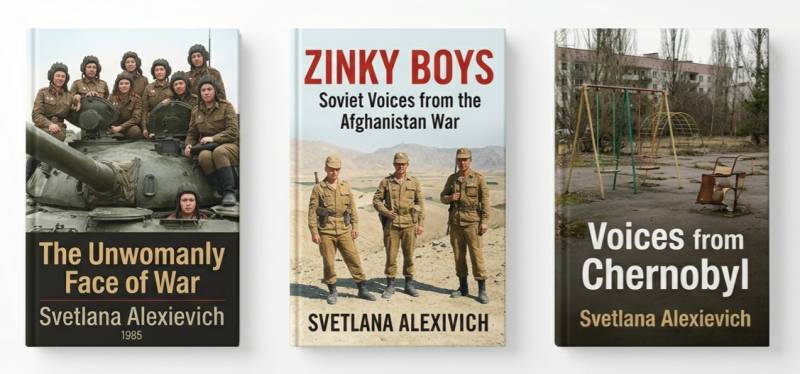
Svetlana Alexievich gathered this lifelong exploration of Soviet history under one project, The Voices of Utopia. The cycle begins with The Unwomanly Face of War, where Soviet women recount their forgotten experiences of the Second World War. In Last Witnesses, children remember the terror of the Nazi invasion.
In Svetlana Alexievich’s narrative, the new market economy did not ease post-Soviet suffering – it only turned pain and sacrifices into remnants of a broken age
The darkness deepens in Zinky Boys: Soviet Voices from the Afghanistan War, which exposes the hidden horror of the Soviet-Afghan War. Its title comes from the zinc coffins used to return dead soldiers home in secrecy. In Voices from Chernobyl, Alexievich records the human and spiritual devastation left by the nuclear disaster.
The cycle reaches its final stage in Secondhand Time: The Last of the Soviets. The book captures the confusion, emptiness, and sorrow that followed the collapse of the USSR.
I often wonder why I chose Secondhand Time: The Last of the Soviets. Perhaps the answer rests within my own generation. Those born in the hopeful years of the 1960s and awakened during the turbulent 1980s looked toward the USSR with admiration and longing. To many of us, it seemed more than a country. It appeared as a promise of justice, dignity, and redemption. That quiet inheritance may have drawn me toward Secondhand Time: The Last of the Soviets.
Another reason may have been my earlier reading of Zinky Boys: Soviet Voices from the Afghanistan War. Through that book, I discovered the extraordinary power of Svetlana Alexievich’s writing. She does not merely recount events. She gathers fractured memories, abandoned confessions, and wounded silences. Then she transforms them into a haunting chorus of human suffering. In her pages, history breathes like a restless phantom. It trembles, mourns, and refuses oblivion. That feeling remained with me long after I finished the book. Slowly and almost unconsciously, it led me toward Secondhand Time: The Last of the Soviets.
Perhaps my choice also emerged from a personal literary search. I wanted to encounter different forms of expression, different cadences of language, and different visions of human existence. Some writers sharpen the intellect. Some awaken compassion. A rare few transform the way we hear grief itself. I sensed that Svetlana Alexievich belonged to that rare company.
When I began reading the book, I made a quiet promise to myself. I would read it, but I would not review it. I wanted to move through its pages in silence. I wanted its voices to settle within me without the burden of criticism or interpretation. But after I completed the first section, something changed within me. The voices would not leave me. They lingered in my thoughts long after I closed the book. Their sorrow carried the weight of ruined dreams and spiritual desolation. Their despair echoed like whispers from a vanished civilisation. Beneath all that misery, I still sensed fragile hope and the persistent ache of human longing.
At that moment, I understood that this was not a book meant for silence. It demanded reflection and witness. It deserved to reach a wider circle of readers. Slowly, almost against my own earlier resolve, I decided that I must write about it. The book is not just about political collapse or economic ruin. It shows how the fall of the Soviet Union shattered human lives and inner worlds. Svetlana Alexievich reveals that the new market economy did not ease their suffering. It only turned their pain and sacrifices into remnants of a broken age.
The book is divided into two parts. The first part is titled “The Consolation of Apocalypse,” with the subtitle “Snatches of Street Noise and Kitchen Conversations.” This part contains ten stories, and the author says they belong to a ‘red interior.’ This phrase symbolises the old Soviet world, its communist beliefs, collective identity, revolutionary dreams, and emotional life. These stories are set between 1991 and 2001, the turbulent years that followed the collapse of the Union of Soviet Socialist Republics (USSR). The new age arrives with promises of democracy and freedom, but for many people, it brings chaos, humiliation, poverty, and loss of identity.
Early in this section, Svetlana Alexievich introduces Marshal Sergei Akhromeyev. He serves the Soviet state with absolute devotion throughout his life. He believes deeply in the socialist dream and its grand mythology. In August 1991, hardline communists launch a desperate coup to save the collapsing USSR. The coup fails within days, and Akhromeyev watches his world disappear almost overnight. He cannot endure the arrival of a capitalist future. Finally, he hangs himself in his Kremlin office. His death reveals the catastrophic cost of a ruined utopia.
Svetlana Alexievich then turns toward private life and domestic memory. She shows how terror enters ordinary homes and corrupts intimate relationships. An elderly woman remembers her husband, a loyal officer in Stalin’s secret police. He spends his days arranging executions, deportations, and prison camps. At night, he returns home as a gentle husband and affectionate father.
The family enjoys comfort and privilege under the Soviet system. They eat well and travel to exclusive state resorts. Their comfort, however, rests upon invisible suffering. While some scream in prison basements, others live in warmth and security. Alexievich exposes the moral disfigurement created by totalitarian power. The system teaches people to love the very men who carry out terror.
The collapse of the USSR also unleashes violent ethnic hatred across the former republics. Buried resentment rises suddenly from beneath decades of forced unity. Peaceful towns transform into landscapes of fear and persecution. An Armenian family lives safely in Baku, Azerbaijan. Then furious mobs flood the streets and demand Armenian blood.
The family flees in desperation. They sell their home for almost nothing simply to survive. The old Soviet brotherhood collapses before their eyes. In its place come exile, suspicion, and brutality. They realise that the dream of international unity concealed deep fractures and historical bitterness.
The second part of the book is titled “The Charms of Emptiness,” with the subtitle “Snatches of Street Noise and Kitchen Conversations.” Like the first section, this part also contains ten stories. However, Svetlana Alexievich describes them as “stories in the absence of an interior.” This section covers the years from 2002 to 2012.
Russia grows more stable, but it also becomes more cynical and spiritually barren. Vladimir Putin rises to power, while wild capitalism hardens into oligarchic authority. Alexievich explores the human cost of this transformation through the tragic love story of Margarita and Abulfaz. Margarita is Armenian, while Abulfaz is Azerbaijani. They fall in love during the final Soviet years, when citizenship still mattered more than ethnicity.
After the collapse, their hometown descends into violence and paranoia. Nationalist gangs begin hunting mixed couples. The lovers flee to Moscow in search of refuge. Moscow offers them only humiliation and hostility. Police officers harass them constantly, while soldiers threaten them with violence. The new Russia treats them as unwanted outsiders. Their love slowly collapses beneath racism, corruption, and fear.
Svetlana Alexievich also confronts the horror of terrorism in modern Russia. A mother named Elena remembers her daughter Ksyusha, a gifted student in Moscow. One ordinary morning, Ksyusha boards the metro on her way to university. A suicide bomber detonates an explosive inside the train carriage. The blast tears apart her body. She survives, but loses both legs and suffers devastating brain damage. This violence grows directly from the Chechen wars and their brutal aftermath. The state wages merciless conflicts in the Caucasus, while ordinary civilians pay the price. Imperial ambition returns home in blood, mutilation, and grief.
Near the end of the book, Svetlana Alexievich captures the spiritual emptiness of the new consumer culture. A young businessman becomes wealthy through privatisation and speculation. He buys luxury cars, expensive clothes, and foreign apartments. Yet he feels a profound emptiness within himself. The Soviet era once offered a grand myth of collective purpose and sacrifice. The new era offers only money, consumption, and spiritual exhaustion. He turns to drugs in order to escape his inner desolation. In the end, he dies from an overdose, and his ashes rest in a small white vase.
Through stories like these, Svetlana Alexievich reveals a crisis of faith and meaning in life. The Soviet Union functioned not merely as a state, but as a secular religion for millions of people. When it collapsed, people lost far more than savings or status. They lost transcendence, certainty, and emotional belonging. Many even longed for dictatorship again, because suffering once gave their lives a sense of grandeur and historical destiny.
Secondhand Time: The Last of the Soviets stands as a monumental work of witness and remembrance. Svetlana Alexievich shows that empires do not disappear quietly. They leave wounds that continue to bleed across generations. Her voices reveal that states may collapse in days, but grief survives for centuries. History destroys nations, yet it scars the human soul most deeply.
Let me end this review with one final truth about Svetlana Alexievich’s art. She does not follow kings, rulers, or generals. She walks beside mothers, workers, soldiers, widows, and old men abandoned by history. She gathers their words from kitchens, sickbeds, train cars, prison yards, and graveyards. Their voices carry sorrow, fear, love, and an endless hunger for meaning. Through those voices, Alexievich rescues the human soul from the silence of history.
The people in this book survive war, hunger, prison camps, and fear. Many still break when their world collapses. They lose their homeland, their purpose, and finally themselves. The Soviet Union vanishes from maps, but it survives in wounded minds.
The deep wound of the books is that states fall in days. Flags burn. Anthems fade. Memory does not. Grief outlives every creed and system.
Still, Svetlana Alexievich finds a small flame in the dark. Russian people still love. They still mourn. They still hope. Their voices tremble, but they refuse silence. In that refusal, they save their humanity.
Empires rise and fall. Rulers come and go. Ordinary people still carry history in their flesh and soul. Svetlana Alexievich leaves us with one hard truth. History does not destroy nations alone. It breaks human hearts first.