

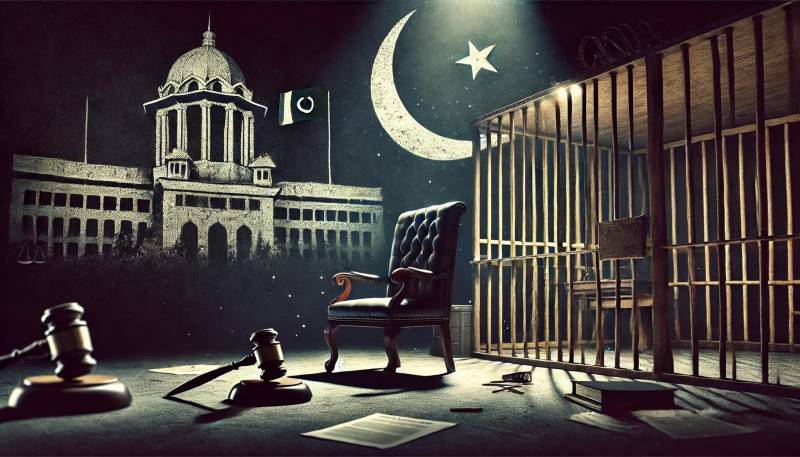
In Pakistan’s political history, one precedent has been set in stone: premiership most likely leads to prison. This is not a mere coincidence; it is in the rulebook of Pakistan’s power politics. From Zulfikar Ali Bhutto in the 1970s to Imran Khan today, the journey from the Prime Minister’s House to a prison cell has become a grim rite of passage. Why? And what do these leaders do once they are incarcerated?
Historically, global leaders’ imprisonment shapes their political legacies. Nelson Mandela emerged from prison to lead South Africa; Gandhi’s jail time immortalised his Quit-India movement, precipitating India’s independence. In Pakistan, however, imprisonment has a twisted correlation with power and influence. Leaders here use their time in confinement to write manifestos, negotiate deals, or quietly consolidate power. Their actions in jail, and the political footprint they leave behind, determine whether they emerge as martyrs, survivors, or symbols of resistance. It appears that the scale of their punishment is directly related to their political footprint.
Zulfikar Ali Bhutto’s 1973 Constitution remains Pakistan’s most enduring democratic legacy. By codifying parliamentary sovereignty and civilian primacy over the military, he directly challenged entrenched power centers. His bold reforms made him a target. Arrested in 1977 under General Zia-ul-Haq and later executed on questionable charges, Bhutto used his imprisonment to pen “If I Am Assassinated”; a critique of military rule and a manifesto for democratic socialism. Smuggled out page by page, his writings transformed him into a martyr whose ideas of social democracy have outlived him. His death immortalised his political legacy as a symbol of civilian resistance against authoritarianism.
Nawaz Sharif’s approach contrasted sharply with Bhutto’s outright defiance. The only prime minister to have been elected three times, Nawaz Sharif also faced imprisonment twice; first after General Musharraf’s 1999 coup, and later following the Panama Paper Leaks in 2018. Facing lengthy prison terms twice, he chose pragmatism over confrontation. Nawaz Sharif negotiated exile in Saudi Arabia in 2000 and later left for London on medical grounds amid corruption charges in 2019. While critics accused him of abandoning principle, these deals allowed him to stage political comebacks, including his return to power in 2013 and later in 2024. However, Sharif’s lack of structural reforms during his tenure meant his political footprint remained limited to economic policies rather than institutional change.
The challenge is not just breaking free from jail—it is breaking free from a system where every leader is destined for it
Asif Ali Zardari spent over a decade in jail during the 1990s and 2000s on charges ranging from corruption to murder; none resulting in conviction. Unlike Bhutto or Sharif, Zardari patiently endured incarceration whilst slowly consolidating power. From his cell, he maintained control over the Pakistan People’s Party (PPP), orchestrated alliances, and even secured a Senate seat. His eventual presidency (2008–2013) showcased how endurance and backchannel diplomacy can outmaneuver adversaries without actively engaging them. Since he never posed an immediate existential threat to the establishment, his punishment (though lengthy), was far less severe than that of his predecessor (Bhutto).
The cycle continued albeit briefly for other leaders; Yousaf Raza Gillani was sentenced for “thirty seconds” for contempt of court in 2012 after refusing to reopen corruption cases against then-President Zardari, and Shahid Khaqan Abbasi who served as the country’s premier during PML N was arrested in 2019 on pretext of corruption and subsequently jailed for 197 days. These incarcerations, while disruptive, did not shape Pakistan’s political landscape in any fundamental way.
Imran Khan’s imprisonment since August 2023 adds a modern twist to this narrative. Accused of corruption and violating official secrets, which he calls politically motivated, Khan has used his time behind bars to write open letters and call for civil disobedience via social media platforms like TikTok, X (formerly Twitter), and Facebook. Unlike Bhutto’s analog-era manifesto, Khan leverages digital tools to sustain his base but risks polarising discourse rather than uniting it under systemic reform. His political footprint remains symbolic rather than structural; a populist rallying cry rather than an institutional challenge.
Pakistan’s democracy remains trapped in a cycle where imprisoning leaders substitutes for dialogue or reform. This recurring pattern stems from three systemic contradictions: civilian leaders who challenge military dominance face severe reprisals; courts often legitimise politically motivated charges that erode public trust, and incarceration fuels narratives of persecution that boost leaders’ popularity but rarely translate into meaningful reforms.
The scale of punishment often reflects the leader's reformist ambitions: Bhutto paid with his life for reshaping Pakistan's democratic framework; Sharif and Zardari faced exile and imprisonment but avoided confrontations with entrenched institutions; Khan mobilised mass support but has yet to leave behind a lasting institutional legacy.
The ultimate tragedy is not just the repeated imprisonment of leaders but the stunting of Pakistan’s democratic potential. The nation remains trapped in an unending loop where personal vendettas eclipse institutional reform and survival supersedes governance.
To break this cycle, Pakistan must address its foundational contradictions: strengthen judicial independence to depoliticise accountability mechanisms; establish civilian oversight over military institutions to ensure democratic continuity; and promote electoral reforms that prioritise governance over populism.
History shows that prison can either silence dissent or amplify it. Bhutto’s writings inspired movements; Sharif's pragmatism kept him relevant; Zardari's resilience ensured survival; Khan's letters aimed to galvanise change. Yet unless systemic reforms are undertaken, these stories will remain part of an unending loop—a revolving door where leaders rise only to fall into confinement.
The challenge is not just breaking free from jail—it is breaking free from a system where every leader is destined for it.