

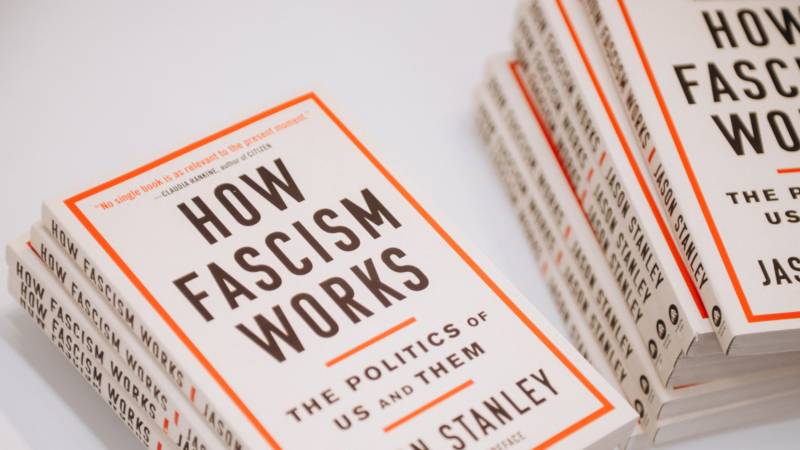
Professor Jason Stanley left Yale University for the University of Toronto based on the political situation in the United States under Trump. His books, How Fascism Works (2018) and Erasing History (2024), are worth reading to understand backsliding democracy and the rise of authoritarianism in recent times. The following illustrates salient ideas from Stanley (2018).
The Features of Fascism
Stanley notes that far-right nationalism has taken over countries like Hungary under Orban, India under Modi, and the United States under Trump. According to him, “fascist politics” divides people along racial or religious lines, dehumanises vulnerable minorities, glorifies a mythic past, perpetuates a sense of victimhood, and thrives on fake news. He writes that fascist politics creates a dominant in-group “us” versus a targeted out-group “them” distinction and generates resentment against a corrupt elite.
He illustrates that Hungary under Orban reads the past to project itself as a defender of Christian Europe against the Ottoman Empire, even though religion was not a major factor in the age of conquest. Similarly, the fascist core of Hindutva is based on creating a mythic past and diminishing Muslims as polluting foreign elements. Stanley adds that Hindutva is inspired by Nazism, as its leaders “regularly praised Hitler and Mussolini in the late 1930s and 1940s”.
The Limits of Free Speech
Stanley adds that fascists push freedom of speech to its limit. Disagreeing with John Stuart Mill, he states that freedom of speech does not yield the truth. This is because the marketplace of ideas assumes discourse based on reason, whereas fascist politics stokes fear and anger against the out-group. For instance, majoritarian Hindu nationalists dehumanise Muslims as “madrassachaps” and “jihadis”, caricature their faith, and engage in sexually crass language hinged on Muslim practices like circumcision.
Stanley shows that fascists manufacture stereotypes into reality and create conditions that subsequently allow them to legitimise ethnic cleansing or genocide
Referencing Mein Kampf, he states that propaganda is about replacing reason with fear and anger by repeatedly hammering a few basic points through pithy slogans. For instance, Hindu nationalists copy and paste propaganda messages through WhatsApp channels. He adds that conspiracy theories allow the rationalisation of fear and anger against a targeted minority group.
Fascism, Democracy, and Inequality
Stanley writes that fascist politics undermines democracy by preying on people’s fears, hatred, and need for an authoritarian. He notes that fascist politicians often assume power through democratic elections with anti-corruption campaigns. Once in power, they attack countervailing institutions. For instance, they target professors who support Palestinian rights and label protesting students as angry mobs. As fascists undermine education, they create a system that yields ideologically indoctrinated, compliant citizens and workers without bargaining power.
Stanley highlights that fascism is most effective under extreme economic inequality. He states that liberalism can cement the power of the in-group, as it fails to address structural inequalities and reparation for past injustices against the out-group. He adds that inequality undermines democracy, as the poor are instigated to support policies detrimental to their own interests. For instance, Trump and Modi stoke xenophobia and racism against immigrants and Muslims, respectively and secure the support of poor whites and Hindus to support tax cuts for the wealthy. He notes that fascism makes our suffering tolerable if the suffering of those we look down upon is greater than ours.
Victimisation and Domination
Stanley writes that fascist politics feeds off a sense of loss and victimisation and projects equality and inclusion as a power grab by the out-group. The dominant in-group feels victimised if it has to share power with the minority out-group. This sheds light on the Congress's rejection of Jinnah’s safeguards for Indian Muslims and of sharing power with the Muslim League.
Stanley argues that at the core of fascism is nationalism based on religion or nation, and that such nationalism is about domination of the in-group that assuages its “aggrieved victimisation” by punishing the minority out-group. For instance, Serbian nationalists invoked the defeat at the hands of the Ottomans and the centuries of humiliation to justify the oppression of marginalised local Muslim populations. Similarly, Hindu nationalists invoke history under the Mughals to justify fascist politics and the oppression of vulnerable local Muslims.
Fascism and Racist Tropes
Stanley writes that fascist propaganda instigates rape allegations against the targeted out-group. He states that Hindu nationalists stoke Islamophobic tropes by projecting Muslim men as a threat to “Hindu masculinity” through the “love jihad” narrative. He adds that the lynching of black men was justified based on rape allegations. Similarly, fake news was spread on the rape of white women by Middle Eastern immigrants in Europe, which mirrors the Nazi propaganda on the rape of pure Aryan women by black soldiers.
Stanley writes that “fascist politics” minimises the problematic acts of the in-group and generates mistrust and suspicion of the out-group. He adds that dominant in-groups describe their own actions as mistakes, but those of the out-group as criminal. For instance, upper-class educated Hindu nationalists downplay the ills of Hindutva and instead deflect onto racist tropes of Muslim communities.
Stanley shows that fascists manufacture stereotypes into reality and create conditions that subsequently allow them to legitimise ethnic cleansing or genocide. For instance, Myanmar treated the Rohingya Muslims poorly with constant harassment and policing, which created negative stereotypes of the Rohingyas and subsequently legitimised their inhumane treatment. This parallels the situation in Palestine, where Palestinians are treated brutally and inhumanely, which has created negative stereotypes and led to ethnic cleansing and genocide.
Overall, Stanley argues that fascism works by dividing people along racial or religious lines, dehumanising vulnerable minorities, glorifying a mythic past, and perpetuating a sense of victimhood. The antidote to this is solidarity amongst people through unions that foster community. This is why fascist politicians seek to dismantle unions and instead appeal to the principle of meritocracy and the idea that worth is measured by productivity.