

The announcement of India’s suspension of its participation in the Indus Waters Treaty (IWT) alludes to an important tactic employed by countries marred with historical grievances towards one another. Water is an essential resource, one that is vital for the sustenance of humans and ecosystems alike. However, from time to time, water has been used as a tool for geopolitical leverage – a concept that should not be encouraged in any shape or form.
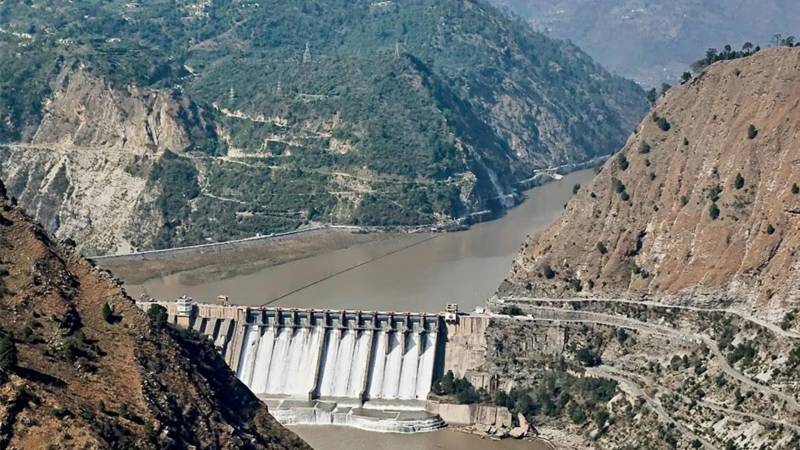
India’s federal home minister has explicitly stated that it will never restore the IWT with Pakistan. The Indus Basin waters support close to 80 percent of Pakistan’s irrigated agriculture and are also an important source of replenishing groundwater resources. Some immediate impacts following India’s decision to hold the treaty in abeyance were witnessed in Pakistan. There was a sudden decrease in the volume of water flowing in the Chenab tributary at Marala. In addition to that, India has initiated maintenance programmes of operational hydroelectric plants to increase the water holding capacity of reservoirs. Similarly, reservoir flushing has been carried out to remove sedimentation; this process can result in sudden inundation downstream. Not only does this cause flooding but also leads to significant water wastage.
It is important to note that these actions, during monsoon season, when several parts of Pakistan are already receiving immense precipitation in the form of rainfall, might not have an impact on a larger scale. Hence, the repercussions of India’s actions will be felt more pervasively in the winter season, when water flows ebb in the Indus and inadequate precipitation fails to compensate for industrial, agricultural, and domestic water requirements.
However, it is not only about India holding back water; it is about creating disturbances in flow, whether a sudden surge in the Indus or a sudden reduction in the waters of the Indus and its tributaries. These seemingly smaller disturbances can eventually build up to produce cascading effects. Pakistan, while being predominantly agrarian, has not reformed itself technologically to manage such shocks. As a result, efficient water-saving schemes are not widely practised across the country. If that were the case, Pakistan would have the capability to store excess water, which could then be redirected towards usage in the winter season.
India has declared the Court of Arbitration to be illegal and in violation of the IWT, stating that any ruling by the court is void and without legal standing, especially since India blames Pakistan for the Pahalgam attack
India cannot necessarily just put an end to the flow of water, but its ability to impact the timing and volume of flows is enough to cause troubles in the green fields of Pakistan. For Pakistan, the generation of hydroelectric power is also dependent on external water resources – in other words, the Indus. Hence, several sectors in Pakistan can be affected if India continues to make such moves in the future, whether distant or near.
The case has been brought to the Court of Arbitration under the request of Pakistan. The court issued a supplemental award, which essentially declared that the court has competence to hear Pakistan’s complaint against India’s Kishenganga and Ratle hydroelectric projects in Jammu and Kashmir. Hence, the court confirmed it can hear and decide the dispute.
However, India has declared the Court of Arbitration to be illegal and in violation of the IWT, stating that any ruling by the court is void and without legal standing, especially since India blames Pakistan for the Pahalgam attack. The Ministry of External Affairs noted that following the April 2025 terrorist attack in Pahalgam, attributed to Pakistan-based operatives, India has exercised its sovereign right under international law to place the Indus Waters Treaty “in abeyance.” India asserted that it is no longer bound to perform any of its obligations under the treaty and that this suspension will remain in effect until Pakistan credibly and irrevocably abjures its support for cross-border terrorism. Furthermore, India accused Pakistan of manipulating the treaty process to deflect from its support of terrorism, calling the arbitration a “desperate attempt” to avoid accountability.
The respect for international law and institutions should be upheld in any circumstance. Mediation should be conducted in such a way that the treaty is re-anchored in international law, with both countries demonstrating mutual respect and cooperation. Including frequent periodical reviews, technological advancement, and fair data exchange over Indus waters will help both countries in the long run. Exacerbating a water resource issue, especially as the Third Pole endures increasing glacial melt, is not going to be of any use to either country.
This is indeed a worrisome situation for Pakistan, since none of the rivers in the network originate within Pakistan. The Indus and Sutlej rivers originate in China, whereas the Chenab, Jhelum, Ravi, and Beas rivers have their headwaters in India. Weaponisation of water for geopolitical leverage is essentially a story of upstream and downstream riparian dynamics, where upper riparian countries have far more control over water resources than lower riparian ones.
This grim situation is not unique to India and Pakistan. Similar disputes exist elsewhere: Syria and Iraq targeting Turkey for its control of the Tigris and Euphrates, or Sudan and Egypt blaming Ethiopia for its control of the Nile. This problem poses a larger threat to the water security of South Asia, a region housing only 4% of the world’s freshwater resources. These resources – whether rivers, groundwater, or precipitation – should be appreciated and valued. The larger river systems in South Asia – the Indus, the Brahmaputra, and the Ganges – are transboundary, flowing through countries such as India, Bangladesh, and Pakistan. However, the precedence that India is setting in regard to the Indus Waters Treaty is a hazardous one. Not to mention, India itself is a lower riparian to China, and China’s upstream infrastructure can pose threats to water supply in India, especially considering China’s economic interests in Pakistan.
Hence, to avoid geopolitical regional competition over water resources, it is important for every country within South Asia to realise the importance of these freshwater resources, not take them for granted, and work cooperatively to set their differences aside and protect these precious resources. Engaging in water politics will not help anyone; it will only create troubles for future generations.