

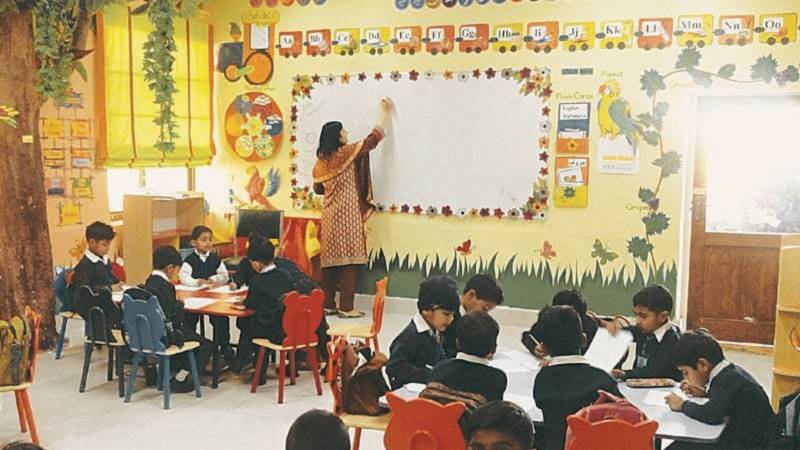
Amidst the expansive schooling universe of Pakistan, from cosmopolitan Sindh and Punjab cities to rocky Balochistan, KP, and snow-covered Gilgit-Baltistan valleys, an unseen exploitation flourishes below the shiny veneer of contemporary schooling. The roads are lined with signboards hollering in defiant, painted letters: “XYZ English Medium School.” Inside the walls, barely larger than a narrow courtyard or a rented two-roomed house, an illusion of school rises not for education, but for money. The “business of education”, once a noble cause, is now a marketplace where knowledge is marketed, teachers are bought and sold, and dignity is negotiated.
Education, in fact, was meant to be the lamp that chases away the shadows of ignorance. But in these so-called English medium schools, the lamp glows weakly, extinguished by greed and neglect. It is very sad indeed that those who carry the chalk of change are themselves bound by chains of deprivation. The private school teacher, typically a well-educated professional master’s or MPhil degree holder is reduced to a mere puppet in the hands of a petty proprietor whose education knows no better than counting coins at the end of the month. These teachers, predominantly women, become the silent victims of a system that thrives on their silence and survives on their helplessness.
In every street corner of Pakistan, from the city streets of Hyderabad to the remote villages of Chitral, one discovers schools springing up like weeds in the rain. Two unemployed graduates, typically young women, are employed not for pedagogic acumen or intellectual capacity but because they are willing to work for the scraps offered to them. The proprietor, frequently a local merchant, an old clerk turned retiree, or a capitalistic opportunist, sits as the self-styled ruler of this mini-kingdom. He employs and dismisses at whim, orders around and dominates, and regards teachers as interchangeable pegs in his puzzle of profits.
It cannot be helped but think of the admission of a young instructor who brought forward a bitter revelation: the very stationery bought by parents, the PPC paper, which is approximately fifty thousand rupees, is used to print the school’s own fee challans. Nothing, absolutely nothing, falls out of the grip of commercialisation. The minimum school fee, she explained, is five thousand rupees; the maximum goes up to one hundred thousand or more. But the teachers, the pillars of this whole structure, are given ten thousand, fifteen thousand, or at most, twenty thousand rupees a month. This appalling disparity is not only an economic outrage; it is a moral bankruptcy of a very high order.
An underpaid teacher loses motivation, self-respect, and creative energy. How can one motivate others when one is burdened by the weight of one’s own despair?
Education, when constricted to business, loses its soul. These so-called institutions are pretence factories, manufacturing neither intellect nor character. The children come in with innocence and graduate with superficial gloss English phrases without understanding, grades without knowledge, and arrogance without ethics. The real loss is not only the teachers who perish in silence, but education itself, its purity, its essence, its life-changing power.
In these dilapidated classrooms, one will discover teachers who show up early, dusty from hours of walking or taking the bus, holding their lesson plans and battered bags. They wear weary smiles, their faces etched with tales of unpaid bills, domestic woes, and forsaken dreams. They teach not because the pay keeps them goin,g for it hardly does, but because somewhere deep in their hearts, the fire of love for teaching still burns. They hope, against hope, that they are providing a better future. But every month, when they get their paltry wages just enough to keep body and soul together in this inflationary era, they are forced to remember their invisibility. Society venerates physicians, engineers, and bureaucrats, but rarely stops to wonder: who taught them to read, to think, to dream?
The tragedy is compounded by the fact that most of these underpaid tutors are educated, competent, and socially obligated women. Their voices are silenced by layers of societal expectation and economic vulnerability. They dare not object, lest they be replaced. They swallow their humiliation, smile through the injustice, and go on teaching like candles burning themselves to provide light, even as the wax of their dignity melts away. As a philosopher once put it, “The teacher is the candle that burns itself to light others.” But in this heartless system, that candle isn’t even given a consistent flame.
The irony cuts deeper when we juxtapose these schools’ enormous profits with the suffering of their educators. The same schools that send the parents astronomical bills for school fees, for stationery, for uniforms, for every little celebration, compensate their teachers below what a skilled worker makes. Parents, drained dry by these payments, do not realise that the teacher who instructs their child in English grammar or mathematics cannot have decent meals at home. It is a higher-order educational hypocrisy, one that has declassified fine teaching as an underclass occupation.
Justice for private school teachers is not a prerogative, but a right of national survival
And where are the authorities? The regulatory bodies of private schools, established to uphold fairness, transparency, and justice, have also turned a blind eye. Corruption penetrates each crack, and teachers’ pleas echo in vain. There is no system to question these so-called education entrepreneurs, no checking of their profit margins, no scrutiny of their arbitrary norms. The government’s silence turns into complicity, and the nation’s conscience is guilty.
This exploitation is not simply economic; it is intellectual, emotional, and psychological. An underpaid teacher loses motivation, self-respect, and creative energy. How can one motivate others when one is burdened by the weight of one’s own despair? This unfairness undermines the moral fabric of our school system, substituting mentorship with robotic instruction and enthusiasm with routine performance. When the teacher’s heart becomes fatigued, learning is dead.
Each day, educators fantasise about escaping to a “better” school, a “slightly higher” salary, a “little more respect.” But even that fantasy too often crashes against the wall of reality. One building varies from another only in the shade of its logo or uniform, not in the content of its ethics. The exploitation goes on, with a new name, a new board, a new promise. The circle of injustice is never broken.
In the meantime, the proprietors prosper. They open new branches, establish franchises, market “international standards”, and pay for air conditioners in the classrooms to impress parents as the teacher stands outside, unpaid, unheard, unseen. The system becomes obese, and the heart of education is famished. Parents are impoverished, teachers shamed, and students deceived. The structure can glisten with hues and ornate stickers, but under that superficial spark is a null truth, an education-less school, a soul-less system.
It is time for society to awaken from this moral slumber. A civilisation which treats its teachers with disrespect is marching towards self-destruction. History bears witness that no nation ever grew strong by demeaning its teachers. If teachers are underpaid, education turns out to be undernourished. If education is undernourished, society turns out to be intellectually anaemic. As rightly said, “If you want to destroy a nation, you do not need bombs; just underpay its teachers.”
Justice for private school teachers is not a prerogative, but a right of national survival. They should get decent salaries, respect, and dignity. They should be recognised as mind-builders, not as slaves of greed-mongering owners. The government needs to move in to regulate, to oversee, and to safeguard them. Parents need to ask where their fees are going, and society needs to honour those who stand in front of the blackboard, forging destinies with tired-out markers.
In this uneven mathematics, one side adding up profits, the other adding up tears, the scales need to be balanced. Let education once again be for its noble mission: illumination, not aggrandisement. Let schools become temples of knowledge once more, not bazaars of manipulation. Let teachers stand tall once more proud, honoured, and unencumbered by economic shackles.
Until that time, all the private school teachers of Pakistan are silent warriors, underpaid but unflinching, exploited but standing strong, unseen but irreplaceable. Their tale is not merely one of hardship; it is a reflection held up to our shared conscience. It challenges us, with eerie simplicity: when did we start valuing walls above wisdom, uniforms above understanding, and profit above people?
Maybe, when we begin to answer that question, the poorly paid teacher will finally take her rightful place not as a drudge of lessons, but as the designer of a nation’s destiny.