

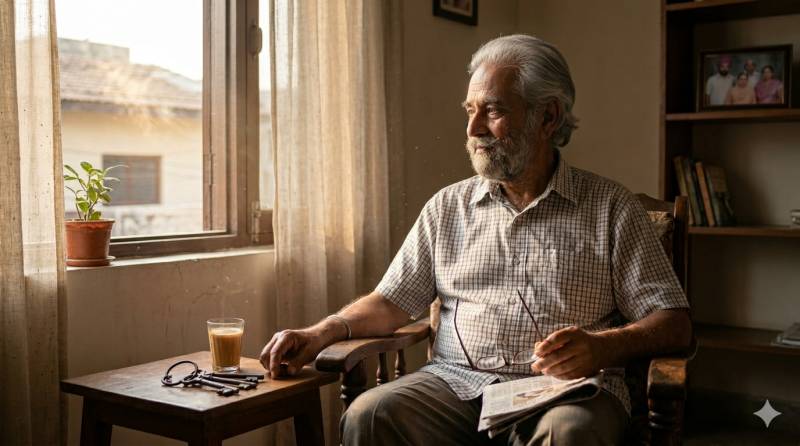
My grandfather started a sentence about Amritsar once and never finished it. “After they came for the shop near Hall Bazaar …” and then he stopped, looked out of the window at the afternoon heat shimmering on the roof next door, and changed the topic. I was 14. I didn’t ask again. The smell of cardamom tea from the kitchen felt stronger, like the silence needed something to fill it. Some things you hold back not because you want to forget, but because you don’t want the weight to pass on. It’s not malice, it’s a priority.
Years later, I realised that pause was the story. The archives will tell you when the riots happened, which neighbourhoods were burned, and how many crossed the border in August 1947. But they won’t tell you what it feels like to abandon a shop your father built, or why some people never say the word “migrate” out loud. They won’t tell you how your hands remember the weight of the shop keys even decades later. Those parts live in the sentences that trail off.
Amritsar and Lahore were hubs of commerce, with the same language and cultural rhythm. My grandfather ran a small shop in the former. These weren’t just cities on opposite sides of a line. Before 1947, a trader could walk from Anarkali to Hall Bazaar and find the same cadence of bargaining, the same mix of Punjabi and Urdu, the same kind of shopfront opening at dawn.
The cities shared suppliers, apprentices, and even the same jokes about slow customers. When that route closed, my grandfather didn’t just lose an address. He lost the network that made the shop work – the supplier in Lahore, the customer who came every Thursday, and the rhythm of the day. Perhaps that’s why the silence feels different from a gap in a document.
The shop near Hall Bazaar becomes a data point, not a place where someone sells cloth, gossips with fellows, and manages his dealings
Archives keep what the state wants to be remembered. Families keep what they can live with. The problem is that when the second record disappears, public memory becomes brittle. People turn into categories: migrant survivor, perpetrator. It’s easier to argue about history when you don’t have to imagine the person who lived it.
This silence isn’t unique; “not talking” has become a survival tactic. Talking means reliving, and reliving means peeling back layers of the past and experiencing those moments, exposing yourself to old vulnerabilities, mentally taking yourself back to the source of a memory that can trigger dormant feelings, grief or trauma. So people choose practicality over memory, because survival, stability and security outweigh emotional nostalgia. For my grandfather’s generation, the immediate priority was to rebuild. New homes, new shops, new routines. Once survival is handled, people start curating their narratives and versions:
“We left with honour.”
“We left with fear.”
“Our side didn’t do that.”
This is where the quiet work begins. Oral histories, student interviews, and local memory projects. None of it is publishable as legal evidence. All of it matters as memory. The conversations are messy. People ramble, contradict themselves, and stop mid-sentence. And that’s probably the point. We often think the danger is denial. The subtler danger is absence. When a generation decides some things are too heavy to say, the next generation inherits silence and fills it with whatever is loudest online or whoever is loudest in the room. Indifference doesn’t always arrive as hatred. Sometimes it arrives as “I don’t know, and I don’t need to.”
The cost of this absence shows up slowly; we lose the ability to see people in history as people. They become positions to argue about, not lives to understand. The shop near Hall Bazaar becomes a data point, not a place where someone sells cloth, gossips with fellows, and manages his dealings.
The responsibility is not to extract trauma; it’s to hold space so the story doesn’t have to be finished in one sitting. History isn’t only in files. It’s in the stories we’re willing to sit through, even if they don’t finish. When we add those fragments together – my grandfather’s half-sentence along with the records in the archive – we get a picture closer to the human scale of it. If we can do that, maybe the next generation won’t have to learn history from textbooks only.