

The standard diagnosis of Pakistani youth and politics goes like this. Young people are apathetic. They don't vote. They don't organise. They are distracted by screens and consumed by cynicism. The solution, according to this diagnosis, is civic education. Teach them how democracy works, and they will participate.
The diagnosis is wrong. And the condescension embedded in it is part of the problem.
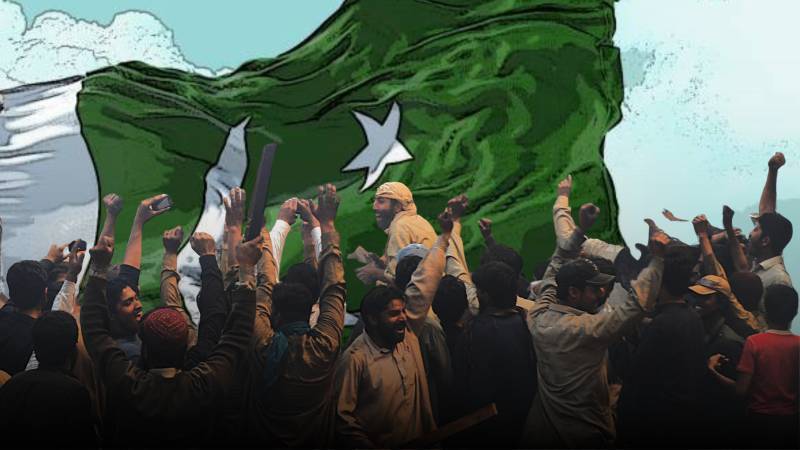
Pakistani youth are not disengaged from politics. Anyone who spent time near a university in 2022 and 2023 watched something that has not been seen in this country in a generation.
Young people, most of them first-time voters, organising without being paid to, travelling to rallies without being bused in, following court proceedings in real time, learning the names of constitutional clauses. Whatever one thinks of the political movement that produced this energy, the energy itself was not apathy. It was the opposite of apathy.
What it was, more precisely, was a demand for performance. Not ideology. Not ethnicity. Not the inherited loyalties that have structured Pakistani electoral politics since 1970. A demand that the institutions claiming democratic authority actually function as democratic institutions. The courts decide on the law rather than on the instruction. That elections produce governments that govern. That a parliament sitting in session is not merely providing cover for decisions made elsewhere.
This is a more sophisticated political demand than the ones that preceded it. And it has been met, consistently, with a political system entirely unprepared to answer it.
The generational shift here is real, and its roots are structural. The cohort now between eighteen and thirty-five grew up after the privatisation of television in 2002. They came of age in a media environment that, for all its subsequent restrictions, had produced a period of genuine if chaotic pluralism. They were formed by the lawyers' movement of 2007 and 2008, which demonstrated that civic mobilisation could produce institutional outcomes.
They watched the 2013 elections with the first serious independent vote count infrastructure. They are the first Pakistani generation for whom the gap between what democratic institutions claim to be and what they demonstrably are has been visible in real time, documented, shared, and argued about horizontally rather than processed through official narrative.
Pakistani youth are in an analogous position. They have grown up inside a system that has explained itself in democratic terms for their entire lives. They want it to be what it says it is
What they distrust is not the idea of accountable government. They distrust the specific and repeatedly demonstrated failure of Pakistani institutions to deliver it.
This distinction matters because the policy responses that follow from the wrong diagnosis are worse than useless. Voter registration drives aimed at a generation that already knows who to vote for but watches its votes adjudicated by non-electoral actors do not address the actual problem.
Civic education curricula that explain the constitutional role of parliament to young people who have watched parliament suspended, bypassed, and manipulated do not build democratic faith. They build a more informed version of the same disillusionment.
The honest question is what a democratic system would need to demonstrate, concretely, to earn the trust of a generation that has learned to read institutional behaviour rather than institutional rhetoric.
The answer is not complicated, though it is demanding. Courts that rule without visible regard for who is currently in favour. A parliament with genuine legislative authority over the full range of state decisions, including the ones currently exempt from civilian oversight. Elections administered by a commission whose composition and conduct do not become the subject of credible dispute in every cycle.
A federalism that delivers services to the provinces rather than transferring funds to be absorbed by provincial patronage networks. A press that reports on power without negotiating the terms of that reporting with power.
None of this is utopian in the sense of being structurally unreachable. All of it has been partially present at different moments in Pakistan's own history. The problem is not that these conditions are impossible. The problem is that each of them threatens an established institutional interest, and those interests have, so far, been more organised than the demand for accountability.
What is new, and what the political establishment has not yet fully absorbed, is that the generation making this demand is the largest single demographic bloc in the country. Pakistan's median age is under twenty-two. This is not a minority constituency to be managed.
It is the country. And it has developed, through a decade of digital communication and political disappointment, a collective literacy about institutional failure that cannot be addressed through the methods previously used to manage political dissatisfaction: patronage, controlled media, and periodic electoral release valves.
The movements that have historically transformed political systems in comparable contexts were not primarily ideological. They were functional. They demanded that institutions do what they claimed to do. The civil rights movement in the United States did not ask for a new constitution. It demanded that the existing one apply to everyone.
The democratic transitions in Southern Europe and Latin America in the 1970s and 1980s were driven by a middle class and a youth population that wanted the state to be what it officially was, not what it was in practice.
Pakistani youth are in an analogous position. They have grown up inside a system that has explained itself in democratic terms for their entire lives. They want it to be what it says it is.
Calling that apathy is not just inaccurate. It is a way of avoiding the question they are actually asking. The question deserves a serious answer.