

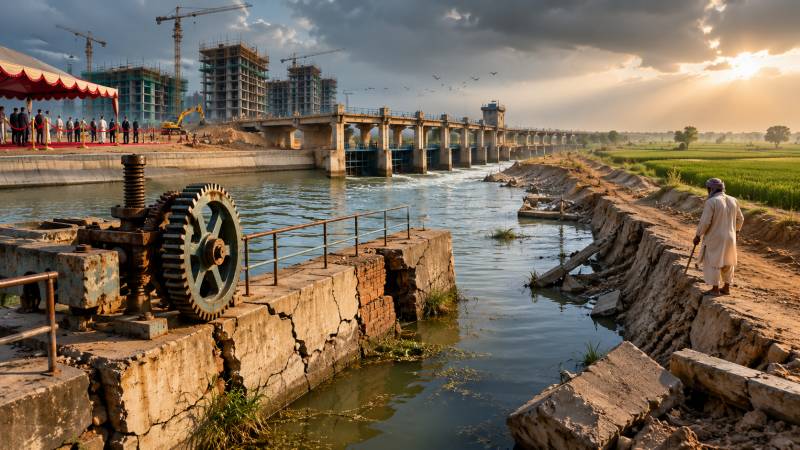
Every government likes to build.
A new building earns a ribbon-cutting ceremony. A new bridge becomes a headline. A new hospital is hailed as a symbol of progress. Concrete is photogenic. Construction wins elections.
Maintenance, by contrast, is invisible.
No minister inaugurates a repaired barrage gate. No television crew covers the desilting of a canal. There is no applause for replacing worn-out hoists, repairing canal linings, strengthening embankments or servicing regulators before they fail.
Yet civilisations are not sustained by what they build.
They are sustained by what they preserve.
That is why the recently announced Punjab Budget should be judged not only by the new projects it promises, but also by the assets it proposes to preserve. Buried within the 2026–27 budget is a line item that received almost no public attention: the money allocated for the Irrigation Department’s repairs and maintenance.
Rs. 8,895,756,000.
That is the amount Punjab has allocated this year, under the object head Repairs and Maintenance, for the upkeep of one of the largest contiguous irrigation systems in the world.
To many readers, it sounds like a substantial sum.
It is not.
Walk along almost any distributary and the first signs of neglect are easy to find. A cracked canal lining. Vegetation is forcing its way through masonry joints. Gates that no longer close properly. Inspection of roads washed away by previous floods. Regulators are awaiting repairs. Silt is slowly reducing the carrying capacity. None of these defects is dramatic enough to make the evening news. But together they determine whether millions of acres receive water when they need it.
Punjab’s irrigation system is not merely another government department. It comprises 13 barrages, 25 main canals, 13 inter-river link canals, thousands of hydraulic structures, tens of thousands of kilometres of canals and distributaries, and the engineering works that sustain agriculture across the province.
Good governments do not measure success only by the assets they create. They also measure it by how responsibly they preserve the assets they inherit
It is also one of Pakistan’s largest public assets.
Official planning documents estimated the replacement value of this infrastructure at approximately Rs. 1.6 trillion more than a decade ago. Since then, Pakistan has experienced extraordinary inflation in steel, cement, machinery, fuel, transport and labour. Any engineer involved in public infrastructure knows that rebuilding the system today would cost vastly more than it did when those estimates were prepared. A realistic engineering assessment places the current replacement value of Punjab’s irrigation infrastructure in the order of Rs. 4 trillion.
Now consider the arithmetic.
Accepted engineering and asset-management practice for mature, ageing hydraulic infrastructure typically assumes annual expenditure on asset preservation and preventive upkeep in the order of 2 to 4 per cent of current replacement value, depending on asset condition, operating environment and the level of service expected.
For an irrigation system built over a century ago, with an estimated replacement value of Rs. 4 trillion, that translates into an annual lifecycle investment of approximately Rs. 80–160 billion.
Punjab has allocated about Rs. 8.9 billion.
Put simply: Punjab is attempting to preserve a Rs. 4 trillion public asset with one-tenth the funding that engineering practice requires.
That should concern not only engineers but every farmer and every taxpayer.
Economists worry about fiscal deficits because they appear in government accounts. Engineers worry about another form of debt that rarely appears in any budget: infrastructure debt. Every year that asset preservation is deferred does not eliminate a liability; it merely converts it into a larger future obligation. Governments appear to save money today while quietly increasing tomorrow’s bill.
Every public asset begins to depreciate the day it is commissioned. Barrages and canals are no different from buildings, highways or factories. Concrete ages. Steel corrodes. Mechanical equipment wears out. Whether governments recognise that depreciation in their budgets is another matter.
The consequences of neglecting infrastructure stewardship are entirely predictable.
A leaking canal lining becomes structurally deteriorated. Minor erosion becomes an embankment breach. A gate that should have been overhauled during the off-season becomes an emergency during peak irrigation demand. A regulator that could have been repaired for a few million rupees eventually requires complete replacement.
Engineers have understood this for generations.
Preventive upkeep is always cheaper than emergency reconstruction. Every rupee invested in timely asset preservation avoids many more rupees of rehabilitation once deterioration is allowed to accelerate.
Governments, however, operate under very different incentives.
They do not underinvest in asset preservation because they dislike engineers or fail to understand infrastructure. They do so because preserving existing assets has almost no political constituency. Voters see new projects. They rarely see the repairs that prevent disasters from occurring. Political rewards therefore, flow towards new construction, while asset preservation quietly competes for whatever money remains after ribbon-cutting projects have been funded.
Democratic politics naturally rewards creation.
Good engineering quietly rewards stewardship.
This political economy explains why lifecycle investment is so often the first casualty of fiscal restraint. What appears to be a saving in one year’s budget is frequently nothing more than a transfer of costs into future years, where deteriorated infrastructure demands far more expensive rehabilitation — or complete replacement.
But this year’s budget carries an additional concern.
Punjab is making these allocations after a year in which devastating floods imposed extraordinary stresses on the irrigation system. Floodwaters scoured foundations, weakened embankments, damaged canal linings, undermined hydraulic structures and left behind defects that frequently emerge months or even years later. Every engineer knows that the years immediately following major floods require increased inspection, preventive upkeep and sustained investment in asset preservation.
If anything, the need for lifecycle investment should have increased substantially.
Instead, the province has budgeted Rs. 8.9 billion against an engineering requirement of approximately Rs. 80–160 billion.
Asset preservation is not simply another budget line.
It is the annual premium we pay to insure a Rs. 4 trillion public asset against avoidable deterioration.
No prudent business would insure a factory worth trillions of rupees while refusing to maintain it. Yet governments often do precisely that with public infrastructure.
Every rupee invested in preserving canals, barrages and embankments protects infrastructure built over more than a century. Every rupee withheld quietly transfers costs to future governments, future taxpayers and future farmers. Deferred asset preservation is not fiscal prudence; it is infrastructure debt that simply does not appear on the government’s balance sheet.
Punjab’s irrigation system is not merely an operating department.
It is a portfolio of public assets accumulated over more than a century.
Good governments do not measure success only by the assets they create. They also measure it by how responsibly they preserve the assets they inherit. That is the essence of infrastructure stewardship.
Punjab’s irrigation system underpins the province’s agriculture, food security and rural economy. Yet the real question is whether a century-old system can remain reliable when the province allocates Rs. 8.9 billion to preserve infrastructure worth approximately Rs. 4 trillion, where accepted engineering practice indicates annual lifecycle investment needs in the range of Rs. 80–160 billion.
Budgets are often described as statements of priorities.
They are something more. They are statements of stewardship. The recently announced Punjab Budget tells us that the province remains willing to invest billions in creating new infrastructure, but only a fraction of what prudent engineering practice would suggest is necessary to preserve the infrastructure it already owns.
Every canal breach begins long before the water escapes. It begins with an asset preservation budget that was never approved, a repair that was postponed, an embankment left unattended and a belief that public infrastructure can somehow preserve itself.
Governments will continue inaugurating new projects. Cameras will continue recording ribbon-cuttings. Speeches will continue to celebrate what has been built. But the future of Punjab’s irrigation system will be decided somewhere else, in the budgets for asset preservation that attract no cameras, no ceremonies and almost no public debate.
Nobody inaugurates maintenance.
Yet maintenance determines whether everything that has already been inaugurated continues to serve the generations that follow.