

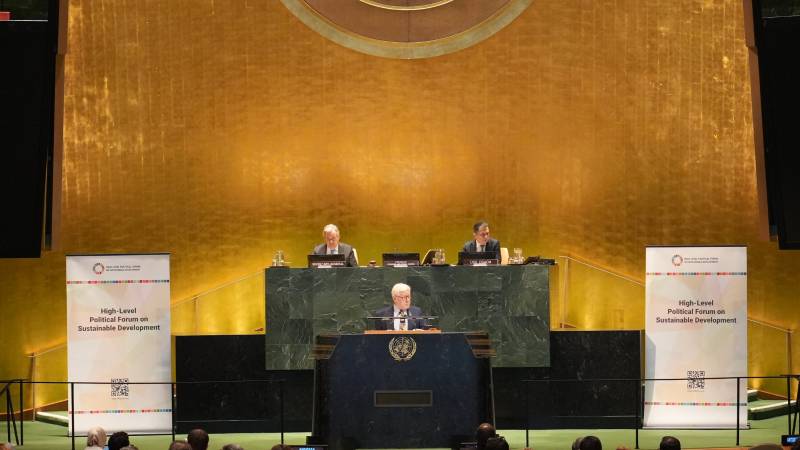
In a world reshaped by climate shocks, economic crises, and geopolitical fragmentation, the 2025 United Nations High-Level Political Forum on Sustainable Development (HLPF) arrives not just as a checkpoint but as a global reckoning. This mid-milestone between the adoption of the 2030 Agenda and its looming deadline offers one last real opportunity to ask: are we still serious about building a just, sustainable, and inclusive world, or have the SDGs become just another set of broken promises?
The HLPF, the UN’s central platform for reviewing progress on the Sustainable Development Goals (SDGs), has always functioned as a stage for global accountability and shared learning. In 2025, however, it must go much further. It should become a place for hard truths and decisive shifts, particularly in the relationship between the Global North and Global South.
The data speaks for itself. More than half of the SDG targets are off track. The COVID-19 pandemic erased years of progress on health and education. Conflict, food insecurity, and forced migration have surged. The climate crisis is accelerating faster than any adaptation plan can keep up.
But the burden of this stalled progress is not equally shared. In the Global South, countries are increasingly trapped in a cycle of debt, disaster, and underinvestment. They are being asked to decarbonise without the financial or technological means to do so. They are told to “build back better” without addressing the structural inequalities that make rebuilding nearly impossible.
As long as financial systems remain rigged in favour of the few, even the most well-intentioned SDG pledges will ring hollow
Meanwhile, the Global North continues to dominate global trade, finance, and governance, yet falls short on critical responsibilities. Climate finance targets remain unmet; vaccine equity failures revealed deep systemic bias; and calls for reforming global financial institutions remain largely rhetorical. The imbalance between who bears the cost of global challenges and who controls the resources to solve them is increasingly unsustainable.
At its core, the 2025 HLPF must answer a fundamental question: can the world govern fairly in an age of shared crisis and unequal power? That will depend on whether the forum addresses the following themes directly and honestly.
First, development must be financed on fair terms. Achieving the SDGs will require over $4 trillion in annual investment. Yet many developing countries are spending more on debt servicing than on health, education, or climate adaptation. In 2025, the Global South will justifiably demand debt restructuring, new sources of concessional finance, and a more equitable global tax and trade system. Without fundamental reforms to the way development is financed, SDG implementation will remain a distant dream for much of the world.
Second, climate responsibility must be rebalanced. While the Global South bears the brunt of climate devastation, the Global North remains responsible for the vast majority of historical emissions. The HLPF must press for enforceable loss and damage mechanisms that compensate countries for irreversible environmental harm. Equally, the Global North must expand technology transfers and provide clear, time-bound pathways for meeting—and exceeding—the long-promised $100 billion per year in climate finance. Climate justice must become policy, not just a talking point.
Third, global governance must shift towards genuine inclusion. The countries most affected by underdevelopment and environmental collapse remain the most underrepresented in global decision-making bodies. The HLPF can and should amplify calls to democratise institutions such as the IMF, World Bank, and WTO. This also means institutionalising the role of youth, indigenous communities, and women leaders in shaping the global development agenda. The Global South must no longer be seen as a recipient of solutions; it must be recognised as a co-creator of them.
True leadership today is not defined by dominance; rather, it is defined by the ability to share power, transfer resources, and stand accountable. The Global North’s credibility at the HLPF will depend on its willingness to confront the economic and ecological contradictions that undermine sustainability efforts elsewhere. As long as financial systems remain rigged in favour of the few, even the most well-intentioned SDG pledges will ring hollow.
The HLPF cannot become another ceremonial event filled with vague communiqués and recycled language. It must be a platform for political courage, where the richest and most powerful states demonstrate their willingness to confront structural inequality—not merely acknowledge it.
We are at a tipping point. Either the 2025 HLPF becomes a forum for resetting the social contract between nations, or it becomes another missed opportunity in a world running out of time.
In a rapidly changing world, the real question is not whether the SDGs are achievable. It is whether the global community still has the moral and political will to try.