

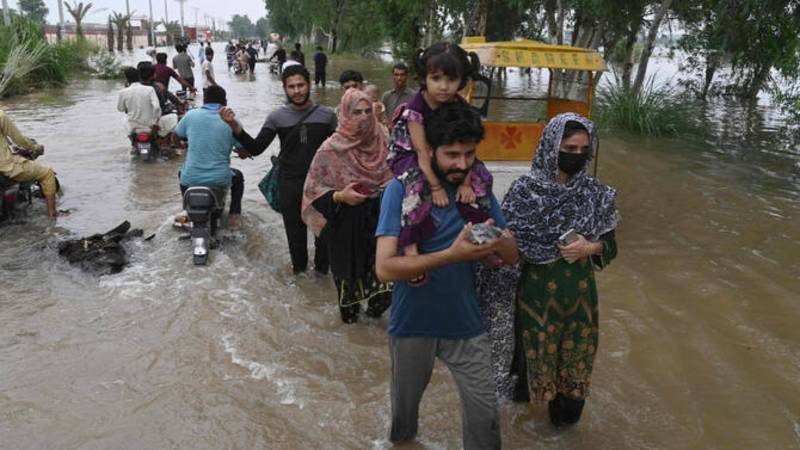
The floods of 2025 will be remembered not only for the water that surged through Pakistan’s rivers, but also for what they revealed about the country’s deeper vulnerabilities. In Punjab, rivers swelled with heavy rains, and people paid the price of decades of poor planning. In Sindh, the Indus stayed within manageable limits, yet panic spread as politics, miscommunication, and institutional chaos created a crisis of their own.
Together, these two stories of physical flooding in Punjab and governance flooding in Sindh show that disasters here are rarely “natural”. Climate change may intensify pressures, but the real drivers are land management, enforcement, communication, and trust.
Punjab: When Safety Nets Become Traps
In Punjab, the rivers behaved exactly as rivers should. Heavy monsoon rains filled them to bursting, and they spilt into their floodplains. The tragedy was that those floodplains were no longer empty. Over time, they had filled with villages, homes, and farmland. What should have been a harmless inundation became a human catastrophe.
The pattern was familiar. The Ravi, Sutlej, and other eastern tributaries have been so heavily diverted for irrigation that they are often described as “dying”. People began to see them as safe land, occupying the very channels where water once flowed. But rivers are never truly dead—they are only sleeping. When the rains came, they woke violently, reclaiming their space and sweeping away everything built inside it.
The same applied to emergency polders. These areas were designed as safety valves: empty zones where water could be diverted through intentional breaches in embankments to protect barrages and bridges. But breaches are rare, maybe once every 10 or 20 years. Living memory faded, governments failed to enforce rules, and people moved in. When engineers opened the safety valves, the “emergency” zones had become densely inhabited traps.
Punjab’s floods, then, were not caused only by rainfall. They were the product of decades of weak planning, neglected enforcement, and misplaced confidence that nature could be engineered away.
Punjab’s floods were physical, Sindh’s floods were political, and both were preventable
Sindh: The Flood That Never Came
Sindh’s story was different. By the time the Indus reached Guddu, the river was carrying more than average but still well within safe limits. Only a relatively small part of the mighty basin had experienced severe flooding—most tributaries were flowing at normal or slightly above-normal levels. When all these flows combined, the overall discharge entering Sindh was a moderate flood: serious, but routine, and well within the system’s design capacity. For experienced water managers, this was not an exceptional situation. It could be handled by standard operating rules and existing infrastructure without extraordinary measures.
But politics told another story. Still haunted by the devastation of 2022, decision-makers escalated warnings and spoke of imminent disaster. Social media amplified images from inundated Punjab, fuelling fear downstream. Families prepared to flee. Aid agencies readied for crisis. Yet the water never came.
Instead, the governance system buckled. Early warning became a mess of conflicting signals. Authority was blurred: should irrigation engineers, disaster agencies, or political leaders take the lead? Even India’s treaty-bound warnings of upstream releases were lost in the noise.
Sindh’s crisis was not of rivers but of communication. It was a flood of words, not water, a stark reminder of how little trust exists between experts, politicians, and the public.
A Tale of Two Crises
Punjab shows what happens when poor planning and weak enforcement turn rivers into killers. Sindh shows what happens when weak governance and confused communication turn a manageable situation into chaos. One crisis was physical, the other political, but both were human-made.
Next time, the roles could easily reverse: governance failures could amplify physical flooding elsewhere, and physical vulnerabilities could trigger political crises in unexpected regions. The geophysical challenges are not limited to Punjab, just as governance and communication weaknesses are not limited to Sindh. Across Pakistan, the interplay between water, institutions, and perception determines whether floods become disasters or remain manageable events.
What Must Change
Three shifts are essential if Pakistan is to avoid repeating 2025.
First, planning and enforcement. Floodplains and emergency polders exist for a reason. If governments allow settlements in these zones, every flood becomes a disaster in the waiting. Land-use rules must be enforced, however politically difficult.
Second, governance and communication. In crises, clarity saves lives. Pakistan needs transparent early-warning systems, clear mandates for who communicates risk, and trusted channels to reach the public. Sindh’s chaos showed what happens when political fear drowns out expert knowledge.
Third, trust and accountability. Information, whether from local experts or treaty partners, is only useful if it is trusted. Building confidence between agencies, between government and citizens, and between neighbours upstream and downstream is as vital as building embankments or barrages.
Beyond Fighting Water
Pakistan cannot keep fighting its rivers as if they were enemies. The Indus basin is not a machine to be controlled; it is a living system to be respected. Climate change will make floods and droughts more erratic, but it is governance and planning that determine whether water becomes a source of life or disaster.
Punjab’s floods were physical, Sindh’s floods were political, and both were preventable. The real danger is not water itself, but the failure to prepare, to enforce, and to govern.
The choice is simple: stop fighting rivers, and start fixing the systems that turn floods into disasters.