

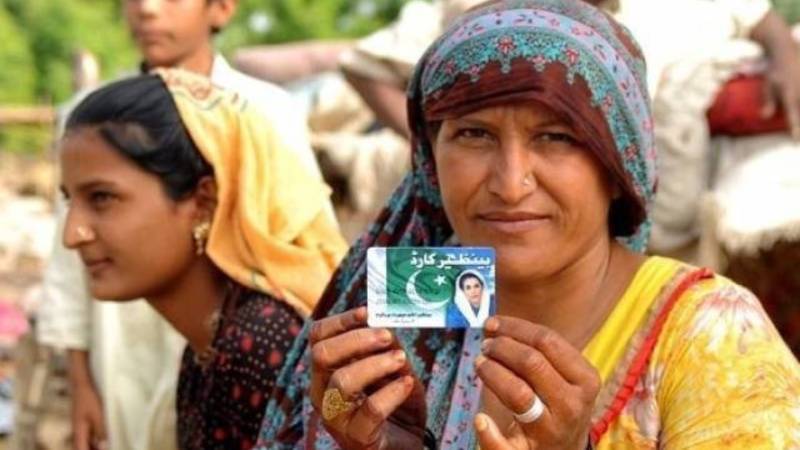
For millions of families across Pakistan, the Benazir Income Support Programme is not a policy debate. It is the difference between eating and not eating. Between keeping a daughter in school and pulling her out. Between surviving a flood and being swallowed by one.
So when whispers circulate inside Islamabad that BISP may be scaled back or devolved wholesale to the provinces, the anxiety those rumours trigger is not abstract. It is visceral. And it is justified.
The justification being offered is fiscal. The figure most commonly cited is Rs845 billion, a large number that sounds alarming until you ask what it is actually doing.
Before Pakistan treats BISP as just another line item to trim, it must answer a more fundamental question: What does a state owe its citizens? And when the state struggles financially, who should bear that burden first: the powerful or the poor?
The Numbers Tell a Different Story
Lost in the rumours is a basic fact: BISP is not collapsing. It is growing.
In fiscal year 2024–25, the programme disbursed roughly Rs592 billion in unconditional cash transfers to nearly 9.9 million low-income families. The proposed budget allocation has risen from approximately Rs694 billion to Rs845 billion, specifically to keep stipends meaningful amid punishing inflation. The beneficiary count is on track to exceed 10 million households, with hundreds of thousands of additional women entering the system for the first time.
This is not the picture of a government retreating from social protection. It is the picture of a government acknowledging that economic conditions have grown more desperate and trying, however imperfectly, to respond.
Pakistan today faces compounding crises: runaway inflation, recurrent climate disasters, food insecurity, a contracting formal economy, and an expanding informal labour force. To weaken the country’s primary shock-absorbing safety net precisely in this moment would not be reform. It would be strategic abandonment.
What Pakistan Built, and Why It Matters
Critics of BISP often speak as though social protection programmes are inherently wasteful. What they rarely acknowledge is how sophisticated and technically formidable Pakistan’s system has actually become.
Through the National Socio-Economic Registry (NSER), linked to NADRA’s digital identity infrastructure, Pakistan quietly assembled one of the largest integrated poverty-targeting systems in the developing world. Nearly 40 million households have been registered and assessed through a data-driven mechanism covering approximately 84 per cent of the population.
Before this existed, social assistance in Pakistan was fragmented, discretionary, politically manipulated, and routinely captured by patronage networks. The NSER introduced rules-based targeting that dramatically improved both reach and precision.
Many countries, far wealthier than Pakistan, are still trying to build what Pakistan already has
When COVID-19 struck, when catastrophic floods displaced millions, and when inflation erased household purchasing power overnight, this architecture allowed Pakistan to respond at a national scale in ways that would have been impossible even a decade earlier.
Many countries, far wealthier than Pakistan, are still trying to build what Pakistan already has.
Why This Debate Is Personal
I want to be transparent about something: for me, this debate is not academic.
Long before BISP became Pakistan’s largest social protection platform, I had to witness the thinking that shaped its earliest foundations. During Shaheed Benazir Bhutto’s years in exile, we would occasionally meet at a modest restaurant on 45th Street in New York. She was consumed by a single question: how could Pakistan build a system that reached the country’s poorest women with dignity, not charity, not patronage, but genuine state protection?
She would ask me to collect data and comparative models: poverty programmes from Brazil, Mexico, and other places that had attempted what Pakistan had not. Sometimes she would call unexpectedly and begin sketching curves on paper: income distribution, poverty reduction trajectories, and the “J-Curve” of rising public expectations against falling state capacity. She was not describing welfare. She was describing the conditions under which states fracture.
In early 2008, I was working in the United States in information and communications technology when I was invited to accompany her on her return to Pakistan as an election observer. I was with her on that journey.
Pakistan’s Parliament voted unanimously to name the new national social protection initiative in her memory. That decision carried symbolic weight far beyond politics. It was an acknowledgement that the programme represented an idea she had returned to again and again: that the Pakistani state must stand beside its most vulnerable citizens, especially women who had historically remained invisible to both policy and power.
After her cold-blooded murder near the garrison town of Rawalpindi, a dictator said she might have survived if she had not stood up through the sunroof of her vehicle in those final moments. Perhaps. But I have come to believe something else: she stood because she believed Pakistan’s forgotten citizens deserved to be seen. That the risk was worth taking.
That conviction stayed with me. It is part of what brought me back to Pakistan, to NADRA, and ultimately to the early technical work that helped make BISP operational. BISP became the first major national project I worked on, as a modest member of a much larger team, attempting to build something Pakistan had never truly possessed: a modern, data-driven, nationally coordinated social protection system anchored in the country’s poorest women.
That is why I cannot be silent when the programme is reduced to a budget arithmetic problem.
Dependency Is a Myth. The Data Shows Mobility
One of the most persistent criticisms of programmes like BISP is that they breed dependency. It is a compelling rhetorical argument. It is also contradicted by the evidence.
The National Poverty Graduation Programme, BISP’s complementary initiative designed specifically to help families achieve permanent economic independence, has already enabled over 370,000 households to graduate out of poverty. Eighty per cent exited extreme poverty entirely. More than half are no longer qualified for BISP support afterwards.
That is not dependency. That is economic mobility
BISP’s complementary programmes have produced equally measurable gains. The Nashonuma initiative, targeting maternal and child malnutrition, contributed to documented reductions in stunting in intervention areas. The Taleemi Wazaif education stipends helped enrol nearly 15 million children in school, particularly girls, who are almost always the first to leave classrooms when household finances collapse.
The World Bank and multiple independent evaluations have documented BISP’s role in reducing inequality and protecting vulnerable populations during successive economic shocks
These are not welfare expenditures. They are long-term investments in the workforce, productivity, and social cohesion Pakistan will need to survive the next several decades.
Austerity cannot Run Downward Only
At the same moment that the state debates whether it can “afford” BISP, a separate controversy has been simmering over the acquisition of luxury VIP aircraft. Add to that the expanding protocol fleets, imported luxury vehicles, and elite administrative perks distributed across multiple tiers of federal and provincial governments, and the cumulative bill runs into hundreds of billions of rupees.
Perhaps these expenditures do not equal BISP’s Rs845 billion annual allocation. That is not the point. The point is moral and political coherence.
A state cannot credibly preach fiscal austerity to the poor while visibly expanding comfort at the top. It cannot ask the most vulnerable citizens to absorb budget cuts while their leaders travel in private jets. Even a fraction of elite expenditure redirected towards BISP could finance quarterly stipends for hundreds of thousands of households, sustain Nashonuma’s nutrition interventions, or keep millions of girls in classrooms.
Fiscal discipline is a legitimate principle. But it must begin at the apex of the pyramid, not at its base.
No nation strengthens itself by dismantling protections for its weakest while expanding privileges for its most powerful.
Why Federal Ownership Is Not Negotiable
Some argue that the logic of the 18th Amendment demands provinces manage their own social protection systems. It sounds administratively tidy. It ignores reality.
Poverty does not observe provincial boundaries. Climate disasters do not stop at the edge of Sindh or KPK. Migration, displacement, and food insecurity are national phenomena requiring national coordination. A fragmented BISP would mean uneven standards, politicised targeting, duplicated infrastructure, weakened interoperability, severe fiscal disparities between provinces, and the effective end of national portability for beneficiaries who move across regions.
Most critically, it would transform a citizenship-based entitlement into a geographically unequal lottery, where whether you receive support depends on which province you happened to be born in.
Pakistan maintains a national army because national defence requires national coordination. Social resilience demands the same logic. A mother in Balochistan and a mother in Punjab are both citizens of the same federation. The state’s obligation to them cannot vary by postcode.
The Real Questions Worth Asking
BISP is not beyond criticism. No programme of this scale and complexity is.
The legitimate questions Pakistan should be debating are these: How can leakage and exclusion errors be reduced further? How can the graduation pathway be accelerated and deepened? How can provincial delivery mechanisms improve while preserving national standards and portability? How can BISP evolve into a broader digital public infrastructure ecosystem, integrating health, education, agriculture, skills training, and formal employment, so that beneficiaries can climb rather than simply survive?
These are reform questions. They make the programme stronger and the state more capable.
Dismantling a functioning national safety net under fiscal panic is the opposite of reform. It is an abdication.
The Cost of Walking Away
The World Bank and multiple independent evaluations have documented BISP’s role in reducing inequality and protecting vulnerable populations during successive economic shocks. Pakistan should take seriously what is at stake if that role is weakened.
A country where millions feel abandoned by the state does not become more stable. It becomes more brittle. The political fragmentation, social unrest, lost productivity, and human suffering that follow broken social contracts are expensive in ways that never appear in a budget spreadsheet until they become impossible to ignore.
Pakistan should reform BISP. Modernise it aggressively. Expand its reach and sharpen its impact. Build the digital infrastructure around it that makes it a genuine engine of economic inclusion rather than just a transfer mechanism.
But any government that retreats from the social contract between state and citizen, especially while expanding its own privileges, should be clear about what it is actually choosing.
It is not saving money. It is spending political legitimacy that it may not be able to recover.