

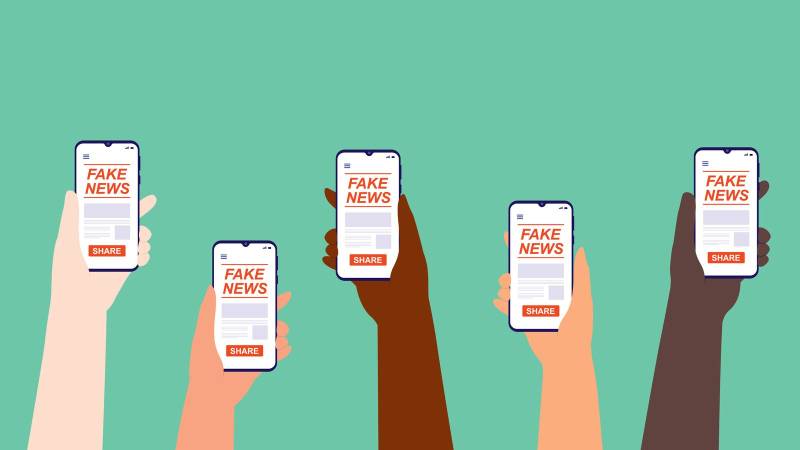
“People are so docile right now. It is almost as if good government means that when the politicians lie to us for our own good, for the public good, and bad government is when politicians lie for their own selfish interests”—James Bovard.
“Repeat a lie often enough and it becomes the truth” is attributed to Nazi propaganda minister, Joseph Goebbels, the fact is that its manifestation is echoing throughout the world and more so in the Land of Pure. The same piece of information if constantly repeated and made to circulate is taken as a sign of truth. After all, one person can lie but not everyone. If there is smoke, there must be fire, which is what makes us inclined to believe something with complete resolve.
As an example from real life, in a picture of the Kaaba during one Haj season, someone misconceived a cloud formation as an angel forcing onlookers too to be struck by that very idea, compelling them to agree. When this scribe saw it, the first question that came to mind was how they knew that it was an angel. According to Islamic belief, no one can see the angels. The perception that angels are winged female-looking entities, is derived from the Bible then how did this staunch Muslim think that he saw one? It was like, if you can see one you are a true believer, and if you cannot then the devil has gotten onto you.
There are many such lies that we get to hear every day wherein the illusion of truth is made to conceal the underlying lie. Misinformation campaigns are run on this very premise and where this works best is in the public sector. Computers are meant to process information but the human brain which is akin to a computer, processes at an incredible speed and with greater efficiency. When people find themselves in familiar situations, they readily accept whatever is placed before them because reasonableness is a difficult path to tread on. It is much easier to be carried away when a multitude is echoing lies spread either by a private or public party than to ponder, investigate, and arrive at an educated conclusion.
Be that as it may, there can be no denying that lies are short-lived and when people realise they have been taken for a ride, their reactions could take on an uncontrollable turn. Friedrich Nietzsche once said: “I'm not upset that you lied to me, I'm upset that from now on I can't believe you”. Once this happens, trust and confidence in someone or institutions take a backseat giving way to doubts and suspicion. This is certainly not a healthy environment in which to build relationships or live in a country where the public is constantly being lied to or made to lie.
A lie can travel halfway around the world while the truth is putting on its shoes
A simple example can be gleaned from an everyday occurrence. Let us say that A owns a plot of land, the market price of which is Rs. 7 million but sells it to B for Rs. 6 million because A is in urgent need of money. This is an honest and truthful transaction but look at the way the government forces both to lie. According to the registration authority, the minimum value on which this plot can be registered in B’s name is Rs. 4 million. This means that B can purchase (evading legal fee) documents in the form of stamp paper by declaring the price at 4 million. Now both A and B would have to pay advance taxes to the federal government under sections 236C and 236K of the Income Tax Ordinance, 2001 for which the Federal Board of Revenue (FBR) has prescribed its valuation charging a percentage of that value which could be Rs. 8 million. Another lie coerced by a public sector entity.
Late Khursheed Kamal Aziz in his book The Murder of History, has been highly critical of the textbooks related to Pakistan Studies that are widely taught in schools all over the country. According to him, many historical omissions and misrepresentations ignore or downplay Pakistan’s multi-cultural, multi-ethnic, and multi-religious past which has its beginnings in the conquest of Sindh by an Umayyad army led by Muhammad Bin Qasim in 711 AD or CE as understood today.
K.K. Aziz claimed in his book that distortions of historical facts and inaccuracies are meant to invoke religious intolerance and anti-Indian sentiments. Astonishingly those who have studied true ancient history are greater nationalists compared to the younger generation who appear to be more anti-Pakistan than the intended anti-India content. One can easily make out false information even with respect to the four wars that were fought between Pakistan and India in 1948, 1965, 1971, and 1999.
Even if curative measures are undertaken the nation has already suffered much damage. As Mark Twain opined: “A lie can travel halfway around the world while the truth is putting on its shoes”. It is going to take a few generations before these untruths are ironed out and the people can at last heave a sigh of relief that they are living in a society that is predominantly honest in its entire composition.
Pakistan is among those countries that are victims of falsity in full radiance because “We swallow greedily any lie that flatters us, but we sip only little by little at a truth we find bitter”, at least that is what Denis Diderot thinks.
Other governments indulge in massive lies as Henry Wotton cynically said: “An ambassador is an honest man sent abroad to lie and intrigue for the benefit of his country”. The stories we have been told about the activities of security agencies like RAW, CIA, ISI, Mossad, KGB, etc. one can imagine the level of lies resorted to in creating terrorist monsters that are unleashed upon innocent people and who play havoc with their lives and properties.
Despite this environment of deception, some people will continue to speak up against this malaise. Much as certain governments might want to disseminate misinformation these false idols will begin to break because of the massive interaction of people on digital social platforms sharing real-time news. Guided by the likes of William Faulkner who said: “Never be afraid to raise your voice for honesty and truth and compassion against injustice and lying and greed. If people all over the world...would do this, it would change the earth” truth will eventually reign supreme.