

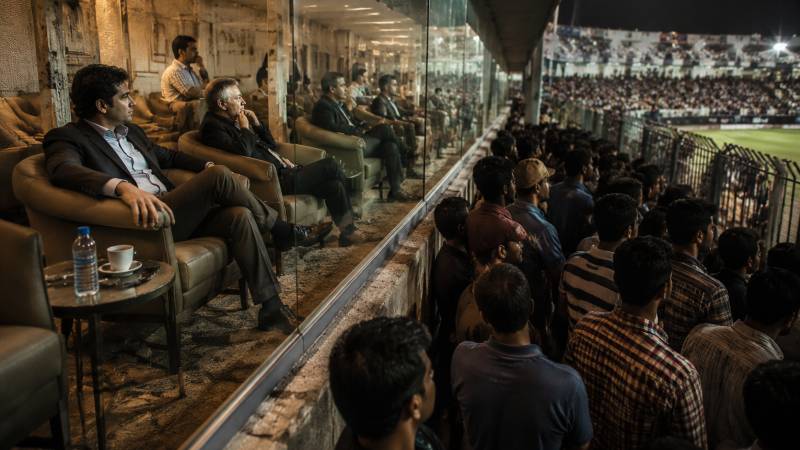
The 2026 FIFA World Cup was pitched to us as the ultimate planetary jamboree—a joyous, borderless festival of football where nations gather under the benevolent, tax-exempt gaze of multinational corporate sponsors to kick an inflated sphere around a manicured lawn. Instead, it has morphed into a magnificent geopolitical caste system, proving once again that while all nations are supposedly equal on the pitch, some are distinctly more equal than others in the VIP lounges and executive boardrooms. If you happen to hail from the wrong patch of dirt, your passport is treated like a biohazard warning by immigration officials who look at you as though you might spontaneously combust, while delegations from the approved hemisphere glide through customs as though carrying diplomatic immunity to reality itself.
Just wander over to the labyrinthine visa processing centers scattered across parts of Africa, the Middle East, and Central Asia to witness this administrative theatre of cruelty in full swing. Aspiring fans, journalists, and even auxiliary athletic staff find themselves subjected to a form of bureaucratic waterboarding. Take the glaring case of the Sports Association of Moroccan National Team Fans, where 40 out of 42 dedicated members—complete with flawless travel histories, paid hotels, and thousands of dollars in non-refundable match tickets—were hit with arbitrary visa rejections by U.S. consulates. Even Senegalese captain Kalidou Koulibaly had to publicly call out the blatant double standards, asking why African teams were forced to play in half-empty atmospheres while their people were locked out at the borders. Meanwhile, Josimar 'Vozinha' Dias, the goalkeeper for Cabo Verde, revealed that prohibitive bureaucratic walls and costs initially barred even his mother from witnessing her son play against global powerhouses.
The systemic gatekeeping did not stop in the stands; it targeted the officials on the pitch as well. Omar Abdulkadir Artan, a Somali referee crowned Africa’s best, arrived in the United States with a valid visa only to be subjected to an 11-hour interrogation at Miami Airport before being deported under the guise of "national security"—a farce so transparent that even UEFA President Aleksander Čeferin had to step in and rescue his career by assigning him to the UEFA Super Cup Final. And who could forget Michel Kuka Mboladinga, the iconic Democratic Republic of Congo "superfan" famous for posing as statue revolutionary Patrice Lumumba? He was barred from entering the U.S. entirely, managing only to watch his team play in Mexico before American immigration red tape slammed the door shut.
Even the distribution of training facilities and match logistics possesses a biting, systemic irony. Traditional European and North American powerhouses luxuriate in state-of-the-art training compounds complete with bespoke nutritionists, high-altitude recovery chambers, and climate-controlled serenity. Conversely, lower-ranked federations from marginalized regions are frequently relegated to training pitches that resemble municipal car parks with a rusty set of goalposts bolted to the asphalt. It is a subtle, elegant apartheid of logistics—why waste prime infrastructure, advanced sports science, or luxury transport on teams whose regional currencies don't make corporate boardrooms salivate? The message is delivered not with a megaphone, but with a quiet, efficient whisper: know your place in the sporting food chain.
Just wander over to the labyrinthine visa processing centers scattered across parts of Africa, the Middle East, and Central Asia to witness this administrative theatre of cruelty in full swing.
Yet, the true masterpiece of this year's tournament lies in its rigorous enforcement of a mandatory intellectual lobotomy. FIFA loves to preach high-minded platitudes about how football unites the world, provided that the world agrees to never, under any circumstances, mention actual human suffering or geopolitical accountability. Let a player, a coach, or a spectator so much as whisper a word of solidarity for populations currently being ground into dust by Western-backed military machinery—such as the resilient waves of fans holding Palestinian flags during matches like Türkiye versus the United States or Germany versus Paraguay—and watch the administrative guillotine drop with terrifying velocity. Fines, indefinite bans, and immediate moral condemnation are hauled out of the corporate closet faster than you can say "keep politics out of sports".
Of course, keeping politics out of sports has always been code for keeping the wrong politics out. When corporate-political Zionist lobbies and heavily funded state-backed Western interest groups weave themselves seamlessly into tournament marketing, stadium sponsorships, and broadcasting narratives, it is hailed as a noble triumph of global partnership and shared values. You can plaster corporate logos tied to illegal occupations all over the digital advertising boards, and the governing bodies will look away with beatific serenity. But let a dissenting voice point out the glaring hypocrisy of celebrating human rights while cheerleading for regimes that systematically dismantle them, and they are promptly banished to the shadow realm of media blackouts, social media shadowbanning, and credential revocation.
The hypocrisy scales even further when examining the financial architecture of the event. Billions of dollars are siphoned into the pockets of bloated governing bodies and transient corporate entities, leaving local host communities to pick up the tab for security, infrastructure strain, and environmental degradation. The ordinary citizen in the host nations is told that the economic trickle-down will cure all ills, even as public services are slashed to fund militarized policing zones around stadiums. It is a masterclass in bread and circuses, updated for the twenty-first century with facial recognition software and algorithmic dissent suppression.
Ultimately, the 2026 World Cup stands as a monument to selective empathy. The narrative spun by the elites is that sport exists in a vacuum of pure athletic merit, untouched by the ugly realities of imperialism, racial prejudice, and systemic exclusion. But when you examine the visa queues locking out fans from nations like Senegal, Haiti, and Iran, the tiered lodging, the confiscated banners, and the sanitized broadcast booths, the reality becomes glaringly obvious. The global game has been neatly packaged, monetized, and fenced off for the comfort of those who hold the geopolitical monopoly on power. The message from the grand organizers is loud, clear, and dripping with condescension: you are free to consume the product, buy the merchandise, and cheer on cue, but if you dare notice that the bread is stale and the circus is rigged, your microphone gets unplugged. After all, nothing says sportsmanship quite like a synchronized, billion-dollar silence designed to protect the comfort of the oppressors while the rest of the world watches from the dark.