

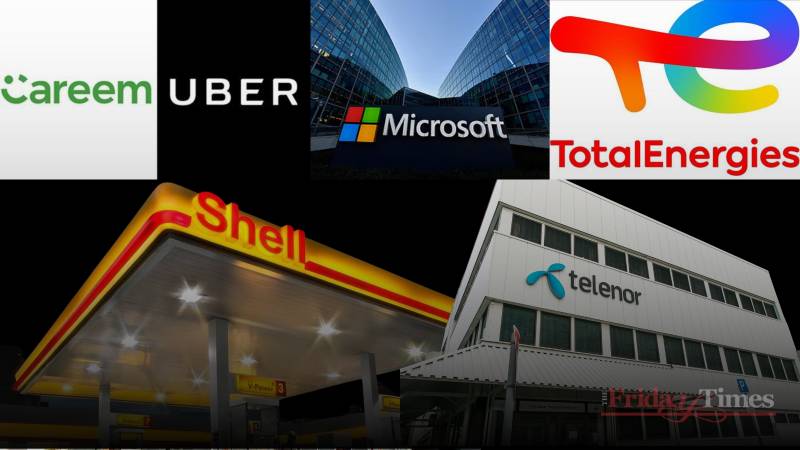
From 2022 to mid-2025, Pakistan has witnessed a concerning trend: the steady withdrawal of at least 13 major international companies across key sectors, including technology, ride-hailing, telecom, energy, and pharmaceuticals. This corporate exodus is not just a reflection of tough business cycles — it signals a deeper malaise in the country’s economic and regulatory environment.
Microsoft, one of the world’s most iconic tech firms, closed its Pakistan operations in July 2025 after 25 years, retaining only a liaison office with a handful of staff. The decision was driven by global restructuring, but also by local challenges — including policy inconsistency, foreign exchange restrictions, and rising operational costs. Similarly, Careem, a subsidiary of Uber, suspended its ride-hailing service on 18 July 2025, citing a harsh economic climate, low investor confidence, and shrinking consumer demand. Uber itself had already exited in 2022 for similar reasons.
Telenor, the Norwegian telecom giant, sold its entire Pakistani business to PTCL in December 2023 after struggling with rising energy costs, heavy taxation, and regulatory hurdles. In the energy sector, Shell Pakistan divested its 77% stake in mid-2023, citing foreign exchange issues and supply chain challenges. TotalEnergies also exited, selling its 50% stake in Total PARCO in 2024 due to declining profitability and unfavorable regulation.
The pharmaceutical sector has been hit particularly hard. Eli Lilly, Sanofi, Bayer, and Pfizer all reduced or ended operations between 2022 and 2024, citing unsustainable margins driven by import dependencies, currency volatility, and delayed regulatory approvals. Fresenius Kabi, a major German healthcare company, also discontinued its operations in early 2023 due to business climate concerns. In the retail energy space, Puma Energy withdrew from the Admore Gas joint venture in early 2022, marking another foreign pullback. Even global industrial names like GE and ExxonMobil have scaled back their presence in Pakistan in the face of prolonged macroeconomic uncertainty.
This wave of exits is not just symbolic — it has had measurable effects on Pakistan’s economic landscape. Net foreign direct investment (FDI), which stood at $1.86 billion in FY2021, declined to $1.47 billion in FY2024, reflecting reduced investor confidence. While Pakistan’s trade deficit narrowed to $24.09 billion in FY2024—down from over $27 billion the year before—this was largely due to import compression rather than export growth. Foreign exchange reserves held by the State Bank improved marginally, reaching $14.5 billion by mid-2025, bolstered by IMF inflows and rollovers from friendly countries.
However, the technology sector remains under strain. Startup funding, which had peaked at $366 million in 2021, plummeted to under $50 million in 2024, as global capital flows dried up and domestic instability worsened. The brain drain in tech has escalated, with anecdotal estimates suggesting thousands of skilled workers relocating abroad. Retention rates among computer science graduates have sharply fallen, as many seek opportunities overseas, contributing to a growing vacuum in Pakistan’s digital economy.
These departures ripple across every layer of the economy. They result in the loss of high-paying jobs, access to global supply chains, and critical knowledge transfer. They also impact consumer welfare, as market competition shrinks and prices rise. Most critically, they damage Pakistan’s credibility as an investment destination, particularly in the digital and innovation sectors.
To reverse this trend, Pakistan must urgently pursue structural reform. This includes currency stabilisation, consistent regulatory policies, and a long-term strategy for digital and industrial development. Without serious and sustained intervention, more exits may follow — and with them, the hope of building a competitive, knowledge-based economy may remain just out of reach.