

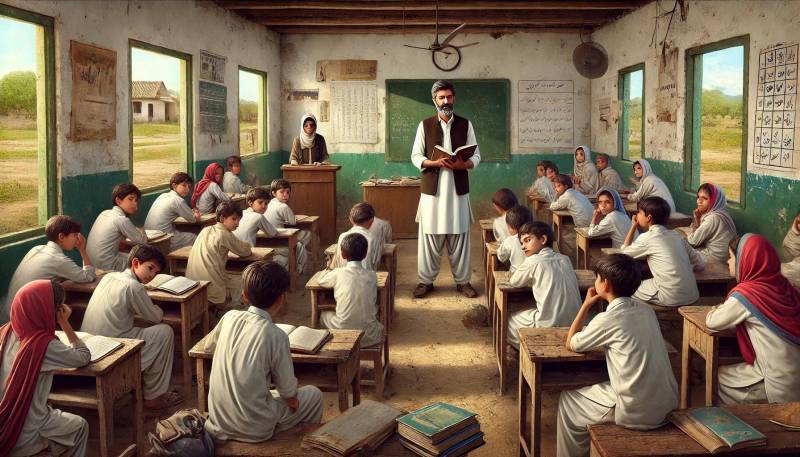
Some students were asked in a public middle school classroom if a few non-Muslim families migrate to your town and live among you, how would you treat them? The majority of the students replied that they would wage a war and fight them until they left our town. By inquiring as to why they would be killed or expunged from the town, this student in a ferocious tone replied that they are infidels and that’s why they must be eliminated. This mindset has been shaped by our social ethos, based on an exclusive religious interpretation, and integrated into our educational institutions. Amidst such social challenges, the purpose of educational institutions succumbs to the prevalent societal psyche. However, since the academic year has come to an end, before printing textbooks for the next year, some essential changes must be brought to the curriculum for a more inclusive and flourishing society.
Due to social and family values children's sexual safety is often not considered. This makes children the most vulnerable section of society to sexual abuse. Data shows that child sexual abuse is mainly and mostly done by close relatives within the family. Therefore, owing to social values and family honour sexual victims are not reported in the police stations and are not even effectively addressed within the family causing insurmountable childhood traumas. In consideration of the mounting child sexual abuse cases, the provincial governments must include chapters on good touch and bad touch in the elementary schools’ curriculum as a preemptive measure for any sexual manipulation. Children who understand good touch and bad touch will not sexually be exploited. Moreover, in school staff training sessions good touch and bad touch concepts must be emphasised.
Along with that, our society has also been mired in gender discrimination, domestic violence, harassment, and honour-killing evils. In KP and other interior parts of the country honour killing, female subjugation, violence against women, etc. are found in the shape of traditions and long-held cultural values. As a result, they play an important role in shaping the worldview of the coming generation. Unfortunately, such critical issues are only addressed in higher education in specific disciplines. There is a need to include lessons in the Social Studies, English and Urdu subjects on these evils from the elementary up to the O level education. These lessons must be based on texts that gradually develop an inclusive, non-violent, and humane approach to differences and long-held cruel customs.
For successive governments reforming the education system and incorporating advanced techniques has never been a priority and such a cold-handedness of one of the important sectors leaves the whole society in doldrums and retrogression
Tolerance and interfaith harmony chapters with examples from the Prophet era must be included in Islamiat, social studies, and Pak studies subjects for catering to religious fanatism and extremism in the country. There is a need to promote inclusive practices including lessons and visits to non-religious cultural and religious heritages like the remains of Gandhara, Harappa, other civilisations and temples, and churches for developing a non-discriminatory world view of the children. When mob lynching and social-religious terrorism concepts are provided on the very fundamental level, with an understanding of the nature of these heinous acts, future generations will be open and tolerant to more diversity and religious freedom.
Moreover, given the deterioration of the law-and-order situation, human rights violations, misuse of power, and social injustice it is necessary to make the constitution of Pakistan an essential part of the curriculum – a separate subject. However, that has never been considered but parts of the constitution including chapters on rights and duties, liberty, and the rule of law should be taught in the middle and secondary school for the development of civic sense and political inclusion. Corruption and maladministration, prevalent in society, could be curtailed only if there is a well-aware citizenry of their rights and duties.
Global issues like climate change, as well as its causes and consequences, must also be included in the textbooks for sustainable use of natural resources and adaptability. Climate resilient practices, like agroforestry, plantation, and curtailment of carbon emission measures, should be encouraged from the very beginning in school via provisions of specific picturesque chapters in the textbooks. Concurrently, career development like speaking of technology, computer, and AI advancement should be taught in the school for a better career choice. Our society has only been stuck in a few careers, engineering and medical fields, whereas in the contemporary world, plenty of socioeconomically important, often nonmaterial, careers can be found and opted for.
Our education system has many flaws ranging from an uneducated and untrained staff, lack of building, due funds, and inappropriate examination system to an overburdened and outdated curriculum. It cannot transform the psyche and socioeconomic status of an individual. Unfortunately, for successive governments reforming the education system and incorporating advanced techniques has never been a priority and such a cold-handedness of one of the important sectors leaves the whole society in doldrums and retrogression.
Education is the backbone of a nation however our education system does not meet societal expectations. It is not playing its part in social uplift and does not develop the nation. It should be passed through an extensive reorganisation and restructured.