

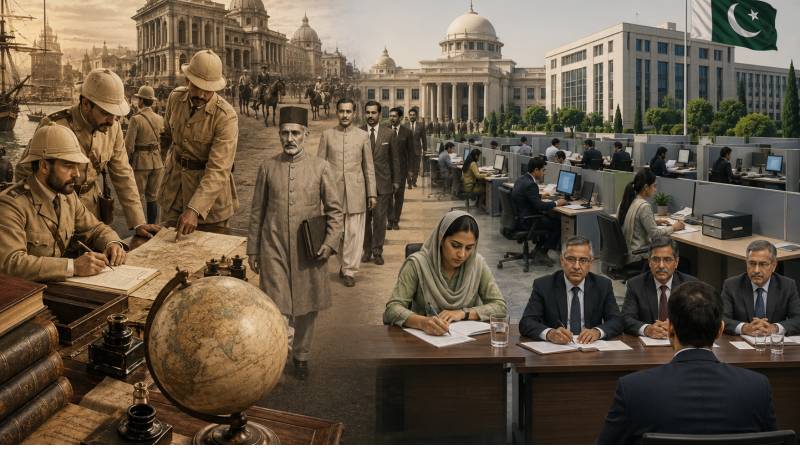
In order to remove the colonial influence within the Civil Services of Pakistan, it is crucial to understand the historical evolution of this very important pillar of modern state system. But its birth was due to the fact that large empires would need loyal Civil Servants to help strengthen their rule over foreign and vast areas of lands.
Laws pertaining to Civil Services primarily deal with the terms and conditions of service. It not only seeks to establish a balance between the interest of the government and Civil Servants, but also protects Civil Servants from the arbitrary actions of the government, ensuring efficient administration and good governance.
Before independence, the Civil Services of Indian Subcontinent was governed under the East India Company Act, 1833, in the nineteenth century. The natives had no place in the public service till 1833, but the Act of 1833, allowed natives to be admitted to higher Civil Services and it provided that no man shall, by reason of his religion, place of birth, descent, colour, be disqualified from holding any place, office or employment under the Company. Nineteenth-century reforms established the idea of a unified civil service, selected through open competition, which started in the Indian Civil Service in 1833, led by Thomas Macaulay.
In twentieth century, the Government of India Act, 1919, provided for the establishment of the Public Service Commission of five members based on the British model to conduct examination in India for recruitment to the All India Services. In 1921, in addition to the written examination, a viva-voce examination was also introduced.
Thereafter, the Government of India Act 1935, provided safeguards to ensure that the existing Civil Servants shall not suffer through the political changes more than is inevitable, and in part that future servants shall be recruited under conditions that will, as far as possible, maintain sound tradition. The 1935 Act further provided for the establishment of a Federal Public Service Commission for two or more provinces.
After independence, the Civil Services of Pakistan is now governed under the Constitution, the supreme law of the land, but there are laws enacted by parliament, rules, Bye-laws and judicial verdicts which have greatly contributed to the evolution of the Pakistani Civil Services.
In order to remove the colonial influence within the Civil Services of Pakistan, it is crucial to understand the historical evolution of this very important pillar of modern state system.
The issue of Civil Servants was also of significant importance during the rule of Mughal Empire. Mughal Emperor Akbar introduced the Mansabdari System, which was a system of 33 grades of the officials of the Mughal Empire, ranging from 10 to 5,000. It helped curtailed the revolts of the feudal lords and military generals against the emperor. According to history professor and former principal of Federal Government College Bahawalpur Mirza Asad Humayun, under this system, Emperor Akbar would transfer officials after two years so that they can neither create their monopoly, political influence nor become strong enough to be able to revolt and overthrow the emperor. He also gave the example of Caliph Hazrat Umar (RA) who was advised by Hazrat Abu Musa al-Ash’ari to transfer the officials after six months.
The Chinese imperial examination system were competitive examinations for recruiting officials, introduced during the Song dynasty (960–1279). Confucius was born in 551 BCE and is regarded as the ‘the First Teacher’ as his teachings have been used to educate and select people for the government and important roles. Candidates faced fierce competition in a series of exams dealing primarily with Confucian texts.
The “Taiping Rebellion,” with a death toll of twenty five million people, started by a disappointed literary student, who failed to pass his imperial examination, and afterwards became a religious fanatic, and believed himself to be the son of God, the younger brother of Jesus Christ, sent to reform China. Although the ruling Qing government eventually crushed the rebellion, the conflict undermined the authority and legitimacy of the Qing Empire, and the Qing Empire never recovered from the damage caused by the uprising. The Chinese Communist Party would later criticise and supress Confucianism, Christianity and western influence.
In the US, under “Spoils System,” the President would replace those officials who worked under previous President with his loyalists, but after President James A. Garfield was shot on 2nd July, 1881, the Civil Services were reformed and “Merit System” was introduced.
In Pakistan, Prime Minister Z. A. Bhutto introduced reforms in Civil Services in 1973, replacing the system of Class I, II, III and IV to a system of Basic Pay Scale from 1 to 22 Grades, and studying the historical evolution of Civil Services can help introduce more reforms in Pakistan, in order to make this pillar of state more democratic and remove the influence of colonialism.