

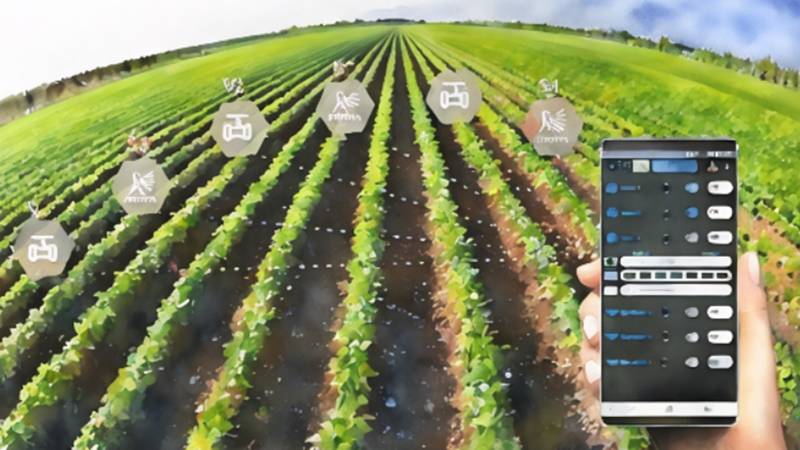
A silent revolution in the heart of Pakistan's vast farmland is underway. Amidst the traditional processes of sowing and harvesting, a new entrant on the scene is Artificial Intelligence (AI). Not in any corporate boardroom nor in tech hubs but quietly transforming how Pakistani farmers are getting their crops grown, resource managed, and food security assured.
The economy of Pakistan is agriculture-based; however, there are several challenges it is currently facing. These include erratic climatic conditions, poor water supply, low crop yields and pest infestations. The present old-style farming practices have failed to address problems that are escalating each day. That is where AI comes in to offer precision, efficiency and data-driven solutions.
Startups and tech initiatives in Pakistan are shifting their focus toward the application of AI in agriculture. For example, BaKhabar Kissan is an online platform that uses AI to give real-time weather updates, pest warnings and crop advisories to farmers through their mobile phones. With 6 million farmers already utilising its services, this can be an example of how AI fills up the information deficit in rural areas
Precision Agriculture: Data as the New Fertiliser
One of the highly transformative applications is precision agriculture. Combining satellite imaging, drones and IoT sensors, AI-based algorithms analyse gigabytes of information to provide such customised recommendations; a farmer is able to compute the exact dose of water, fertiliser or even pesticide required at a specific block of his cultivated area.
Farming in Rahim Yar Khan, for example, has seen a reduction of up to 30% in water usage from the AI-aided drip irrigation systems
In Punjab, which is a province whose agricultural economy is dominated by wheat and rice, AgriSmart is using drones fitted with multispectral cameras to monitor crop health. The data gathered by the drones on chlorophyll levels, soil moisture, and plant stress are analysed by AI systems for actionable insights that can be delivered to farmers who are fighting high input cost.
Tackling Water Scarcity with AI
One of the pressing issues in Pakistan has been water scarcity. PanAgro Technologies is now developing an AI-driven irrigation system that makes predictions on the requirement of water for irrigation through weather forecasts, soil data, and type of crops, ensuring the effective use of each drop of water. Such development is vital in arid regions like Sindh and Balochistan.
Farming in Rahim Yar Khan, for example, has seen a reduction of up to 30% in water usage from the AI-aided drip irrigation systems, and the far-reaching consequences of this kind of innovation would be out of the ordinary, especially to a country heavily reliant on Indus River to produce its crop.".
Fighting Pests with Algorithms
Mass crop destruction due to pest infestations has always proved a nightmare for Pakistan's farmers. AI presents an opportunity to act in advance. Apps such as Plantix, now becoming popular in Pakistan, would allow farmers to upload photos of diseased plants. The app's AI analyses the image, diagnoses the problem, and offers on-spot remedies.
Also, for example, AI-powered traps using computer vision are currently being tested so that the same farmers can identify pests early and therefore take targeted action before infestations spread. These systems are already being tested in Sindh's cotton fields, where pest outbreaks remain a perennial problem.
Challenges to Adoption
The potential of AI for agricultural use is colossal, but that does not stop the barriers ahead. Many Pakistani farmers are small-scale, either financially or otherwise, with relatively low digital literacy. The costs of using these AI-enabled tools are too expensive for smallholders, and the absence of internet facilities in rural settings is a considerable barrier.
However, there are some organisations trying to bridge these gaps. For instance, Digital Dera is an area-specific community-based tech hub: that provides IT training to farmers in rural areas. Subsidies and micro-financing models are also in the process of being absorbed as ways to make this technology accessible to the marginalised farming community.
Integrating AI in agriculture is not only about the progress of technology; it is a matter of saving a sector that feeds millions and, therefore, a pillar sustaining the economy of Pakistan. Through these means- tackling systemic inefficiencies, climate risk mitigation, and farmer empowerment with data-driven insights- AI could really transform farming in Pakistan.
It is at the level of scale where the solution would really prove true, by reaching the millions of small-scale farmers that constitute the backbones of Pakistan's agricultural sector. If implemented wisely, this combination of AI and agriculture might become a turning point not only for the industry but also for the country's future.
The question now is: will Pakistan seize this opportunity, or let it slip through its fingers like grains of sand?