

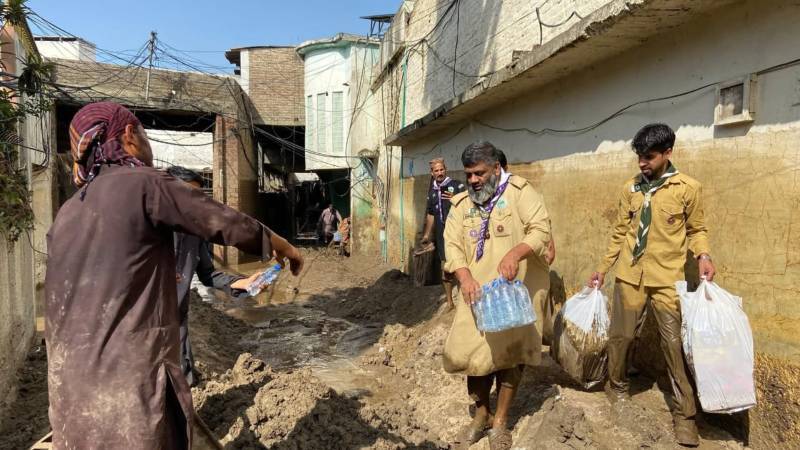
Since the end of June, nearly seven million people have been affected across Pakistan, with close to three million evacuated from their homes. Around 150,000 people are currently sheltering in 1,580 evacuation centres set up by the authorities, leaving families in uncertainty as the monsoon waters begin to recede.
“We and our humanitarian partners continue to support the Government-led response,” said Stéphane Dujarric, Spokesperson for the Secretary-General of the United Nations. “To date, UNICEF has provided more than two metric tonnes of essential medicine to the north, in the capital of Punjab province, Lahore, and over two metric tonnes to the south, in the city of Multan.
“These medicines are being distributed to local health clinics. UNICEF has also provided nutrition supplies and safe drinking water, relocated school materials, and established temporary learning centres. The World Food Programme (WFP), for its part, is delivering food, nutrition services, cash assistance and logistics support across Punjab and Sindh.”
“As people begin to return to their homes, additional funding is needed to provide assistance and rehabilitate basic infrastructure. We have already released $5 million from the Central Emergency Response Fund, with an additional $1.5 million channelled to local NGOs from the Asia-Pacific Humanitarian Fund,” Dujarric added.
The floods, triggered by heavy monsoon rains and overflowing dams in India since August, have left a trail of destruction across Punjab. Fields that once flourished with wheat and other crops are now barren mud, and homes stand cracked or destroyed.
In Qatalpur village, 45-year-old Mohammad Mohsin returned with his family from a relief camp to find his house damaged. “We left everything behind when the water came. Now there is nothing to come back to,” he said, his voice breaking as he pointed to the cracked walls. Stories like his are repeated across the flood-hit province, where displaced families face the harsh reality of ruined homes and lost livelihoods.
Authorities have described August as the province’s worst flooding on record. According to Punjab Relief Commissioner Nabil Javed, the deluge damaged 2.5 million acres of farmland and claimed 118 lives. Most of the 2.6 million people displaced have returned home, yet the scale of loss is only now becoming clear. Surveys are planned to assess the full extent of damage to crops, homes and infrastructure.
For many families, the floods have erased not just property but the security of generations. Farmers speak of lost harvests and drowned livestock, leaving them with the daunting task of rebuilding from scratch.
The humanitarian response has been swift but challenging. UNICEF has delivered medicines, safe drinking water and temporary learning centres for children, while the World Food Programme (WFP) has provided food, nutrition support, cash assistance and logistics aid across Punjab and Sindh. Yet as communities begin to rebuild, the need for continued funding and infrastructure repair grows urgent.
Experts warn that such extreme flooding is part of a global trend. “Water-related hazards continue to cause major devastation this year,” said Celeste Saulo, WMO Secretary-General. “The latest examples are the devastating monsoon flooding in Pakistan, floods in South Sudan and the deadly flash floods on the Indonesian island of Bali. And unfortunately, we see no end to this trend.”
Saulo explained that warmer air temperatures allow the atmosphere to hold more water, leading to heavier rainfall and more destructive floods. Her warning comes alongside a new WMO report showing that 2024 was the hottest year in 175 years of observation, with global surface temperatures reaching 1.55 °C above the pre-industrial baseline.
For Pakistan, the combination of extreme heat and intense monsoon rains underscores its vulnerability. The United Nations Office for the Coordination of Humanitarian Affairs (OCHA) has repeatedly flagged the country’s exposure to climate extremes, from heatwaves to catastrophic flooding, highlighting the urgent need for humanitarian support.
In Punjab’s flood-hit villages, these global climate statistics are a lived reality. Families like Mohammad Mohsin’s are navigating a slow, uncertain path towards recovery, dependent on relief supplies and aid while confronting the devastating impacts of a warming world. The floods are not just natural disasters; they are a stark reminder of the human cost of climate change and the critical role of international and local humanitarian response in saving lives.