

The electric supply industry (ESI) formally started when Thomas Edison established two thermal power plants around 1882, first in London and then in New York. Early plants, including those of Edison’s, were designed to produce and supply only low-voltage direct current (DC) power to consumers. These plants were located closer to consumers to serve them directly and were isolated from each other.
Power in electric circuits is the product of current and voltage. Any increase or decrease in current or voltage results in a proportionate decrease or increase in the other. Losses in the system, however, are not linear. Doubling the current leads to quadrupling of losses, and reducing the current by half reduces these to a quarter.
In the DC systems, current runs continually in one direction, like in batteries and fuel cells (Figure 1). These systems, however, had one serious constraint: once designed and deployed, the voltage in these systems was difficult to change.
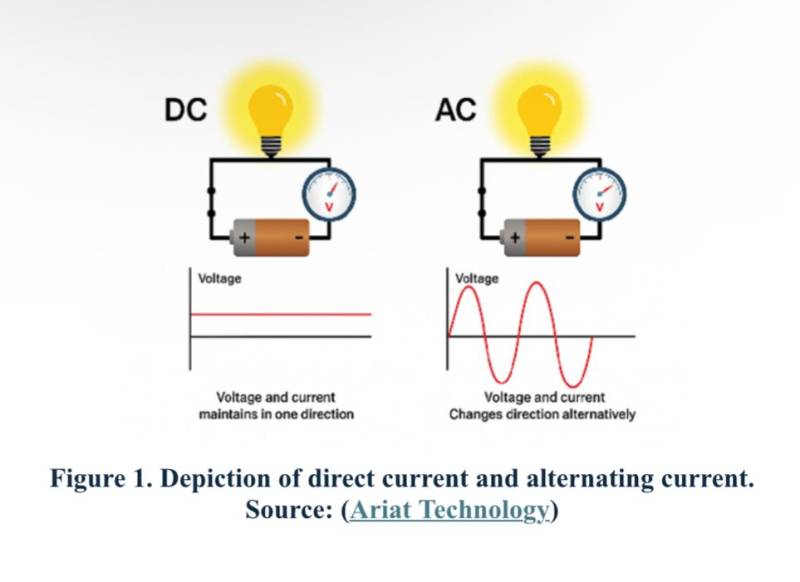
Whether the above constraint drove them is hard to tell, but somewhat concurrently with Edison’s inception of his DC system, another group, led by George Westinghouse, introduced alternating current (AC) and successfully demonstrated, using transformers, the ability to raise or lower voltage as per the need.
The two groups quickly got entangled in a fierce battle during the first decade of the nascent ESI, which came to be known as “The War of the Currents”. Edison’s group fought tooth and nail against the other group, often resorting to below-the-belt tactics, but two events turned the battle in favour of the AC system.
The first was the Chicago World’s Fair that took place in 1893, at the height of the War of the Currents. General Electric of Edison bid to electrify the fair for half a million dollars, but lost to Westinghouse, which bid to do it for only 70% of that of Edison, using the AC system.
The second, and decisive, blow came when the Niagara Falls Power Company awarded the contract to generate power from Niagara Falls to Westinghouse. In November 1896, Buffalo, New York, was lit by AC power generated from Niagara Falls. By this time, General Electric had also jumped onto the AC train. That practically ended the first War of the Currents. By 1907, most DC systems in the US were either scrapped or switched to AC mode.
Direct current supply systems almost vanished except for a few applications in which their economy and performance were superior to those of the AC systems. For instance, high-voltage direct current (HVDC) is more feasible for transmitting large chunks of power over extended distances. We also deploy them for underground supplies, which are difficult to serve via AC systems. HVDC is also used to connect two AC systems operating at different frequencies, like 50 Hz and 60 Hz.
Every time we convert AC to DC or from DC to AC, we lose a significant portion of the electricity we could save
The first hundred years of the ESI saw small systems merge and grow into a gigantic business enterprise, both in scope and size. The industry saw power plant sizes doubling every 6 or 7 years. Between 1955 and 1970, the plant size jumped from 200 MW to 1,400 MW, a seven-fold increase.
The previously isolated systems were also interlinked into a complex web of high and extra-high-voltage transmission lines to serve consumers located far away from generators. The electricity prices also followed a similar trajectory, either declining or remaining stable in real terms. The ESI was a marvel of engineering excellence and was dubbed “the largest and most complex machine in the world”.
The major factors contributing to this boom included the “economies of scale” in generation, wide distances between major load centres and good generation sites (especially hydro), and the technical and economic benefits that interconnecting isolated systems held by way of reserve sharing, energy trading, and reliability improvement.
Like all good things, the “bigger was better and cheaper” boom of the ESI ended in the 1970s when the OPEC oil embargo triggered a sharp rise in the industry’s costs of production, which regulators were reluctant to pass on to consumers. Growing environmental concerns with mega generation and transmission projects made these difficult to finance.
A few additional events in the past few decades have not only halted ESI’s growth on the traditional path but have forced it to revert to its original small, granular, and distributed structure. There seems to be a resurgence of interest in the DC system of electricity generation and delivery.
Notwithstanding the efforts of the ESI, regulators, and governments globally to make a transition to sustainable electric supplies by phasing out ESI’s reliance on fossil fuels, the mode and the infrastructure being used are the same AC systems. There is a compelling need to rethink this century-old paradigm that has served society quite well for over a century, but perhaps has run its course.
The five notable factors that justify this rethinking include: (a) reduction in the costs of renewables, particularly distributed solar photovoltaic; (b) popularity of electric vehicles and the demand for affordable battery storage packs; (c) availability of inexpensive information and telecommunications technologies; and (d) society’s quest for sustainable energy supplies.
The technical superiority of renewable technologies had never been in dispute, nor their negligible operating costs; the main hurdle to their uptake was higher upfront costs. That obstacle also evaporated in the last decade as their costs plummeted.
According to a recent report from the International Renewable Energy Agency (IRENA), “24/7 Renewables Outcompete Fossil Fuels on Costs”, between 2010 and 2024, total installed costs of solar photovoltaic declined by 87%. Battery storage costs fell even more sharply, declining by 93%. IRENA expects these costs to fall even further, by 30% in 2025, and this trend to continue in the next 5 to 10 years.
Though the primary energy feeds to a power plant may be different, the basic concept and technology employed beyond the prime mover is the same—electromagnetic induction. In sharp contrast, solar photovoltaic systems are based on an entirely different phenomenon—direct conversion of solar radiation into electricity. It offers a unique and unprecedented way of serving electricity demand at the source.
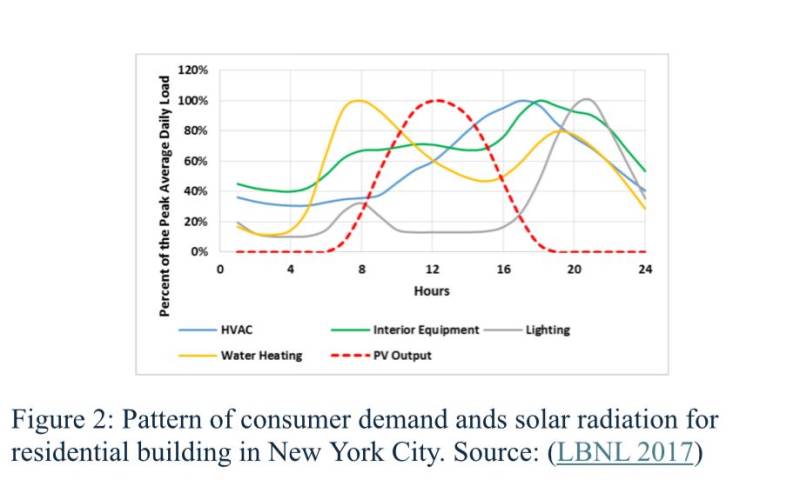
A study conducted by Lawrence Berkeley National Laboratory (LBNL) for the California Energy Commission (CEC) a decade ago had revealed that residential consumers’ demand correlated positively with the diurnal pattern of solar radiation (Figure 2).
Our demand for electricity services has also been changing rapidly. Computers, LED lighting, telecommunication devices, artificial intelligence, data centres, storage battery fixtures, digitalisation, private or public electric vehicle charging facilities, mobile charging, electronic media, and the internet are just a few examples of the services which are already being powered by DC supplies by first converting AC to DC.
Every time we convert AC to DC or from DC to AC, we lose a significant portion of the electricity we could save. There is no wisdom in continuing to supply them through the AC-based distribution grid when we can easily power them with DC directly.
The War of the Currents may not have been over yet, and a second round of it may be brewing up quietly. Whether it gains further traction and grows into a full-scale second round of War of the Currents is anybody’s guess. We should keep our fingers crossed, meanwhile. George Bernard Shaw has a golden piece of advice: “Some men see things as they are and ask why? I dare to dream of things that never were and ask why not?”