

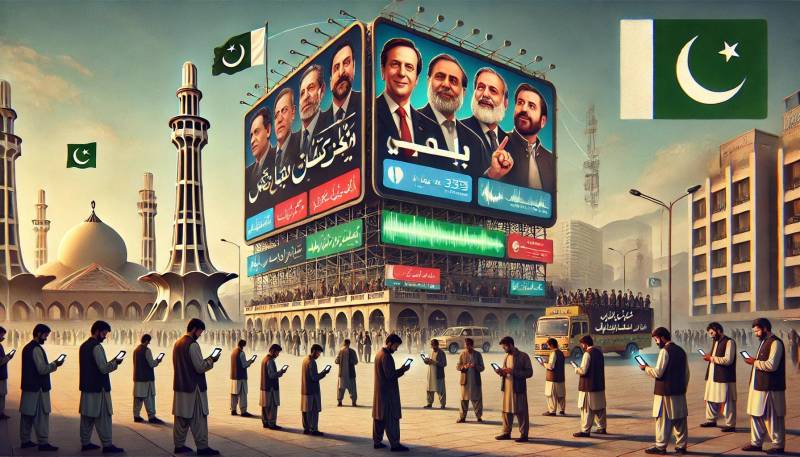
The Lahore High Court’s recent scrutiny of the Punjab government’s advertising expenditures has reignited a familiar debate in Pakistan: where does the line between public service messaging and political branding blur? State-funded advertisements are meant to inform citizens about policies, initiatives, and development projects, yet they often seem more focused on the faces behind the projects rather than the projects themselves. When government advertisements resemble campaign billboards, the question arises—are they truly serving the public, or are they subtly serving a political agenda?
The issue is not without precedent. In 2018, the Supreme Court banned the use of politicians’ images in government-sponsored advertisements, recognising the potential for such campaigns to be misused for self-promotion. That same year, it was revealed that the federal government had spent Rs890 million on media advertisements in just three months, with substantial allocations to print and electronic media. The court also directed Shehbaz Sharif to return Rs5.5 million spent on self-promotional government ads. Earlier, in 2013, the Supreme Court had ruled that every rupee spent from the public exchequer must be audited, striking down a provision that had shielded Secret Service Funds from independent scrutiny.
These funds, spread across 27 ministries, amounted to over Rs3.57 billion in the 2012-13 fiscal year. Between 2013 and 2022, the federal government spent Rs8.7 billion on television advertisements, averaging nearly Rs1 billion per year. However, spending patterns shifted dramatically based on the ruling party. From 2013 to 2018, under the PML-N government, advertising expenditures totaled Rs6 billion—an average of Rs1.2 billion per year. When the PTI government took office in 2018, it cut annual spending to Rs700 million, totaling Rs2.8 billion over four years—a 41% decrease. This trend highlights how government advertising is not just a means of public communication but a political tool, wielded to maintain influence and control. Public funds, meant for governance, often end up funding narratives.
A government confident in its performance does not need to flood the media with self-praise—its work should be evident in the quality of life of its people, not just in promotional campaigns
The sheer volume of state-sponsored publicity raises concerns about financial priorities. In a country grappling with economic challenges, where public services remain underfunded and inflation continues to burden citizens, excessive spending on political image-building is not just wasteful—it is a disservice to taxpayers.
Over the years, successive governments have used public funds to dominate the media space, but the scale and strategy of such advertising have evolved. Today, entire pages of newspapers are bought, prime-time television slots are filled, and digital platforms are saturated with state-sponsored content. This raises an important question: when public money is used to shape narratives that favor those in power, does it leave enough space for independent journalism and diverse perspectives? Media institutions, like any other businesses, rely on advertising revenues, and government advertisements have long played a role in sustaining them. However, when these funds are used selectively or as leverage, it creates an environment where financial pressures can influence editorial decisions. While independent journalism persists, the challenge remains: when state funding is used as a tool of influence rather than a neutral public communication resource, it distorts the balance of public discourse.
Beyond its effect on journalism, this unchecked political advertising not only diverts resources from essential public services but also allows governments to amplify their narratives while overshadowing critical issues. When pages of newspapers and hours of airtime are dedicated to state-funded publicity, what remains for reporting on governance failures, economic struggles, or public grievances? A government confident in its performance does not need to flood the media with self-praise—its work should be evident in the quality of life of its people, not just in promotional campaigns.
This issue transcends party lines. Political advertising at the taxpayer’s expense has long been a tool of those in power, regardless of affiliation. The absence of a clear, regulated framework for government advertising has allowed these practices to persist unchecked. If public funds are truly meant for public service messaging, their allocation must be transparent, justified, and free from political influence. A formal policy is needed to ensure government ads prioritise genuine public awareness over political optics. Without such accountability, the cycle will continue—each new government will condemn its predecessor’s excesses, only to engage in the same practice once in power.
The Lahore High Court’s intervention is an opportunity to introduce accountability into government communication. A fair policy—one that prioritises governance over optics—would not only protect public funds but also strengthen media independence. Advertisements should serve the public interest, promoting healthcare, education, disaster management, and public safety, rather than political slogans.
Governments that deliver don’t need billboards. Their legacy is written in progress, not in paid promotions.