

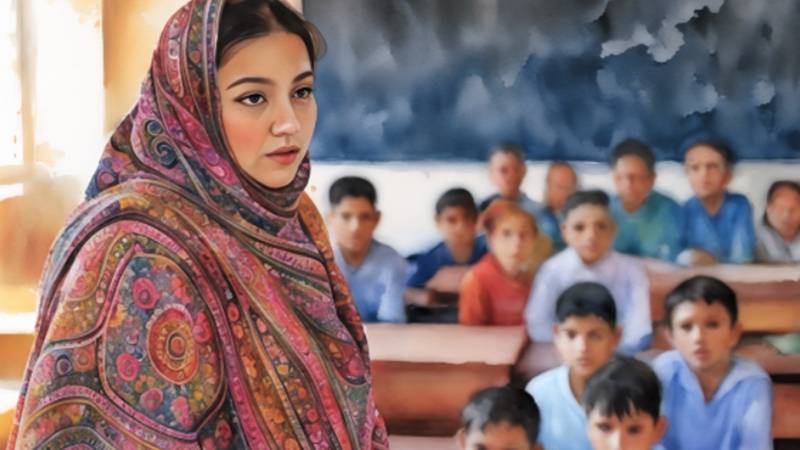
Dera Bugti is one of the most resource-rich districts of Pakistan, and its political figures have consistently held top government positions. Unfortunately, the district remains educationally marginalised, shaped by tribal dynamics and political instability. Historically, its natural gas reserves—discovered in 1952—fueled economic interest but failed to translate into social development.
Tribal conflicts, notably the 2006 military operation following Nawab Akbar Bugti’s death, exacerbated displacement and insecurity, further sidelining education.
Political influence without educational progress
Individuals from Dera Bugti have held significant positions in Pakistan's government. Notably, Nawab Akbar Khan Bugti, a prominent figure from the region, served as Chief Minister and Governor of Balochistan. His legacy continues through his family members, who have occupied important roles. Provincial Education Minister Nawab Saleem Bugti (son of Nawab Akbar Khan Bugti), his grandsons Shahzain Bugti (former Federal Minister), Nawabzada Ghoram Bugti (former Provincial Minister), and Mir Sarfraz Ahmed Bugti (former Interior Minister of Balochistan, Senator, and Federal Interior Minister for nine months—now Chief Minister of Balochistan) are key examples. Additionally, Tariq Masoori Bugti serves as President of the Pakistan Hockey Federation and a Member of the National Assembly, while Main Khan Bugti holds the position of Secretary of Petroleum and Energy.
Despite these influential positions, education remains neglected in Dera Bugti. Traditional norms, resistance to modern systems, weak governance, and corruption have perpetuated low literacy rates, particularly for girls, with female literacy stagnating at a mere 4%—among the lowest in Pakistan.
The education crisis perpetuates dire socio-economic conditions. Tribal conflicts claim over 50 lives annually, while poverty and unemployment dominate daily life
The district’s sole degree college operates with only three permanent and four temporary faculty members, far below the required minimum of 21. The college building, constructed in the 1980s, is near collapse. Educational infrastructure is in shambles, with buildings damaged during the military operation still unrepaired. Teacher vacancies remain unfilled. Of over 300 primary schools, only 20 are functional, mostly located near urban areas. Approximately 20,000 school-going children are out of school, and the dropout rate exceeds 85%, reflecting severe institutional neglect.
Limited and ineffective interventions
Gas companies like OGDCL contribute minimally through CSR initiatives, providing shoes, bags, and small cash stipends (5,000–10,000 PKR) for girls, alongside limited school supplies annually. The military and Frontier Corps Balochistan (FC) have established high schools in each tehsil (serving 500 students) and colleges in Dera Bugti and Sui. The Military College Sui, established in 2011, has produced over 50 Bugti officers but enrolls only 15 local students yearly. NGOs and private schools remain scarce due to security threats and cultural resistance.
The education crisis perpetuates dire socio-economic conditions. Tribal conflicts claim over 50 lives annually, while poverty and unemployment dominate daily life. Gender discrimination and honor killings persist, reinforced by low awareness and entrenched norms. Health outcomes are catastrophic, with 37 maternal deaths recorded in 14 months and 5,000 women suffering from anemia.
The lack of qualified local teachers, inadequate facilities, and government neglect cement the cycle of deprivation. Without addressing these structural issues, Dera Bugti’s potential remains stifled by its literacy crisis, perpetuating a legacy of conflict and inequality.
Why is education lacking?
There is no priority given to education. Awareness could challenge tribal norms and hierarchies—something tribal chiefs and gas companies have failed to achieve. Educated individuals become politically aware and demand their rights, posing a threat to the interests of gas companies and the status quo.
The rise of madrassas instead of formal schools is a concerning trend. Minority groups, including Hindus and Sikhs, face additional challenges. To address these issues, a comprehensive approach is necessary, focusing on:
- Increasing investment in education infrastructure.
- Recruiting qualified local teachers.
- Promoting girls' education.
- Addressing tribal conflicts and fostering community trust.
- Encouraging private sector participation.
By working together, we can break the cycle of deprivation and unlock Dera Bugti’s potential.