

“Government is instituted for the common good; for the protection, safety, prosperity and happiness of the people; and not for the profit, honour, or private interest of any one man, family, or class of men.” — John Adams.
For the ordinary citizen, access to public institutions such as the President/Prime Minister’s House, Parliament, Supreme Court, Foreign Office and even the federal and provincial secretariats is quite a cumbersome business. This is understandable because if everyone could walk in freely, there would be utter chaos, with officials’ security also at stake.
A news report in 2010 mentions how a veiled female managed to get inside Parliament during an ongoing session, finding a seat next to the late female member Mehnaz Rafi, which created quite an uproar at this intrusion.
Similarly, when governments organise functions, the attendees are those who have been issued formal invitations that are checked as they enter. This prevents the possibility of unauthorised persons from joining. Again, a very apt measure to ward off the chances of an undesirable incident and to ensure the safety of guests.
In Pakistan, although there are no set laid-down procedures for inviting guests to high-level meetings, certain SOPs are required to be observed depending upon the office to be visited. These include a formal invitation, security clearance and a conventional check-in process that at times calls for the submission of personal phones and even handbags. Any document that needs to be carried for the meeting is thoroughly checked before being returned to the guest.
Security staff members are properly briefed about the guests, and a reception committee is formed to extend full comfort and hospitality to the guests, who are supposed to verify their identity and have their names registered. Even at the time of departure, in many cases, they are made to sign themselves out in order to ensure their evacuation from the venue. Guests are supposed to be punctual, dressed in proper attire and display good behaviour during their stay.
People of dubious character and connections conveniently make their way into the corridors of power, while the helpless citizens of this country struggle to be heard for their genuine grievances
All these actions are meant to manage things smoothly without causing unnecessary furore. They are also important to check the entrance of anyone who is either uninvited, does not have permission, intends to create some commotion, or may be a potential terrorist. A few precautionary steps can go a long way in avoiding disastrous incidents, and all this does make a lot of sense.
So, as far as delegation members, invitees, attendants, etc. are concerned, their credentials need to be meticulously verified by officials and intelligence agencies. Special training is meted out for this purpose to eliminate the probability of mistakes. Therefore, whenever there is a failure, it would imply serious lapses in procedure, which in turn would indicate lack of training, incompetence, irresponsibility or mere callousness on the part of the concerned officials, calling for stern accountability.
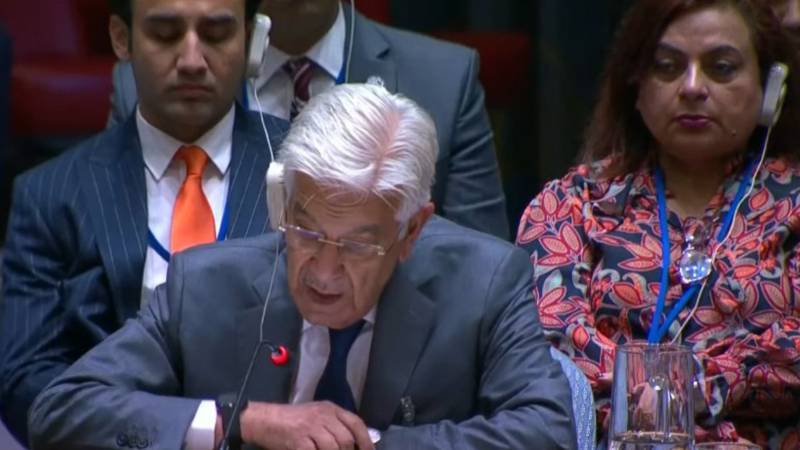
A news item dated 27 September 2025 mentions that Defence Minister Khawaja Asif posted a message on X asking the Foreign Office how a woman who was never part of the team was permitted to sit right behind him while he was addressing the Security Council at the United Nations (UN) on 25 September 2025.
Any government event of an international nature is mostly handled by the Foreign Office, but amazingly, its statement emphatically claims that Ms Shama Junejo (the lady in question) was neither an official part of the Pakistani delegation nor was her seating approved by the Deputy Prime Minister and Foreign Minister, Muhammad Ishaq Dar. In other words, the Foreign Ministry was totally ignorant about the entire matter.
Messages on X from former federal ministers Ms Shireen Mazari and Fawad Chaudhry imply that the Foreign Office was blatantly lying about not granting permission to Ms Junejo to become part of the delegation, as the Pakistan Mission to the UN based in New York City receives a list of all members who are then provided with necessary official identification for entering the UN building. They demanded an honest response from the government.
Now the question is, what were their reservations about this particular woman, and why were government spokespersons evasive in their replies about her? The answer lies in the fact that, apparently, as gleaned from her various social media postings, Ms Junejo is a pro-Israel advocate voicing regard for Israeli President Benjamin Netanyahu.
Considering the long-standing position of Pakistan with respect to Israel, the presence of Ms Junejo at a sensitive event not only reflects poorly on the government’s performance but is also a source of embarrassment for the country.
It may be recalled that five years back, a TikToker by the name of Ms Hareem Shah had made headlines with her allegedly unauthorised entry into the Foreign Office, where she recorded a video in the ministry’s committee room. Tremendous hue and cry was raised by the then Opposition (now in power) and their supporters, accusing the then government of lapses and complacency in allowing her to take liberties with crucial government offices.
Now, when the present government is getting a dose of its own bitter medicine, its officials are disassociating themselves from any knowledge of Ms Junejo’s participation, expecting the nation to believe whatever fabricated story they are spinning.
Anyhow, irrespective of the acts of the present or former government, the fact remains that people of dubious character and connections conveniently make their way into the corridors of power, while the helpless citizens of this country struggle to be heard for their genuine grievances. Protestors are handled with ruthlessness, fired at with tear gas and real bullets, while the influential, with the help of ominous officials, manage to cross all boundaries.