

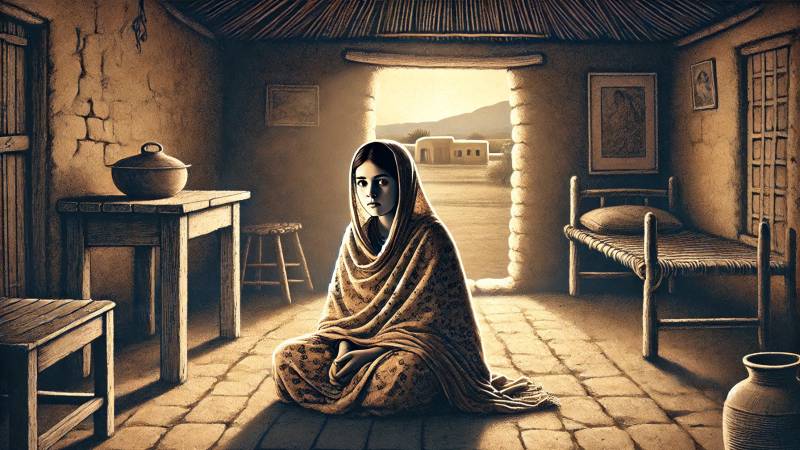
The narrow, winding streets of a remote village in Balochistan lead to a small mud-brick house, where 27-year-old Shabana sits quietly on a charpoy. Her frail hands clutch the edge of her dupatta as she narrates a story she has repeated many times, yet the pain in her voice remains fresh.
"For three days, I was in labour. There was no doctor, no hospital, only the village midwife, who kept saying the baby would come. But it never did."
Shabana’s prolonged labour resulted in an obstetric fistula—an injury that left her incontinent, ostracised, and hopeless. “I was leaking urine all the time. My clothes, my bedding—everything smelled bad. My husband left me, my in-laws sent me back to my parents. I wanted to die,” she says, eyes downcast.
Shabana is one of many women in Balochistan suffering from this preventable childbirth injury. Obstetric fistula, a hole that develops between the birth canal and the bladder or rectum due to prolonged, obstructed labour, is a condition largely unheard of in urban spaces but tragically common in rural Pakistan, where maternal healthcare is almost nonexistent.
Balochistan, Pakistan’s largest yet most underdeveloped province, has an alarming maternal mortality rate. According to the Pakistan Demographic and Health Survey (PDHS), Balochistan records 298 maternal deaths per 100,000 live births—one of the highest in South Asia. Many of these deaths and injuries occur due to a lack of access to emergency obstetric care.
"Fistula cases are difficult to document because women rarely come forward," says Dr Shershah Syed, a well-known gynaecologist and advocate for maternal health. "They are ashamed, they are abandoned, and they have no means to reach medical help."
He explains that in Balochistan, the combination of early marriages, poor nutrition, and lack of healthcare facilities creates a perfect storm for childbirth complications. Many young girls, married off before their bodies are ready for childbirth, experience prolonged labour, and with no access to caesarean sections, they develop fistulas.
The Long Road to Healing
For years, women like Shabana believed their condition was a curse or divine punishment. In many cases, families resort to faith healers, unaware that a simple surgery can fix the condition. This is where Karachi’s Koohi Goth Hospital steps in—a place that has changed countless lives.
Established by Dr Shershah Syed, Koohi Goth Hospital is Pakistan’s only specialised centre for fistula treatment, offering free surgeries and rehabilitation to affected women.
“When we receive patients from Balochistan, they are in terrible condition,” says Dr Naz, a surgeon at the hospital. “They are malnourished, weak, and psychologically broken. The first step is to reassure them that they are not alone and that this is a medical condition, not a curse.”
The hospital not only performs surgeries but also provides vocational training, ensuring that the women, once healed, can become financially independent. Many survivors stay back to assist new patients, offering them comfort and hope.
Despite the availability of treatment, many women never make it to hospitals like Koohi Goth. “There is a deep-rooted stigma attached to women’s reproductive health,” says Dr Syed. “Families hide their daughters, fearing shame. Husbands often abandon their wives, leaving them to fend for themselves.”
Samina, another survivor from a village near Turbat, was only 16 when she developed a fistula. “For two years, I didn’t step out of my house. My mother used to cry every day, trying different herbal remedies. When my uncle finally heard about a hospital in Karachi, he took me there secretly.”
After her surgery, Samina returned home, but her husband refused to accept her back. "He had already remarried," she says, her voice calm but firm. "But I have learned to stitch now. I make clothes and earn my own money. I don’t need him."
A Human Rights Crisis
Experts argue that fistula is not just a health issue; it is a human rights crisis. "The existence of fistula means that a healthcare system has failed women," says a representative from UNFPA Pakistan, which has been working on maternal health initiatives.
According to UNFPA, Pakistan sees an estimated 3,500 new cases of fistula every year, yet only a fraction of these women receive medical care. The situation in Balochistan is worse due to the lack of trained gynaecologists, midwives, and emergency obstetric units.
“The government needs to take this issue seriously,” says Dr Syed. “We need more maternity centres, trained birth attendants, and awareness campaigns. Women should not have to suffer like this in the 21st century.”
For Shabana, the journey from shame to recovery has been life-changing. After her surgery at Koohi Goth, she stayed at the hospital for a few months, learning basic tailoring skills. Now, back in her village, she dreams of opening a small sewing centre.
“When I came back, people still whispered about me. But I no longer care. I want to help other women like me, tell them that there is hope,” she says, a small smile appearing on her face.
In the silence of Balochistan’s deserts, where the voices of women are often unheard, survivors like Shabana and Samina are breaking barriers—one stitch, one story, one life at a time.