

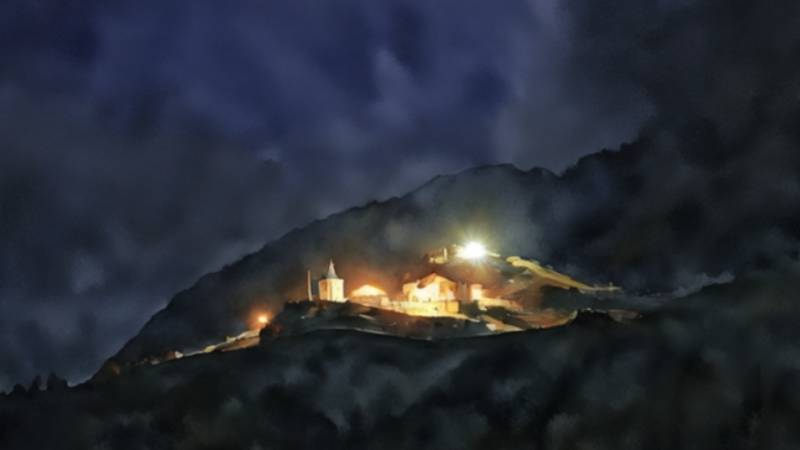
Gilgit-Baltistan (GB), the land of towering peaks and glacier-fed rivers, remains paradoxically trapped in darkness. Despite having abundant natural resources and being a key contributor to Pakistan’s water and tourism wealth, the region continues to suffer from an unrelenting electricity crisis.
In summer, residents face 6 to 8 hours of load shedding daily, while in winter, the outages stretch to 18 to 20 hours, a crisis once attributed only to freezing temperatures. This has crippled businesses, disrupted education, and deepened public frustration across Gilgit-Baltistan. Protests have become a common sight in Gilgit city, Skardu, and other districts, while political leadership remains unresponsive.
In a dimly lit classroom in Hunza, students huddle around a single solar lamp, straining their eyes to read. “We begged the authorities for a small generator, but they said there’s no budget,” says a teacher. Meanwhile, a nearby government rest house glows brightly, its diesel-powered backup humming through the night.
Data reveals a grim picture. Gilgit city has a total installed capacity of about 70 MW, yet in winter, only 33 MW is generated. Even in summer, when water flows are high, the system delivers just 59 MW. This shortfall is not merely seasonal, it is systemic.
GB has 148 power stations across 10 districts, yet suffers from chronic electricity scarcity. Why? Because most of these stations were constructed without proper feasibility studies, cost-benefit analysis, or understanding of seasonal variations. As a result, many powerhouses go idle in winter due to frozen streams, wasting public funds and failing to deliver power when it is needed most.
A new crisis is emerging: the exodus of skilled youth. Over the past five years, GB’s freelance and digital economy had begun to thrive, with young professionals working remotely for national and international clients. Private banks, IT startups, and e-commerce ventures were slowly taking root, offering alternatives to traditional government jobs. But erratic power has forced many to relocate to cities like Islamabad or Karachi. “I was earning $1,500 monthly as a graphic designer, but constant outages made deadlines impossible,” says Ali Raza, who recently moved to Rawalpindi. His story is not unique. With every skilled worker who leaves, local businesses shrink, unemployment rises, and markets destabilise. Projects stall, investors hesitate, and the cycle of deprivation deepens.
Data reveals a grim picture. Gilgit city has a total installed capacity of about 70 MW, yet in winter, only 33 MW is generated. Even in summer, when water flows are high, the system delivers just 59 MW
This isn't just an engineering problem, it is a governance failure. The Water and Power Department lacks effective project planning, grid integration, and seasonal backup mechanisms. The focus has remained on adding new projects without improving the performance of existing ones.
Even when an additional 10 MW was added to the Gilgit grid over the past 18 months, it was swallowed up by growing demand and poor distribution. No real load prioritisation exists, and no winter contingency plan is in place.
Contrast this with Nepal, where similarly rugged terrain hasn’t stopped innovative micro-hydro projects from bringing 24/7 electricity to remote villages. If Nepal can do it, why can’t GB?
Pakistan’s broader energy crisis is often blamed on Independent Power Producers (IPPs), pricing mechanisms, or distribution losses. But GB’s situation is different. Here, even where electricity can be produced cheaply through hydropower, it isn’t because there is no integrated policy, technical foresight, or political will.
The government must immediately move away from short-term fixes like expensive thermal generators and instead focus on sustainable, long-term solutions. Solar mini-grids and wind hybrids must be deployed in remote villages. Relying on frozen rivers in winter is no longer viable in a warming world.
Some communities are taking matters into their own hands. In Skardu, a youth-led cooperative has installed solar panels to power a co-working space for freelancers. “We’re losing talent daily. If the government won’t act, we will,” says organiser Fatima Khan. Such initiatives deserve policy support, tax breaks for solar adopters, subsidies for energy-efficient tech, and grants for micro-grids could stem the brain drain.
Every new station must be preceded by rigorous hydrological, environmental, and demand-based analysis. Equitable distribution must be ensured, with an end to VIP exemptions. Public hospitals, schools, and community centres should receive priority during outages. Youth-led startups and community-driven energy cooperatives should be supported through grants and training.
Most importantly, an independent audit of GB’s energy projects both planned and completed is essential to expose inefficiencies and mismanagement.
Gilgit-Baltistan is not asking for luxury, just electricity to live, work, and study. The people of this mountainous region, who already endure physical isolation and harsh winters, are now facing a blackout of opportunity.
It is time for both the federal and GB governments to move beyond paper plans and ribbon-cutting ceremonies. The power crisis in GB is not just about electricity; it’s about justice, dignity, and inclusion. The lights must come back on, not just in homes but in policy corridors too.