

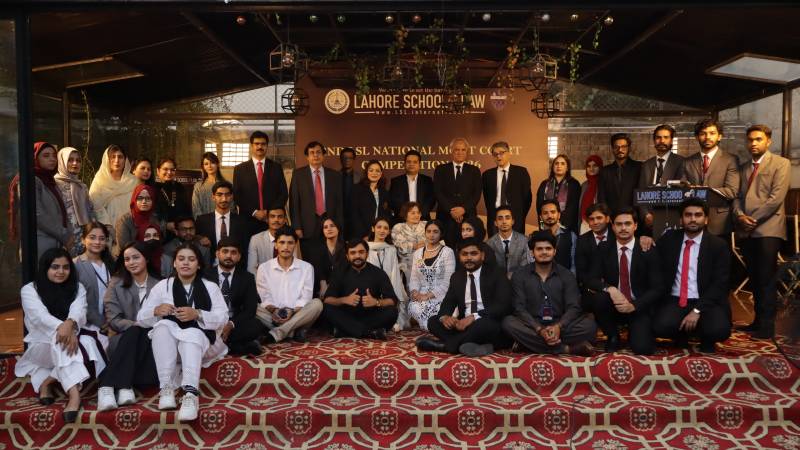
As violence within marriage is increasingly understood beyond physical harm, law students from 16 institutions debated, through a moot court held on April 14–15, emerging legal challenges relating to psychological control, digital surveillance, and economic restriction.
The competition, titled the National Moot Court Competition 2026 and organized by the Lahore School of Law, challenged participants to engage not only with the letter of the law but with its deeper purpose—the protection of human dignity in the context of domestic violence under contemporary legal frameworks. Participants demonstrated strong legal reasoning, depth of research, and a nuanced understanding of evolving domestic violence jurisprudence.
The competition was made possible through the support of distinguished partners and collaborators, including the Punjab Women Protection Authority, AGHS Law Firm, Women in Law Initiative Pakistan, Musawi, Pannu Law Associates, the Center for Law and Justice (CLJ), Qanoon Dan, and Legal Arch, each contributing to advancing legal awareness and strengthening discourse on domestic violence and women’s rights.
The event was adjudicated by a distinguished panel of legal professionals who brought expertise, rigor, and thoughtful engagement to each round. The panel included former Lahore High Court Justice Anwaar ul Haq Pannu as Chief Guest, along with Barrister Muhammad Ahmad Qayyum, Advocate Mehar Muhammad Iqbal, Assistant Professor Shaffaf Shahid Latif, Head of the Nadira Hassan Law Department at Kinnaird College University, and Mahnoor Kazmi, a Fulbright scholar with a Master’s in Mental Health Counseling from Boston College. The rounds were further presided over by members of the legal fraternity, including Humma Ijaz and Mr. Hassan Shah, whose incisive questioning and feedback enriched the experience for participants.
The competition featured multiple rounds, including preliminary rounds, quarter-finals, semi-finals, and a Grand Final, testing participants’ advocacy, research, and analytical skills at each stage.
From among 16 participating institutions, the Grand Final was contested between Quaid-e-Azam Law College and Government College University Lahore. Both institutions showcased outstanding legal talent and advocacy skills, with Quaid-e-Azam Law College ultimately emerging as the champion.
The competition concluded with an award ceremony graced by Justice (Rtd) Nasira Javed Iqbal, who presented shields to the distinguished adjudicators in recognition of their valuable contributions. Shields were also awarded to the student organizers and the heads of LSL’s management departments, acknowledging the dedication and effort behind the successful execution of the event.