

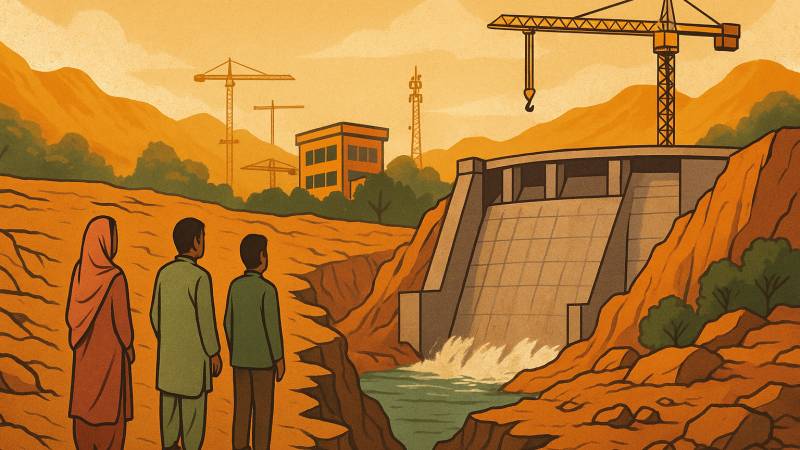
The April 11 meeting of the Central Development Working Party (CDWP), approved or forwarded a staggering Rs. 1.82 trillion worth of development projects. While some investments in education and IT were thrown in for balance, the overwhelming bulk of resources were geared toward big-ticket schemes, especially the revised Dasu Hydropower Project, now valued at Rs. 1.74 trillion—more than 95% of the entire portfolio discussed.
One would expect that a government genuinely aiming to lift the lower and middle-income segments would channel its limited fiscal space toward healthcare, employment schemes, SME support, or social protection. Instead, it has leaned into large-scale, long-gestation projects whose benefits, while significant in the long run, are unlikely to trickle down in any meaningful way soon.
Kicking the Can Down the Road
Once estimated at Rs. 479 billion, the Dasu hydropower project’s revised cost has ballooned to Rs. 1.74 trillion—an increase of more than 260%. Minister for Planning Ahsan Iqbal didn’t hold back in calling out WAPDA for mismanagement, unexplained design changes, and the "criminal negligence" of awarding a major road contract in foreign currency. He even ordered a third-party audit of the revised cost estimates. But for all the tough talk, the project was still referred to ECNEC for final approval.
By brushing aside its own concerns and going ahead with the project, the government seems more interested in propping up the optics of development than ensuring accountability. Meanwhile, the burden of reckless cost escalations will eventually be passed on to the public, either through tariffs or taxes.
In a country where every rupee counts, what we spend and where we spend it is the clearest expression of what we stand for
Leaving People Behind
In contrast, people-centric projects received a much smaller slice of the pie. A Rs. 28 billion education project for Balochistan was forwarded to ECNEC, backed by $100 million from the World Bank. Another Rs. 3.88 billion was approved to establish a sub-campus of Quaid-i-Azam University in Sheikhupura, contingent on land availability. Compare that to the Rs. 1.74 trillion being poured into Dasu, and the imbalance becomes glaring.
Even within the realm of IT, the government's “Prime Minister’s Initiative” for startups and training was capped at Rs. 5 billion. It’s commendable in intent, but negligible in size, just 0.29% of what’s being committed to a single hydropower project. This raises serious doubts about the government's claims of nurturing youth, innovation, and employment.
Likewise, the Sindh Flood Emergency Rehabilitation Project (Rs. 12.26 billion) and water supply projects for Quetta and the Kachhi Plains (worth Rs. 27 billion combined) appear as afterthoughts—modest, reactive measures rather than transformative solutions for vulnerable communities. The fact that these too were forwarded to ECNEC without full approval shows they haven’t been pushed through with the same urgency as headline-grabbing infrastructure.
Covering Up Fiscal Strain
The pivot to mega projects also masks the reality of a development budget that has shrunk in real terms. Between 2018 and 2022, Pakistan’s annual public sector development spending witnessed significant cuts. Even today, the fiscal space remains tight, with domestic revenues disproportionately coming from indirect taxes and regressive levies that squeeze the working class. According to official data, lower and middle-income groups bear the brunt of the tax burden, while sectors like agriculture and real estate, together making up nearly 39% of GDP, contribute just 1% to tax revenues.
So when the government signs off on trillion-rupee projects but drags its feet on expanding direct welfare spending or fixing revenue leakages, it sends a clear message: the façade of growth matters more than its distribution.
Turning a Blind Eye to Dissent
Adding insult to injury is the parallel erosion of civil liberties and political space. Over the past three years, dissent has been clamped down, opposition leaders have been sidelined, and public protests met with internet shutdowns and mass detentions. The state's growing appetite for control has come hand in hand with its developmental tunnel vision—where decisions are taken top-down and communities are expected to simply fall in line.
This centralisation of planning power, combined with poor oversight, as seen in the Dasu case, means the public has little say in what gets built, how much it costs, or who benefits.
Walking the Talk or Talking the Walk?
In a country where every rupee counts, what we spend and where we spend it is the clearest expression of what we stand for.
The government would do well to come clean about its priorities. If the goal is truly inclusive growth, then investments must move beyond concrete and steel. They must focus on the people—on jobs, on education, on local resilience. Until then, no amount of high-powered committee meetings or development jargon can mask the reality that the state is talking up inclusion while doubling down on exclusion.