

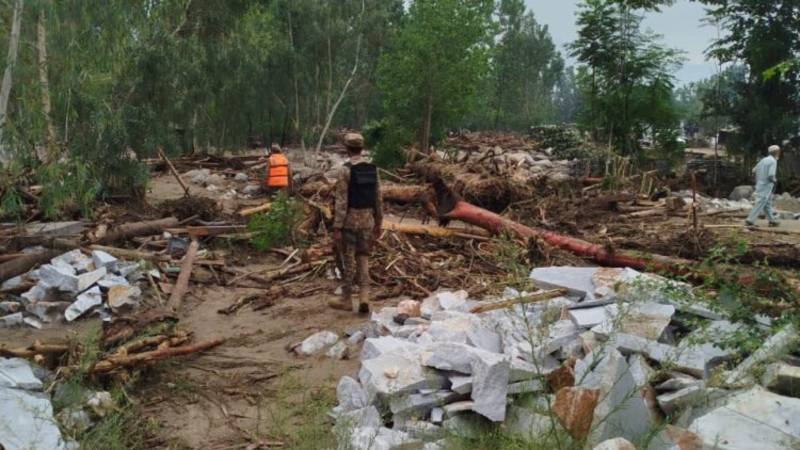
Months after flash floods and glacial lake outbursts tore through Pakistan’s north and north-west, the scars remain etched deep across Khyber-Pakhtunkhwa and Gilgit-Baltistan. What began in mid-August as sudden cloudbursts and glacier collapses has become a prolonged struggle for survival, one that continues quietly, long after the television cameras moved on.
Provincial authorities in KP confirmed over 400 deaths from the mid-August floods, while remote valleys in Gilgit-Baltistan saw destructive glacial outbursts that washed away water channels and cut off entire communities. In the weeks that followed, life in many parts of the mountains slowed to a fragile crawl, power lines down, roads buried under debris, and families trapped in isolation.
From the high valleys of Hunza, 27-year-old Salman Tanveer described life in Gulmit as “back to the Stone Age.” The mid-August glacier outburst, he said, brought everything to a standstill: “Power and internet were cut for ten days, roads were blocked, and students and tourists were stranded. People here are resilient; they share food, water, and shelter — but the stress is real. Many who rely on remote work are now facing financial and mental strain.”
Local reports confirm that the outburst damaged irrigation channels and blocked sections of the Karakoram Highway, leaving communities reliant on volunteer-led efforts and local solidarity networks. “Climate change is hitting us harder every year,” Salman said. “Without stronger government and international support, rebuilding feels impossible.”
In the low-lying plains of Swat and Buner, the Christian community was among those most affected. Simon Walter John, Project Coordinator at AGAPE Trust in Peshawar, said over a hundred Christian families lost homes and belongings. “While we thankfully recorded no casualties, families are displaced and struggling to meet basic needs,” he said. “The most urgent needs remain shelter kits, food, clean drinking water, and hygiene supplies.”
Local outlets confirm ongoing protests in Danyore, where residents demand accountability for delayed reconstruction and unsafe volunteer work conditions
AGAPE Trust and local church networks have been distributing emergency rations and bedding while planning medical outreach and temporary shelters efforts, still constrained by limited resources. Zeeshan from Jesus Evangelical Church reported that at least 25 homes in his area were filled with mud and debris. “People lost everything. We serve everyone regardless of faith, but the need is massive, and minorities often get overlooked in distributions,” he said.
In Mingora, resident Nouman Ali recounted days of exhausting recovery. “For the first few days, there was no government help. People were clearing debris from their own homes and streets. Only later did some NGOs arrive,” he said. Much of the early relief came from informal charity groups, friends pooling resources to buy drinking water and basic medicines.
Similarly, in Buner’s Bishnoi village, youth minister Jadaun Joseph reported damage to Christian homes and local infrastructure. “Most families are surviving through community networks, sharing shelter and food. Organised relief hasn’t reached everyone,” he said, calling for targeted aid to rebuild livelihoods and restore dignity to affected minorities.
In Gilgit’s Sultanabad, Aleena Abbas, a university student and volunteer, witnessed the destruction firsthand. “When the Sultanabad nala flooded, it destroyed water channels supplying drinking water. People switched to tanker water to survive,” she said. Volunteers trying to repair the Danyore–Sultanabad water channel lost their lives, seven men who stepped in to fill the state’s vacuum. “It’s not just seven deaths, it’s seven families left behind. This was the government’s responsibility, not the people’s.”
Local outlets confirm ongoing protests in Danyore, where residents demand accountability for delayed reconstruction and unsafe volunteer work conditions.
Environmental engineer and climate communicator Ameera argues that these disasters reveal a governance crisis as much as a climate one. “Floods are natural in Pakistan’s landscape,” she said, “but their destructiveness is amplified by human mismanagement, blocked nalas, construction on floodplains, weak drainage systems, and absence of local planning.”
Ameera warns that unless local communities are included in water and infrastructure planning, Pakistan will keep repeating the same cycle. “The country doesn’t need expensive technological fixes; it needs people-led solutions, basic maintenance, and democratic accountability,” she said. Her prescription: revive local governance, enforce floodplain regulations, restore drainage pathways, and strengthen frontline public health systems to prevent outbreaks of dengue, E. coli, and skin infections.
Despite devastation, local churches, mosques, and volunteer groups remain at the forefront of the response. Revd. Shahzad Gill of the Church of Pakistan called on civil society and faith groups to unite for relief and rebuilding: “These floods are part of a wider climate emergency. The church stands with all affected communities in prayer, in support, and in action.”
From Hunza’s cut-off valleys to Swat’s flooded plains, the human stories converge around one theme: resilience. People are rebuilding from the ground up, sharing what little they have. But as winter approaches, the same question echoes across the mountains: will the world remember us after the water recedes?