

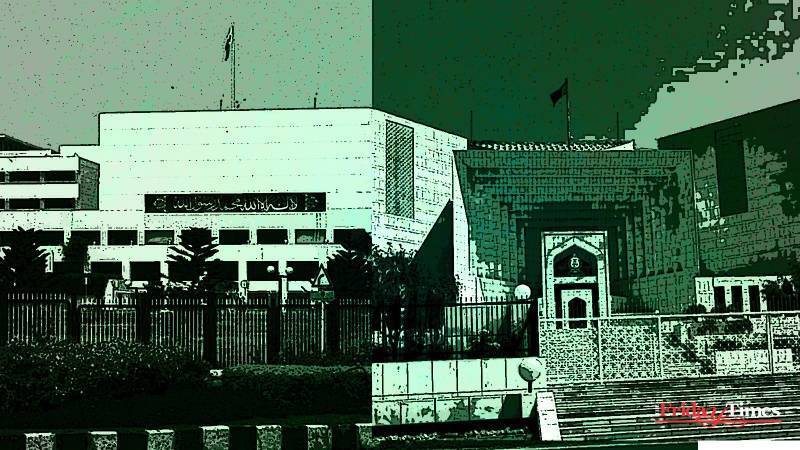
The fact that, for much of its existence, Pakistan’s superior courts have actively aided and abetted authoritarian rule is not something that happened on a whim or was an accidental occurrence: it is a pattern that has repeated itself for decades, shaping the country’s political trajectory just as much as any general or politician.
While the military is often (and rightly) criticised for direct interventions in politics, it has rarely acted alone – often helped by politicians who wanted to have a go at the civilian aspect of power that they were allowed to grab, and by an enabling judiciary that mostly legitimised and okayed just about every successful coup, every extension of extra-constitutional rule, and every erosion of democratic authority.
The roots of this phenomenon stretch back to the earliest years of Pakistan’s existence. And the most infamous example was delivered as far back as 1954, when the then Chief Justice of Pakistan, Muhammad Munir, validated the dissolution of Parliament by Governor General Ghulam Mohammad, on the grounds of the so-called Doctrine of Necessity. That judgment, which legitimised an autocratic and anti-democratic action, cast a very long shadow on Pakistan’s constitutional development and political evolution.
Ostensibly a legal justification for emergency action during extraordinary circumstances, the doctrine became a convenient fig leaf for successive military takeovers. Justice Munir’s reasoning was subjective and questionable, and relied on selectively interpreted maxims and dubious claims about state survival. It was arbitrary at best, and at worst, deliberately designed to permit unelected actors to usurp political power without consequence.
The Doctrine of Necessity was not a one-off aberration; it became the scaffolding upon which later courts erected more elaborate justifications for authoritarian rule. When General Zia-ul-Haq overthrew Zulfikar Ali Bhutto’s elected government in 1977, the Supreme Court once again obliged. It not only validated the coup but went a step further by granting General Zia the authority to amend the Constitution at will. A judiciary meant to be the guardian of constitutional supremacy instead authorised its dismantling, enabling a prolonged dictatorship that reshaped Pakistan politically, socially, and legally. The same Supreme Court also found Mr Bhutto, who had been deposed as Prime Minister, guilty of a trumped-up and concocted charge, for which one of Pakistan’s most popular politicians was hanged.
A judiciary that consistently acts as an instrument for disciplining civilian governments and shielding military authority cannot simultaneously claim to be a guardian of democracy
This pattern of legitimising the overthrow of civilian rule repeated itself in 1999, when General Pervez Musharraf deposed Prime Minister Nawaz Sharif. Once again, the Supreme Court validated the coup, invoking necessity and stability. Musharraf’s subsequent rule, which included sweeping constitutional changes, the erosion of civil liberties, forced political reconfigurations, and the suppression of dissent, all took place under the umbrella of judicial approval. At critical junctures, such as the question of his holding the dual office of President and Army Chief, his referendum, or his extension as Army Chief, the superior courts acted as enablers and facilitators.
This judicial inclination to scrutinise civilian governments more aggressively than military rulers is one of the most troubling aspects of Pakistan’s constitutional history. While courts tended to tread lightly around military rulers, they repeatedly went after elected prime ministers, often on shaky legal grounds. Every major civilian prime minister in the post-Zia period, Benazir Bhutto, Nawaz Sharif (multiple times), Yousuf Raza Gilani, and Raja Pervez Ashraf, has faced judicial action that resulted in either disqualification, removal from office, or the crippling of their political authority.
In these high-profile cases, convictions or disqualifications were often rooted in allegations of corruption. Yet, the standards of proof, the speed of proceedings, and the expansive interpretation of constitutional clauses, such as Article 62(1)(f), displayed an unmistakable asymmetry. Civilian leaders were held to impossible standards of “sadiq” and “ameen,” while military rulers who violated the Constitution itself faced no comparable judicial scrutiny. The consequence of that is evident before us in a seemingly endless cycle where civilian leadership is weak, fragmented, and vulnerable to removal, and not by voters but by judicial intervention.
There is another issue as well, and that is decidedly more contemporary. It relates to the superior courts engaging in judicial activism in recent years, with the Supreme Court using its power of suo motu, more often aggressively, not when autocrats are in power, but when elected governments attempt to assert control or challenge entrenched interests.
Perhaps the most striking recent symbol of this linkage between the judiciary and unelected institutions emerged from an extraordinary admission by a recent former Chief Justice of Pakistan. He publicly acknowledged meeting the then Director General of the Inter-Services Intelligence multiple times while serving as the country’s top judge. For a Chief Justice constitutionally independent and expected to be insulated from political interference, to meet regularly with the head of the intelligence apparatus would normally be a valid reason for him to resign from the post, or be removed by the government of the day.
Such actions reinforced the perception that certain favoured (“ladla,” as they came to be referred to) political actors or institutions receive favourable consideration from courts, whether in verdicts, scheduling of cases, disqualification proceedings, or the use of discretionary powers.
The idea of the “ladla”, a favoured political actor or institution, has become central to Pakistan’s political narrative in recent years. Court decisions, the timing of judgments, and the selection of cases have repeatedly appeared designed to benefit certain parties while disadvantaging others. Whether or not this perception is always fair, the damage to the judiciary’s credibility is undeniable. When the public begins to believe that decisions are guided not by law but by political engineering, the entire constitutional order is weakened.
A judiciary that consistently acts as an instrument for disciplining civilian governments and shielding military authority cannot simultaneously claim to be a guardian of democracy. Its selective assertiveness, bold and aggressive towards elected leaders, timid towards unelected ones, has significantly contributed to a weakening of democracy in Pakistan. By legitimising coups, facilitating political manipulation, and undermining elected institutions, the superior courts have helped entrench a system in which ultimate power lies outside the constitutional domain.
If Pakistan is to build a robust democratic order, the judiciary must confront its own past openly and critically. It must acknowledge the damage inflicted by doctrines like necessity, by partisan judicial activism, and by informal interactions with unelected power centres. Independence is not merely a matter of insulation from political pressure; it requires a consistent commitment to constitutionalism, even when doing so is inconvenient or risky.