

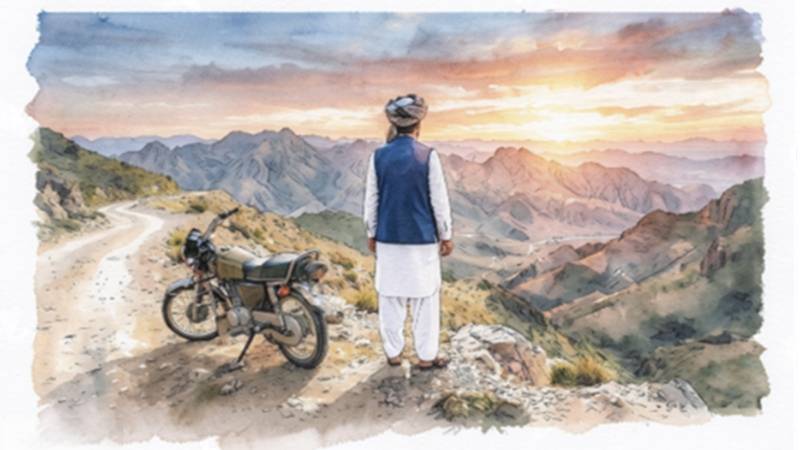
The land of Balochistan has been nurturing its culture, language, and traditions for centuries. Even today, the reflection of history is visible in the customs and attire of the tribes living in Balochistan. In the context of these living traditions, one of the garments worn is the Balochi turban, known as “Phag” or "Paag." In the Brahui language, it is called "Dastar." It is a vital part of Baloch cultural history and serves as a traditional identity for the Baloch nation. While generally perceived as a mere piece of cloth to cover the head, in Baloch society, it is viewed as a symbol of honour, dignity, and bravery. The Phag is a historical and permanent aspect of Baloch heritage and ethnic identity.
It is made from cotton cloth. Typically, 15 to 20 metres of fabric are required to create one, signifying its volume and importance, though the length may vary across different tribes. In today's market, its value ranges between 3,000 to 4,000 rupees.
In Baloch tribes, it is considered a hallmark of prestige. Generally, the turban symbolises respect; when a tribal elder passes away, the tribal leaders place the turban on the head of the successor after the funeral prayers ("Fateha Khwani"). The Balochi Phag is also worn by the groom on his wedding day. Indeed, Balochi cultural dress is considered incomplete without it.
The Phag identifies a person's tribal affiliation and their rank within the tribe (e.g., whether they are a commoner or a tribal Chief/Sardar). Each tribe ties the Phag in a distinct style, making their identity easily recognisable. Tribes that use it most frequently include the Bugti, Marri, Brahui, Buzdar, Qaisrani, Khetran, Mazari, and Mengal.
Historically, the system was based on 'collective ownership' and 'democratic selection' – the Sardar was a servant of the tribe, not a ruler
Generally, the poor or labouring class wears smaller turbans, while great Sardars and landlords wear large, refined ones. One reason for this is practicality; a labourer finds it difficult to manage a large turban while performing physical tasks, whereas Sardars wear larger ones as a mark of status.
The colour of the Phag can reflect a person's personal or economic circumstances. For example, a black turban signifies that a close relative has passed away, or a loved one has been lost in a tribal feud. The individual continues to wear the black turban until the death is avenged or a settlement is reached. Once peace is restored, they return to wearing white.
Beyond identity, the turban serves several practical purposes:
- Historically, it was used as a shield during battles to protect the head from blows.
- It serves as a rope or cloth when needed. Nomads used it to draw water from wells or to rescue humans and animals who had fallen into wells.
- During wars, it was used as a bandage for the wounded.
- If a tribesman was martyred, the army would divide the turban into three parts to shroud the body for burial.
- While crossing rivers, warriors would use the Phag to cover their bodies after removing their clothes. At night, it served as a blanket.
In the tribal history of Balochistan, "Dastar Bandi" (the ceremony of binding the turban) was not merely a ritual but a name for a social covenant and loyalty. However, recent scenes emerging from Dera Bugti contradict this ancient tradition.
A while ago, the 'Masoori' sub-clan of the Bugti tribe, along with other tribal officials, held a grand programme to perform the "Dastar Bandi" of the Chief Minister of Balochistan, Mir Sarfraz Bugti, portraying him as the chosen Chief of the tribe. Before this news could even fade from the headlines, another "Chief" emerged the very next month. Everyone is asking: What is happening? And who actually holds the authority to elect a tribal Chief?
The roots of this confusion run deep. Mir Sarfraz Bugti’s turban was placed by one grandson of Nawab Akbar Khan Bugti, while the "Dastar Bandi" of Din Muhammad Bugti was performed by another grandson. This contradiction reveals that the Phag is no longer a symbol of tribal unity, but has become a political tool in a war of interests.
To understand this, we must look at the evolution of the tribal system:
- Historically, the system was based on "collective ownership" and "democratic selection." The Sardar was not necessarily the son of a Sardar, but someone with leadership qualities—brave enough to lead in war and wise enough to make socio-economic decisions. He was a servant of the tribe, not a ruler.
- The first crack appeared during the British Raj. Robert Sandeman introduced a "policy of incentives," giving Sardars salaries, judicial powers (under the FCR), and lands. This made the Sardar accountable to the British state rather than his own people.
- Under various influences, the democratic choice was replaced by "hereditary" rule. The tradition took root that the eldest son must be the successor, regardless of merit. This system has now fractured down to grandsons and great-grandsons.
- Historically, the Bugti tribe was migratory. However, the discovery of gas and natural resources ended this movement. "Collective ownership" has vanished, replaced by individual battles over royalties and land divisions among descendants.
The most critical factor now is the youth. Today’s youth in Dera Bugti belong to the middle class; they are educated and informed via social media. They see the Phag being used for hereditary power struggles while common tribesmen lack clean drinking water and healthcare. This educated class is weary of "artificial Sardari." For them, a leader is not one who protects his royalty, but one who provides progress and employment.
State intervention and the killing of Nawab Akbar Bugti in 2006 dealt the final blow to this system. Now, every influential person carves out an "artificial identity" to protect personal interests.
When a social structure fractures internally this deeply, forced attempts to mend it only prolong the crisis. You cannot breathe life back into a shattered vessel by simply gluing it together. The time has come to emerge from the spell of this hereditary system and move towards modern civic consciousness and democratic values—where decisions are based not on the Dastar (turban), but on the "Dastur" (constitution) and merit. This obsolete system is no longer needed.