

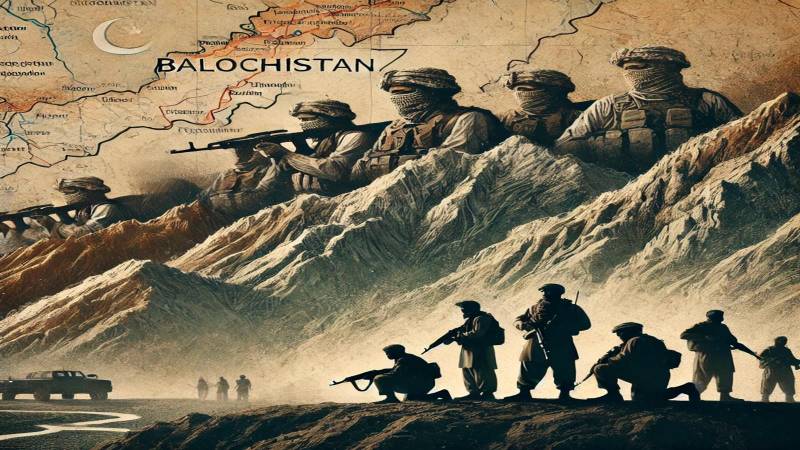
Balochistan is once again making headlines across the country, but unfortunately, the news is grim. The condemnable act of the Jaffer Express train hijacking in Bolan carried out by the Balochistan Liberation Army (BLA) shocked the entire country. Armed militants took control of the train, held passengers hostage, and challenged the state’s writ in broad daylight. For many, this incident marked a new low in the ongoing conflict and raised disturbing questions about how deeply entrenched the insurgency has become. It also highlighted just how vulnerable the province has become to such bold attacks. It demonstrates not only the capacity of insurgents to carry out high-profile actions but also the weaknesses in the state’s ability to protect ordinary citizens.
What is more troubling than the acts themselves is the environment in which such incidents are taking place. The ground realities in Balochistan have worsened to a point where these events are not just isolated acts of violence, they are symptoms of a much deeper problem. The increase in attacks by insurgents is not accidental. These groups are not growing stronger on their own. They are feeding off the frustration, anger, and hopelessness that many young people in Balochistan feel today. When citizens believe that the state has failed to deliver justice, provide opportunities, or even listen to their concerns, they start looking elsewhere for a sense of purpose. Unfortunately, this has become fertile ground for insurgent recruitment.
There is also no denying the fact that adversaries of Pakistan are fueling the insurgency in Balochistan by providing material support. However, it needs to be understood that they are merely exploiting a home-grown Faultline in Pakistan. The support of hostile elements to Baloch insurgency will be futile if there are no willing recruits on the ground to take part in the insurgency.
There are several reasons why the frustration is growing so rapidly. One of the most damaging factors has been the manipulation of elections in Balochistan. The 2024 general elections were widely perceived as rigged and unfair. Candidates who had popular support were sidelined, and political engineering resulted in the emergence of a government that many believed lacked legitimacy. When people feel that their vote does not count, they also begin to feel that their existence does not count. This perception of exclusion pushes people further away from the political process and closer to those who offer alternative, albeit violent, paths. People lose faith in the democratic system and turn towards those who promise to fight for them outside the constitutional framework.
It is important to understand that the current crisis in Balochistan cannot be addressed through force alone, treating it purely as a security problem is not only short-sighted but also counterproductive
Moreover, the current provincial government in Balochistan has largely failed to deliver on basic governance. There is widespread incompetence at various levels, and public services are in shambles. Whether it’s education, healthcare, infrastructure, or economic development, the government appears to be disconnected from the everyday problems of the people. The result is that a majority of the population continues to live in poverty without access to quality education, healthcare, clean drinking water, or employment opportunities. This vacuum has allowed insurgent groups to expand their influence. When the state fails to provide even the most necessities, people become more receptive to those who promise an alternative system, even if it is based on violence and rebellion.
Another critical issue is the complete lack of ownership that Baloch people feel over their affairs. Despite being rich in resources, Balochistan’s local population has little to no say in how those resources are managed or where the profits go. Whether it is Gwadar, Saindak, or Reko Diq, common Balochs feel that the key decisions are made elsewhere, often without any consultation with local stakeholders. The extraction of natural gas, minerals, and other valuable resources continues, but the benefits rarely reach the people who live in the province. This has created a deep sense of alienation. People feel that their identity, their history, and their rights are constantly being sidelined. When a region is treated like a colony rather than an equal part of the federation, resistance becomes inevitable.
Adding fuel to the fire is the way Balochistan is represented, or more accurately, misrepresented in the national media. During the coverage of the Bolan train hijacking, for instance, there was hardly a single Baloch voice present on national television panels or major podcasts. Most of the commentators discussing the incident had no real understanding of the province, its history, or its complex political dynamics. Instead of offering nuanced analysis, the discussion was filled with assumptions and half-truths. Such misrepresentation not only spreads misinformation but also adds to the existing frustration among Baloch citizens. When people do not see their voices in national conversations, they start to believe that they don’t matter. This further widens the trust deficit between Balochistan and the rest of the country.
It is important to understand that the current crisis in Balochistan cannot be addressed through force alone, treating it purely as a security problem is not only short-sighted but also counterproductive. What we are witnessing today is not just an insurgency; it is a political crisis that requires a political response. The state must first recognise this reality. Without this recognition, any measures taken will only address the symptoms and prolong the conflict. No number of military operations can bring lasting peace unless the deeper grievances are addressed.
There is an urgent need to create space for negotiations. Dialogue must be initiated, not as a favour but as a necessary step toward restoring peace. For that dialogue to be meaningful, it must include all stakeholders, especially those who have been excluded for decades.
At the same time, the provincial government must be held accountable for its role in the crisis. It cannot continue to operate without responsibility or consequences. The current leadership in Balochistan must step up and take ownership of the situation. It must begin by improving governance, reaching out to local communities, and making sure that development funds are used for public welfare rather than personal gain. There must be transparency in how public funds are spent and a serious effort to bridge the gap between the government and the people.
To resolve the Balochistan conflict, what is required is sincerity, empathy, and a long-term vision. Balochistan cannot be treated as a problem that needs to be controlled. It must be seen as a province with its people, aspirations, and rights. The people of Balochistan deserve dignity, representation, and justice. Only then can we hope to put an end to the cycle of violence? Will the government finally take proactive steps to address the grievances of a province and end the perpetual violence or not? Its actions in the near future will prove it either way.