

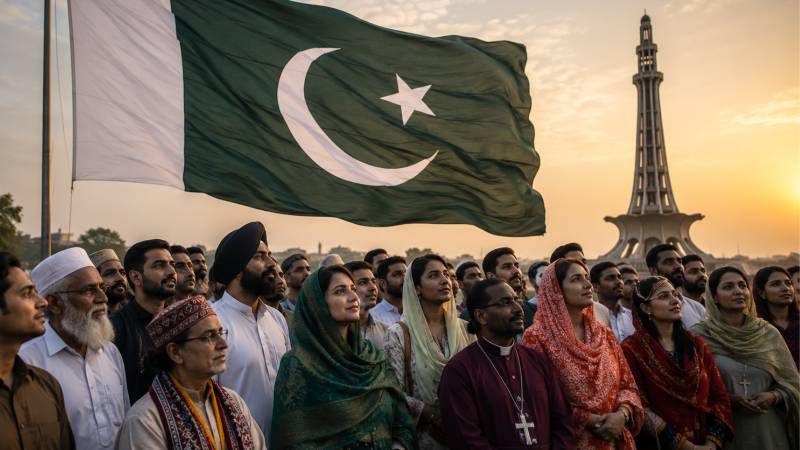
The white in our flag reminds us of the minorities that have enriched our culture, social mores and polity, making Pakistan a true melting pot of cultures and civilizations, in keeping with our Indus Valley heritage. Indus Valley was a melting pot of cultures and languages brought forth to Indus Valley by a regular wave of foreign invaders like Persians, Greeks, Kushans, Scythians, Huns and Turks. The alluvial plains and their fecund nature welcomed all outsiders who melded well with the life-giving plains of the land of the six rivers.
The relics found form the ancient ruins of well-planned cities like Mohenjo-Daro and Harappa indicate a tolerant and pluralist society with syncretic ethos. The poison of communal hatred that had vitiated the communal harmony in parts of sub-continent that now constitute Pakistan, was a consequence of the charged political environment in the years leading up to the partition. That evanescent environment was a veritable anachronism in this part of the sub-continent where the accommodative ethos of Sufi saints defined the religio-cultural sociology of the popualtion.
People since millennia have lived in harmony in the Indus Valley region that now constitutes Pakistan, a fact that was certainly not lost on the human rights focussed political sensibilities of the founder of Pakistan i.e Quaid e Azam Muhammad Ali Jinnah. He had very clearly articulated his vison for Pakistan in these words, “You are free; you are free to go to your temples, you are free to go to your mosques, or to any other places of worship in this State of Pakistan. You may belong to any religion or caste or creed — that has nothing to do with the business of the State.”
The above words by the founder of Pakistan and one of the best legal minds of his times were in fact a Vade Mecum for the human rights and religious freedoms for the minorities. Pakistan as a state, has largely lived up to those high ideals barring some exceptions and desultory incidents, that never attained sanctity at the bar of public opinion that still echoes the centuries old catholicity of the spiritual beliefs and religious practices. While it is true that the migration pattern of few minorities like Parsis indicates a dwindling of their numbers but that has more to do with the economic reasons and the personal preferences of the new generation.
The white in our flag is still being embraced by the society and the state with alacrity. The minorities have bled with us in wars and stood by us in our hours of crisis. The likes of Cecil Chaudry and Mervyn Middlecoat saved our skies while countless army and naval officers have performed prodigies of valour in the service of the nation. Writers like Bapsi Sidhwa have enriched our literature while several others continue to liven up our socio-cultural landscape. While it is true that the religious particularism and the concomitant transnational terrorism have resulted in persecution of Muslims and the minorities with equal ferocity, it is also a fact that such excesses have attracted national opprobrium from all communities and segments of society.
The support for minorities is embedded in the DNA of the Pakistani state and the white in its flag is emblematic of that fact.
It is worth highlighting that the main impulse behind creation of Pakistan was to protect the rights of the minorities. It was a fear of the likes of RSS and Shiv Sena who were openly repudiating their syncretic past by extolling the hate filled texts of the Hindutva ideologues like Savarkar. Pakistan therefore was supposed to be a country where all faiths, sects and ethnicities could live and practice their faith, enjoying the equal status under the law of the land.
Pakistan by and large has lived up to that ideal and where acts of religious persecution have happened, those have not been targeted at minorities alone. The misuse of the blasphemy law has been actively discouraged by the state which is applied indiscriminately. Since 2005, 61 individuals have been convicted on blasphemy charges out of which 48 were Muslims, 7 Christians, 2 Hindus and 4 Qadianis. Out of current 524 under trial blasphemy cases. only 11% involve minorities. The acquittal of Asia Bibi, Shagufta Kausar, Shafqat Emmaneul, Notan Lal by higher judiciary indicate the fair trials in appeal courts of higher judiciary.
There is no doubt that certain acts against the minorities in the past have led to national and international censure but those acts were by individual entities. At state level, Pakistan is going an extra yard to ensure an equal treatment for the minorities as per the law of the land besides providing channels to institutionalize the protection of minority rights. To assuage their social and political concerns, special platforms have been created that include special grievance cells for minorities to report any threat or violation of rights, District interfaith Harmony Committees, and Welfare Fund Forums.
Special care is taken to celebrate the minorities days and protect and develop their holy places of pilgrimage and worship. The expansion and renovation of Darbar Kartarpura for Sikh community, that is capable of hosting over 5000 Sikh pilgrims daily along with constitution of the Pakistan Sikh Gurdwara Parbandhak Committee (PSGPC) was formed on April 11, 1999, by the Government of Pakistan indicates the state’s desire to protect and promote the minority interests. There are 2189 churches in Pakistan (1 church per 1206 Christians), 732 temples ( 1 temple per 5699 Hindus), and 58 Gurdawaras (1 Gurdawara per 159 Sikhs) while in UK there is only one mosque per 2249 Muslims.
The rights of minorities are being protected through special legislation in National Assembly like the “National Commission for Minority Rights Bill, 2025” which establishes a statutory body charged with the responsibility of safeguarding and promoting the legal, economic, and social rights of non-Muslims. Minorities are being given special job quotas like 5% reserved jobs at federal and provincial level besides a quota of 4 seats in Senate, 10 in National Assembly, and 23 in Provincial Assemblies, in addition to the merit seats. Over 2000 minority officers are serving in senior government posts (Grade 17 and above)
The minorities enjoy special protections and welfare support like the endowment funds and the special allocations of slots for vocational training. In order to protect their family laws, legislation like Hindu marriage Act 2017 has been introduced by the Ministry of Human Rights which is applicable to entire country except Sindh province. On the similar lines a Christian Marriage and Divorce Act is being introduced which after due consensus amongst different Christian factions would be introduced in the parliament.
It is against the above backdrop of minority support that the insidious propaganda of discrimination and abuse of minority rights appears incongruous with the ground realities of Pakistan. The vested interests, inimical to Pakistan, pick up on cases like Maria Shahbaz where a Christian girl converted to Islam after contracting a marriage of her own volition. She was given a patient hearing by the court where she disclosed without any duress that she had contracted the marriage of her own free will without any pressure. A few vested quarters latched onto her example and started a vicious smear campaign against the state of Pakistan in foreign countries. When the facts were presented about her consent and due process of law, those quarters started giving another twist to the tale by citing fabricated evidence in support of their assertions.
The support for minorities is embedded in the DNA of the Pakistani state and the white in its flag is emblematic of that fact. In accord with the millennia old traditions of religious accommodation and socio-cultural pluralism, the legatees of Indus Water Civilization embrace religious diversity and inter faith harmony as the central motif in the tapestry of their religious beliefs and socio-political mores. The state is wedded to the covenant of support for the minorities articulated by the founder of the nation 79 years ago. Any attempts to undo that covenant risk undoing the very concept on the basis of which Pakistan came into being.