

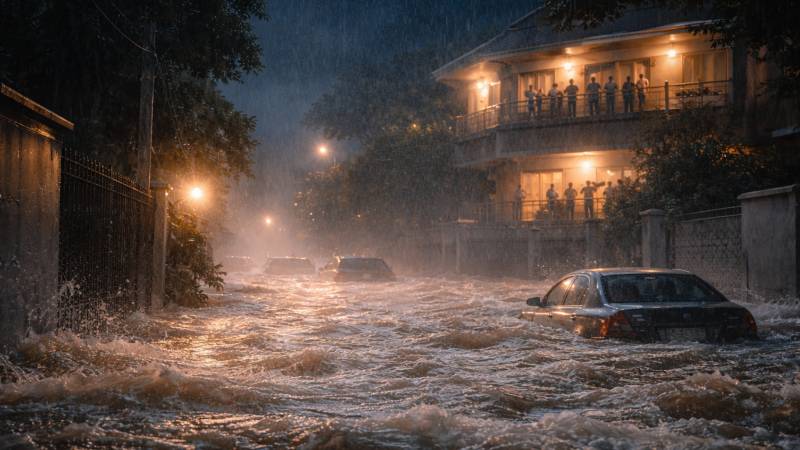
Almost four years ago, on an August night, my husband and I, along with our two-year-old daughter, buckled into her car seat at the back, were coming back from Peshawar in Pakistan. As we entered Abbottabad, our hometown back then, it started to rain and, within the very next minute, it was raining very heavily. The next minute, even faster, and then in hardly five minutes, it rained like crazy. And in no time, the craze of the rain turned into aggression.
Within minutes, the roads were submerged in water. It was dark, it was raining, and water was everywhere, making it impossible to distinguish the roads from the greenbelts. The water level on the road rose to the extent that we could only see double-storey houses on both sides. I told my husband I could feel water creeping up to my feet inside the car, and in the next two to three minutes, water was up to our knees. It was the moment when my husband decided to switch off the car. Now we were in the car, on a road, with water outside and rising up to the level of the car bonnet. It felt almost impossible to escape this predicament.
We knew that it was an expensive residential area in Abbottabad. Houses were big, and affluent people lived there. In that moment of despair, while the wipers on the windscreen were struggling hard against the downpour to give us a view of the flooded road ahead, we looked up and saw three or four girls standing on the third-storey terrace of a bungalow, waving their hands and asking us to come inside. I looked at my husband. Our daughter, unaware of the gravity of the scenario, was still sleeping. And then again, we looked outside.
At the main gate of that house was a man standing amid heavy rain, shouting and moving his hands. In that thunderous situation, we had a few seconds to decide something. We could only guess that he was asking us to come inside. The house was very high above the road because we were able to see the base of the iron gate.
Anyhow, my husband swiftly unbuckled our daughter, switched off the car, and opened the door, which was another miracle. Despite the gust of heavy water, we were able to open the car door, and we got outside. The water had reached up to my shoulder, but we were still able to labouriously wade through it.
When we entered that house, in the garage, there was a staircase leading to the second and then to the third storey. My daughter was awake, and she was in the arms of my husband. She was not crying; her eyes were blank, perhaps she was thinking it was a dream. We were all in a state of shock, not talking to each other, just looking and following the other person’s gaze.
Climate change is mostly taught through records, reports and numerical figures, but not through lived human experiences
As we entered, there were so many people already in that house, all rescued by the homeowner, who was a businessman. That night, he rescued everyone: old, young, rich, poor, whoever was on that road, he kept pulling them out till morning. Without thinking about the safety of the women and children in his own house, he kept on bringing strangers in distress inside. That night, I witnessed the rise of humanity while nature was determined to fall down on us. It reinforced my trust in the human race and kindness. Still, people put themselves at risk to save the lives of others.
When the rain got slower, from the terrace on the third floor, I spotted my car. Its tyres had left the ground, and the car was floating in the unruly waters. It moved around for a while and then got stuck somewhere. In almost an hour, I was able to see the roof of the car. We all were captives of a cloudburst. A cloudburst is a sudden, excessive, and highly localised downpour of rain. These intense storms usually last only a few minutes to an hour, dumping vast amounts of water that trigger flash floods and landslides, especially in mountainous areas.
By this time, the ground floor of the house, which was almost four feet above the road level, was flooded with water, and on the second and third floors, there were people in every lounge and room. Around 5 a.m., the rain finally stopped. Water gradually receded, and the host family was making parathas and tea for their guests in unrest. People were talking to each other like they had known them for years. Women were in a separate lounge while men were in other rooms.
It was a night of remembering Allah while talking to fellow human beings. After 7 a.m., in the morning, I could hear the noise of traffic on the road. The Rescue 1122 team had arrived. Our car was stuck between two humps. The water had retreated into the nala close by. Some people’s cars had been carried away by the floodwater.
Many years later, I saw video footage on Facebook of a car being carried away by the surging waters during a cloudburst. The flood swept away a man with his daughter as they got caught in a rain-swollen seasonal stream. The vulnerability of even affluent areas to urban flooding is a reminder from nature that when natural disasters come, they do not care about social status or level of education. They just come and sweep everything away. Again, it was seen in the flooding events in 2025 when villages, together with luxury neighbourhoods, were inundated with water.
I wrote this story while I was working on a paper on climate change, and my dad borrowed Adventures of Climate Science: Scientists’ Tales from the Frontiers of Climate Change for me from the library. I initially rejected it because I consider myself a person who is not into scientific content, but when I read it, this book inspired me to write my own story.
I realised that climate change is mostly taught through records, reports and numerical figures, but not through lived human experiences. This story shows how rapidly an ordinary night turned into a life-threatening adversity. Climate change is real, it is filmic, it is punchy, and it has arrived.