

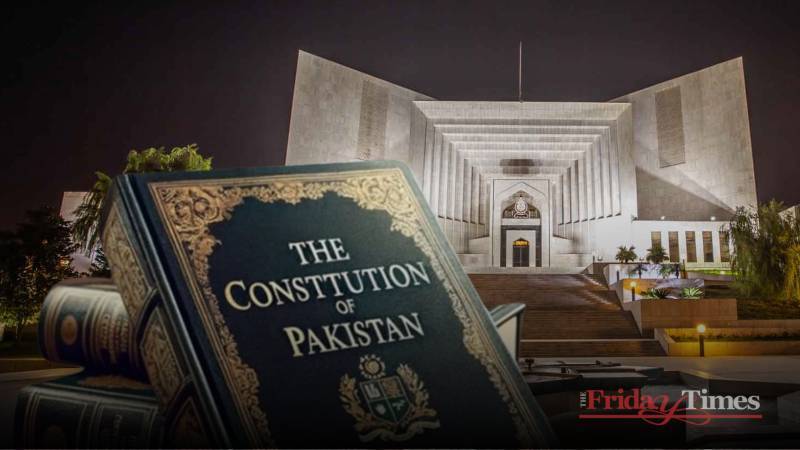
Among the many fictions Pakistan continues to tell itself, none is as persistent or as tragic as the belief that democracy still breathes within its borders. Fair elections, civilian supremacy, rule of law, civil liberties, intra-party democracy, all of these were already in decline long before anyone even whispered “27th Amendment.” The Amendment did not create the rot; it delivered the coup de grâce. With it, the last remaining guardrails, the fragile, flickering checks and balances that occasionally restrained the powerful, have now been buried. The pretence of democracy has never felt so hollow, nor the silence of institutions so deafening.
Accountability, that elusive ideal, was always selective, wielded as a cudgel against inconvenient rivals and withheld as a shield for allies. There were moments, brief and brave, when courts dared to speak truth to power, when a judgment startled the executive into momentary humility. Those moments are gone.
Yet the rulers persist in speaking the language of democracy, as though repetition could resurrect meaning. They recite the familiar litany of stability, order, and reform while hollowing out the very values they invoke. Whatever moral legitimacy lingered in the system evaporated the day the Amendment was tabled. Power has shed all pretence of accountability. The “elite” now answer to no one, exercising power without restraint and cloaking self-interest in the garb of national duty.
Politics has become a game of survival, accumulation, and pretence. The citizenry has been reduced to spectators, watching with weariness and disillusionment. Cynicism is not an accident; it is the intended outcome. When citizens no longer believe, they no longer resist. Why bother engaging with a system that mocks its own rules? Why participate in a democracy that treats the public not as stakeholders but as an audience too fatigued to demand accountability?
Let us dispense with euphemisms. The 27th Amendment is not reform; it is resignation. It announces, without irony, that accountability is obsolete. Pakistan no longer enjoys the luxury of pretending that democracy is merely “flawed.” The façade has cracked beyond repair. Once, even in the darkest moments, there existed pockets of dissent, remnants of institutional muscle memory that refused to surrender completely. That space has been sealed off, in the name of “stability.”
Pakistan’s democracy has not stumbled; it has been hollowed out by design. Pretending otherwise only postpones the reckoning that comes when power is concentrated beyond accountability
We are told this is progress. We are told it is necessary for order, for continuity, for “national unity.” But we must not be deceived. Stability built on silence is not stability; it is suffocation. Order imposed by fear is not governance; it is control. Unity demanded at the expense of truth is not unity; it is coercion. The tragedy of Pakistan’s democracy is not its sudden collapse but its slow suffocation, administered gently by those sworn to protect it. Every amendment, every doctrine, every patriotic “reform” has chipped away at the democratic promise until all that remains is a husk wrapped in constitutional language.
The 27th Amendment marks the point of no return. It does not change the system; it exposes it. In Pakistan, power does not flow from the people; it flows around them, above them, and despite them. The Amendment merely codifies an unspoken truth: that authority rests with the unelected, the entrenched, and the unaccountable. It formalises what was already practised. The charade endures only because illusion is necessary to maintain control. The rulers still invoke democracy because even autocracy needs a moral disguise.
We must abandon the fantasy. Pakistan’s democracy has not stumbled; it has been hollowed out by design. Pretending otherwise only postpones the reckoning that comes when power is concentrated beyond accountability. Every time we call this system a “flawed democracy,” we grant it a legitimacy it no longer deserves. This is not a failure of democracy; it is a betrayal of democracy. And the betrayal is bipartisan, institutional, and complete. No single party can claim innocence; each has played its part in nurturing the illusion and normalising the decay.
No tanks rolled into Islamabad this time. No general declared martial law. The death of democracy came quietly, disguised as legality, delivered through parliamentary procedure, endorsed by those who claimed to defend it. That is the genius of this new order: it kills democracy through its own instruments.
So where do we go from here? The question now is not whether democracy can survive in Pakistan, but whether the people can survive its ghost. A society can endure authoritarianism if it recognises it as such. But when oppression is disguised as “continuity”, when control masquerades as reform, and when silence is sold as peace, it corrodes the soul of the nation. We begin to forget what freedom looks like, what dissent sounds like, what citizenship means beyond a vote tallied and forgotten.
And that is the final tragedy. The idea of democracy, once vibrant, messy, and hopeful, has become a relic. And relics, however revered, cannot govern.