

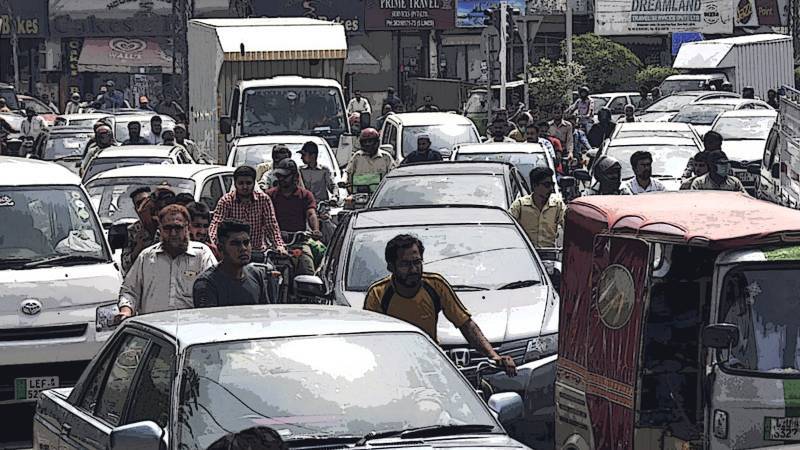
Pakistani car drivers are in a hurry. They do not want to stop at a traffic light. They do not want to give way to another car and most of all to pedestrians. If a hapless walker inches forward hoping to get to the other side of the road, the cars will speed up to make sure they do not give her the way—you couldn’t be blamed for thinking that the car drivers are trying to kill the pedestrians. Policymakers and the powerful who cruise in luxurious cars, with darkened windows, often as part of a convoy of security cars, have not let themselves be exposed to the mantra ‘pedestrians have the right of way.’ Other than designating certain shopping areas as pedestrian-only, the government has done little for the common walking man.
Yet to its credit the Punjab government has sprung into action on many other urban fronts. It has removed encroachments from congested streets, making them wider and making it easier for cars to traverse the chaos. The Chief Minister has made it a point to emphasise cleanliness, although this hasn’t yet manifested itself in a meaningful way. The eyesores that are the walled rectangular trash dumping spaces still overflow and spill their contents. Often households burn trash and foliage on the side of the road, making the already polluted air worse. A far more robust trash management system would have to be established to control the refuse. Such a policy would have to run awareness campaigns about how and where to dump trash and about recycling.
Trash comes with other considerations. An ecosystem exists in which some communities benefit from the putrid heaps. Birds, cats, dogs and other feral animals pick through the garbage for edibles and sustain themselves through the refuse. Perhaps this explains the thriving populations of crows and kites, and other street animals. A crow will at times pick up a piece of meat or a bone, lose its grip, and drop it in a manicured lawn where the pet dog will end up consuming it with ample glee, unaware that he may be eating something toxic. The circle of life flowing from trash doesn’t end with animals. All across the cities, human scavengers are bent upon the piles picking for materials and goods to be used, or sold in the scrap industry. Discarded vegetation and half-eaten fruit become a tasty meal for their goats, cows, horses and donkeys.
Controlling Pakistan’s prolific population growth rate and establishing a public transportation system could in the long run be far more effective in easing the pressure on clogged roads
Sometimes I wonder if the feral animals and scavenging humans weren’t doing their recycling work, garbage sites would morph themselves into high-rise structures.
Could the recent urban development initiatives be leaving some in the lurch? With the encroachment removal drives, what will become of the street vendors who sell all kinds of goods from their colourful carts, which they push back to their homes at the end of the day? Just like the truck art, the cart culture of Pakistan adds to the urban charm, not to mention the livelihood it provides to thousands. I hope the pushcarts will still find space on the side of the roads.
Similarly, will a modernised system of collecting and hauling trash to landfills endanger a vital part of livelihood for the human scavengers? Or would the government be thoughtful and make them a part of the new system? As for the stray animals, shelters could be established and spaying and neutering campaigns launched to control their populations, instead of the harrowing practice of culling dogs by poison—that’s one urban absurdity that the government should ban.
Amongst the spate of projects, Pakistani authorities and car drivers seem to have a favourite—building overpasses and underpasses. These have been sprouting up and curling and curving all around Rawalpindi and Islamabad. Many of these structures are of course needed to ease the pressure of ever-increasing cars, but in part they are a result of drivers’ obsession with not wanting to stop at a traffic light, and a general apathy towards the common walking man.
Traffic lights are simply a part of urban life. They not only help regulate traffic but also give pedestrians a chance to cross the street safely. Whereas more traffic lights with crosswalks are needed, they are being removed at every opportunity.
And several times a year, the discontented earth jolts Rawalpindi and Islamabad out of slumber. It does that to many other parts of Pakistan. I hope the government keeps earthquakes in mind when planning and constructing flyovers.
Controlling Pakistan’s prolific population growth rate and establishing a public transportation system could in the long run be far more effective in easing the pressure on clogged roads. Perhaps Punjab government’s best initiative is the launch of climate-friendly, electric public buses in many parts of the province. I hope the government will keep expanding this network.
It’s clear that the Punjab government is interested in urban development. It has a simple way to make good choices—keeping the common man foremost in mind.