

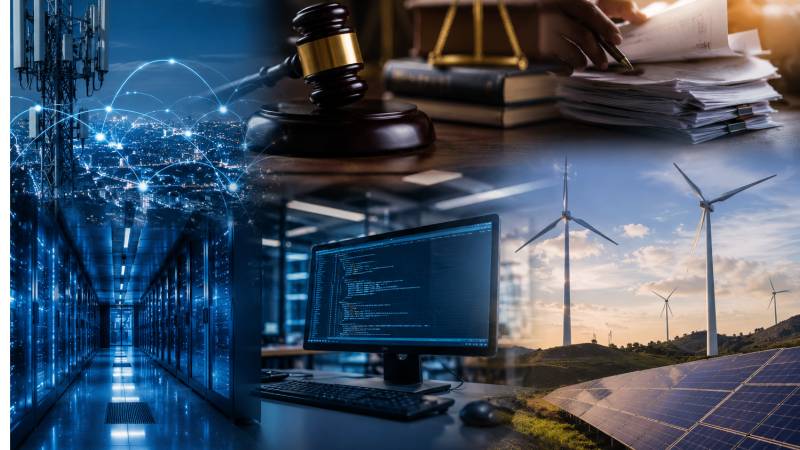
Laws designed to accelerate development often remove legal obstacles. The question is Whether Pakistan’s telecommunication bill also remove environmental safe guard. The overriding language of the bill in section 27(A) and overlooking precautionary principle established in Shehla Zia v. Wapda case may risk prioritizing connectivity over environmental caution. Technological advancement must be paired with environmental reviews, renewable energy targets and e-waste management to ensure sustainable development.
Pakistan seeks climate resilience and environmental sustainability. The Telecom bill, 2026 moves in a different direction. Sustainable development, central to our climate policy requires that economic growth should not be at the cost of the environment. The bill focuses on rapid installation of telecom tower for speedy deployment of 5G infrastructure. The goal is bona fide yet certain aspects are creating hindrance especially in a country that is extremely vulnerable to floods, heatwaves and environmental shocks. In such a critical scenario it is important that environmental consequences of any future action be considered. Pakistan needs IT sector growth and connectivity, but the law should not pretend that telecom expansion is environmentally neutral.
Improving digital connectivity is an absolute necessity and a legitimate objective. The bill raises concern when viewed through an environmental lens. It overlooks the environmental footprint of telecom expansion, weakens environmental review and diverts from the principle set by supreme court of Pakistan in Shehla Zia case.
Firstly, the bills main focus is expanding the modern digital infrastructure, meanwhile the environmental foodprint it would leave behind remains unaddressed. 5G offers blistering speed and expanded network capacity, consequently requiring denser infrastructure, more equipment and more energy consumption. Resulting in the need for more towers, more cooling need and increased electricity consumption over time. According to the international telecommunication union (ITU) ICT sector contributes 1.7 to 4.0 percent of global carbon emission. Considering the global rise in demand for telecom and digital infrastructure, the emission rate is only bound to increase. (The World Bank)
Bills main focus is expanding the modern digital infrastructure meanwhile the environmental foodprint it would leave behind remains unaddressed.
According to “Assessment of Economic and Environmentally Sustainable Issues in the Mobile Communications Industry in Pakistan” reducing energy consumption in telecommunication power systems is crucial to facilitate economic resource saving and sustainable development. (Qlantic Journal of Social sciences and Humanities) Sustainable development in this case would require renewable-energy requirements and life-cycle obligations for e-waste management. By omitting these the bill accelerates network expansion without addressing environmental responsibilities.
Secondly, section 27(A) of the bill gives licensees the right to access for infrastructure installation stating that the provisions of the bill shall be implemented "Notwithstanding anything contained to the contrary in any other law, rules, regulation, policy...". In other words, it may exempt the telecommunication companies from compliance with environmental and climate policies along with any other laws of the state. Environmental review governed under the Pakistan Environmental Peotection Act (PEPA) exists to identify and mitigate potential ecological imbalance that might result from the development. The overriding language rises serious concern because environmental damage is often cumulative and difficult to reverse, once construction begins. Furthermore, a telecom site is not just a pole or a tower. It requires associate access routes, back-up power system and ongoing maintenance that have environmental implications. By solely focusing on expansion, the bill treats environmental review as a procedural hurdle rather than a legal safeguard.
Thirdly, the bill departs from the Supreme Courts’ judgment in Shehla Zia case. The judgment in its interpretation of Article 9 of the constitution, set a precedent that right to life and dignity encompass a right to healthy environment. Furthermore, upholding the Precautionary principal the Court made it clear that development cannot proceed in disregard to environmental consequences. The bill raises constitutional concern because it seeks to ease infrastructure roll out while weakening the mechanism through which environmental concerns are evaluated. The states’ objective to modernize digital infrastructure must be executed in the light of constitutional protections. If environmental safe guards are neglected in the pursuit of rapid advancement, the questions raised are not merely regulatory but constitutional.
This does not mean that Pakistan faces a choice between digital development and environmental protection. Digital infrastructure can expand while remain subjected to sustainability standards. But that would require to pair the connectivity with meaningful environmental review, renewable energy initiatives and clearly defined policy guidelines regarding e-waste and managing environmental footprints of equipment. (International Journal of Multidisciplinary and Current Educational Research)
A country extremely vulnerable to climate crisis cannot afford a litigation that treats environmental safe guard as secondary. The very foundation of environmental constitutionalism begins with the understanding that progress and development are not only measured by what is built but also by environmental safeguard that accompany it.