

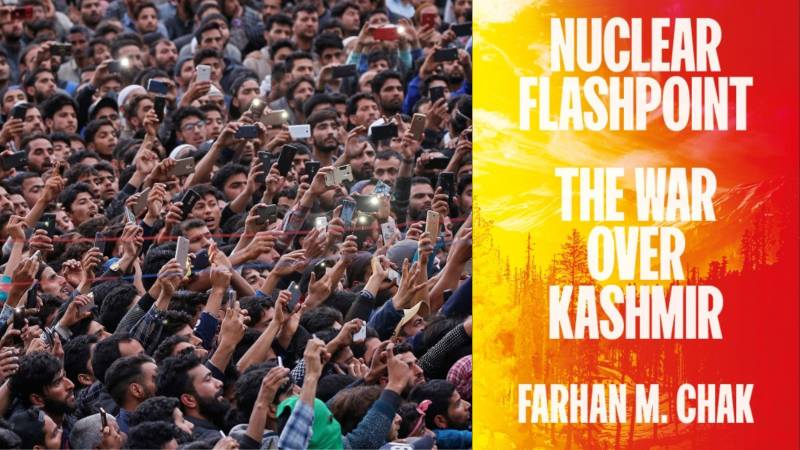
For non-Blacks, non-Palestinians, and non-Kashmiris, it is important to centre stage the voices of folks whose narrative is subject to erasure and gaslighting. This is why Farhan Chak’s book, Nuclear Flashpoint: The War Over Kashmir, is important, as it offers a Kashmiri Muslim narrative. A synoptic review follows.
Chak notes that a “sophisticated network of misinformation” by India is directed to “avoid international attention” and “control the narrative” on Kashmir. He argues that Kashmir cannot be considered as a separatist movement, as it has never been part of India. He questions, “on what authority did the Maharaja decide to accede” to India without consulting the people of Kashmir. He adds that by refusing Kashmiris their right of self-determination, India continues the “legacy of British colonialism”.
Pathology of Loss and Coercive Patriotism
Chak highlights the role of a “violent, Islamophobic, and supremacist” Hindutva ideology in India’s settler colonialism, dispossession of land, and erasure of identity. He states that India’s majoritarian intolerance results in fascism that exhibits the “pathology of loss” against Kashmiris and Muslims. Moreover, he argues that many post-colonial Indian scholars with “Hindutva proclivities” propagate false mythical narratives, erase Kashmiri Muslim oral tradition, and appropriate Kashmir by conflating its Buddhist history with Hinduism.
On India’s coercive patriotism, he asks us to “imagine someone insisting that you must love them, carry their flag, sing their songs, and chant their anthem” and that “if you refuse … they threaten your life. Love me, or else”.
He also notes the contradictions and inconsistencies of Hindu nationalists when they disagree with Pakistani claims that they are not Indians and equally disagree with Indian Muslim claims that they are Indians.
Chak highlights the use of the Jamiat Ulama-i-Hind, who chastise Kashmiris for demanding the right to self-determination, giving them the choice between “compliance” or “punishment”. Additionally, he highlights that such Muslims uncritically imbibe the narrative of partition to exaggerate hostility to Pakistan and blame their suffering in India on it.
According to Chak, Muslim sell-outs like Sheikh Abdullah and Ghulam Muhammad Bakshi were used to disenfranchise the Kashmiri people for personal privilege. This is reminiscent of the co-opted Palestinian Authority that betrayed the Palestinian struggle in exchange for becoming a “useful puppet regime for the Israeli state”.
The resistance against a hegemonic Indian identity is depicted as “separatist”, “anti-national” or “terrorist” to delegitimise the Kashmiri right to self-determination
Islamophobia and the Partition Industry
Chak argues that “institutional support for Islamophobia” occurs at the “highest political office” where the term “final solution” has been used by drawing parallels with Israeli action in Palestine. He states that a system of “settler-colonialism and apartheid” is instituted in Kashmir. This results in the policy of “demographic flooding” to dilute the Muslim demographic, removing Kashmiri Muslims from positions of authority, changing the names of public institutions to enforce Indianisation, and gerrymandering electoral districts to disenfranchise the Muslim majority.
Additionally, the resistance against a hegemonic Indian identity is depicted as “separatist”, “anti-national” or “terrorist” to delegitimise the Kashmiri right to self-determination. However, he emphasises that Kashmir is an anti-colonial issue, not a religious war. In this regard, even Salman Rushdie had stated:
“The phrase of ‘crackdown’ that the Indian army uses is a euphemism of mass destruction. And rape. And brutalisation. That happens all the time. It’s still happening now. And so, yes, I am angry about it! The decision to treat all Kashmiris as if they’re potential terrorists is what has unleashed this, the kind of ‘holocaust’ against the Kashmiri people. And we know ourselves … how important it is to resist treating all Muslims as if they’re terrorists, but the Indian army has decided to do the opposite of that, to decide that everybody is a potential combatant to treat them in that way. And the level of brutality is quite spectacular.”
Chak argues that a small privileged elite minority weaponises the term partition to “mock, exclude, (and) demonise” those who reject the narrative of a “monolithic India”. They weaponise victimhood based on “psychological resentment at thousands of years of perceived subjugation”. However, Chak rejects the “artificial construction of the hegemonic Indian imaginary” and argues that in 1947, the British Raj was divided, not India. He quips that to “bewail the division of Mother India, she must be created”.
Chak states that those who subscribe to the two-nation theory have been “caricatured as communalists, separatists, and religious chauvinists”. He argues that “Muslim nationalism” was not “against India or Hindus”, unlike Hindu nationalists who engaged in othering and demonising Muslims. Moreover, he states that “there is no legal or moral justification for denying any people the right of self-determination”. He questions why Muslims must be penalised by hegemonic Hindu nationalists for determining their own identity and why an identity must be forced upon them.
Hindutva is driven by insecurity, shame, unmanliness, and cowardice, which instigates hyper-aggressiveness to compensate for such inadequacy
Hindu Colonisation and Genocide Denial
Chak describes the “racist, colonial” Dogra rule as “Hindu colonisation”, which resulted in 1846 as a reward for Dogra co-operation with the British. This led to a tyrannical and “aggressive Hindu state” over a Muslim majority that included “banning the call to prayer, destroying mosques”, and shutting out Kashmiri Muslims from bureaucratic employment. He adds that the Dogra strategy included confiscation of land, forced labour of Kashmiris, extortion of agricultural produce, ethnic cleansing, and genocide. Thus, he states that the Dogra rulers treated Kashmiri Muslims “worse than slaves”. In contrast, the Mughals did not alter the “socio-cultural or religious composition of Kashmir”.
Chak argues that Muslims constituted 70% of the majority prior to the Jammu genocide by the Dogras that resulted in the murder of 237,000 to 500,000 Kashmiri Muslims. This resulted in Jammu becoming a Hindu-majority province. To perpetrate the genocide, RSS Hindu youth were transported to Kashmir and arms were distributed to them just as Muslims were disarmed.
Apart from the planned execution by RSS goons, Patiala armed forces, subordinate to the Indian army also participated in the genocide before the “outnumbered” and “outgunned” Pakistani tribesmen arrived in response. Thus, Chak states that without the Jammu massacre “aided and abetted by the Indian government” there would not have been the “so-called tribal invasion”.
Chak notes that India downplayed the seriousness of the genocide and deflected “accusations of ethnic cleansing”. It also framed the genocide as “counter violence”, a strategy that it later adopted with Gujarat under Modi in 2002. However, Chak argues that such framing “betrays the organised nature of the genocide” and the “ideological motivations of the Dogras”, which involved Islamophobic tropes and demonisation of Muslims as “filthier than dogs”. Thus, Chak argues that the Indian government was “complicit in hiding the (Jammu) massacre” and that genocide denial is a major factor in the “politics of extermination”.
The Shame of Hindutva
Chak emphasises that at its core, Hindutva is driven by insecurity, shame, unmanliness, and cowardice, which instigates hyper-aggressiveness to compensate for such inadequacy. This leads to the exhibition of machismo through cow vigilantism, hatred against Muslim men marrying Hindu women, threatening Muslim women, and razing mosques. This analysis is shared by Pankaj Mishra, who notes that the racial ideology of Hindu nationalists served to address a perceived “lack of manhood” and that Hindu nationalists forge a “hyper-masculine” national identity based on a narrative of “humiliation, helplessness and insecurity”.
Finally, Chak notes that Arundhati Roy has stated that “Kashmir has never been an integral part of India”, and has been joined in solidarity by the likes of Swaminathan Aiyar, Gautam Navlakha, and Angana Chatterji. However, he questions that “not a single civil society organisation stands for the rights of Kashmiris to choose their future”. Overall, he highlights that the literature on Kashmir is dominated by post-colonial Indians with an ideological viewpoint that is complicit in structural violence. To remedy that, he presents his book to project the Kashmiri Muslim voice that has long been suppressed.