

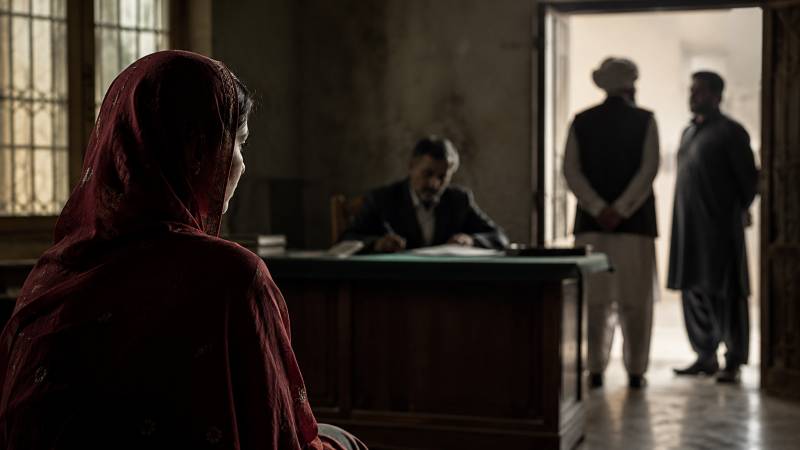
This very month, Gullan Bharo, a young mother of two from Sindh, was shot dead in her home by her husband and his uncle. She had left an abusive marriage and spent nearly three years living with her father. She had not even formally sought khula.
Yet none of that mattered. Her husband declared her kari, and that word, once spoken, became exactly what it means.
Contrary to popular belief, kari does not mean guilty. It means marked, stained. In the brutal world of karo-kari, the accusation requires no evidence and no hearing. A man says the word, and the social machinery around him begins to move like a war machine set to kill.
What makes the case particularly hard to look away from is that Gullan knew. She said so on camera days before it happened. "I know I will be killed. For the sake of my father's dignity, I will sacrifice myself and go back to live with him."
She had fled to a police station, named the men she feared, and asked to be sent to Darul Aman. She had done everything textbook needed by the system. The court later accepted her father's surety and returned her to family custody. Ten days later, she was dead. Here is the catch: her killing is the system working as it usually does.
Karo-kari is not a custom that survived despite modernity; it has adapted to it, persisting through decades of legal reform and periodic national outrage precisely because it is not about morality at its root.
In upper Sindh's zan, zar, zameen (woman, wealth, land) economy, all three sit together as things a man can lose, and losing them without consequence is unthinkable to those whose authority depends on that claim remaining intact.
The practice has remained in documented form since at least the colonial period. It concentrates in the feudal-dominated districts of upper Sindh like Jacobabad, Ghotki, and Sukkur, where the wadera or feudal system has historically been strongest and the state correspondingly thinnest.
She agreed to go home. What is worse is that the state let her
Feudal lords have a structural interest in keeping communities insular and internally policing: a village that resolves its honour disputes through jirga rather than courts is a village that remains dependent on the wadera for justice. In simple words, a village that stays controllable.
Researchers who have studied karo-kari ethnographically have found something even grimmer underneath the patriarchal logic. The accusation is frequently an economic instrument. A man declared karo must pay heavy compensation or flee, and a woman declared kari loses whatever property or inheritance she held.
Honour is merely the language, with a monetary transaction underneath.
There is also a psychology to this that rarely gets examined. A daughter in these communities does not grow up free and then have her freedom taken. She grows up already knowing, at some pre-verbal level, that her existence is load-bearing.
That her behaviour, her body, her choices carry the structural weight of her father's standing in the world. His honour is not separate from her, which means she has spent her entire life managing it, often without being told explicitly that this is what she is doing.
When her father places his pag (turban) at her feet in court, he is activating something installed in her long before that moment. And there is a second layer underneath even that: women in these situations often internalise the very framework that condemns them, not out of weakness but because it is the only moral language they were ever given.
Gullan said she would sacrifice herself for her father's dignity as though this was simply the right thing to do. And in the world she had been raised inside, it was.
What Gullan's case adds to this history is a specific institutional failure worth naming. She reached the state, sat in a courtroom, and named the men who would kill her. The court accepted her father's surety and returned her to the custody of the people she had identified as the threat, then closed the file.
The surety system, in this context, is less of a protective mechanism and more of a way for the court to transfer its own responsibility. Her father placing his turban at her feet in court is a gesture read as desperate love, but functioning as a pressure instrument so culturally dense it overrode her stated terror.
She agreed to go home. What is worse is that the state let her.
Gullan's case reached us because there was a video. Before her, Khalida Chandio was shot dead by her uncles while her village watched. Both women got names in the press. But there are numerous cases without footage that do not.
What we mourn, we mourn based on visibility, which is to say we largely mourn what the powerful choose not to bury. Until that practice is addressed, the next Gullan already exists somewhere in upper Sindh, still running, still hoping the state will save her.