

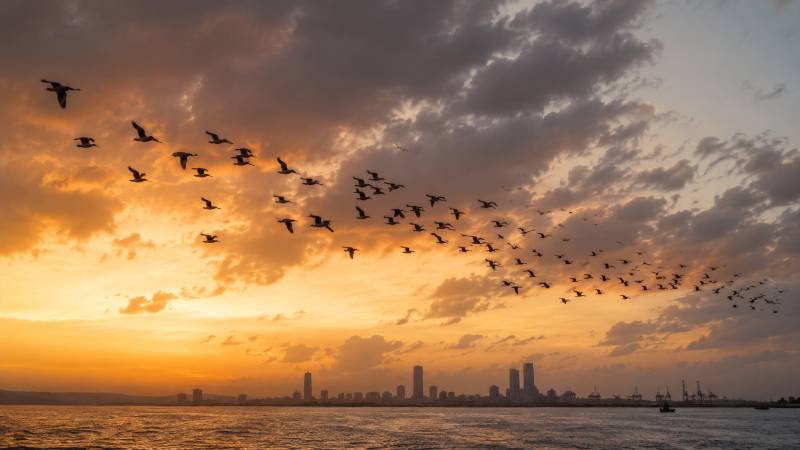
A large flock of migratory birds sailed over the sea, their wings flapping in unison, some in the lead, some following, but all going away. They were leaving behind a land simmering in rising heat and humidity. Some human beings, too, leave behind simmering land, but they seldom, if ever, move in a flock flying together. This is what makes them human: individual pursuit as opposed to collective leaving.
Migratory birds from Pakistan leave for Europe, and some human migrants also head towards Europe. It is important to note, though, that while many seek European destinations, Europe as a migratory destination for birds is different. Human migrants who leave because of climate change are a different breed altogether and need to be appreciated for their reasons for migration.
A human migrant was accustomed to leaving Karachi when temperatures and humidity began to rise. The environment became suffocating, and energy was getting sapped. She would then leave for six months, a longish period that matched the temperatures in Karachi. She would seek destinations in Europe before landing in New York and then returning. Yes, like migratory birds, she would return year after year.
Human migration for better weather can face some challenges, but not many. When menopause descended upon her, it changed her life. She slipped in and out of depression as she fought this storm. This was a change in the weather inside her, but what persisted was her way of dealing with the weather outside — to fly away from it. Not easy to balance the two weather conditions, though the external weather is easier to manage, while the weather inside goes along with her flights to a better environment. (Hmm… a tough task? Only the one practising flight in poor weather can answer this question.)
Choices are not that difficult if the passport allows easy access
For migratory birds, there are no social constructs around flying about. Their instincts are programmed to leave for better havens, even as those havens shrink or are abused by human beings. But migratory birds also have the most welcoming scenarios. In one South Asian country, a community refused the installation of electric poles as they might discourage the migratory birds. On the other hand, human beings are immersed in their social constructs, especially for women.
Purdah, hijab, behaviour, and liberalism are some concerns that guide the human migrant in choosing where she lands in countries where the temperature is right. Choices are not that difficult if the passport allows easy access. Moreover, financial liberalism also allows the human migrant to make choices that suit her.
While the weather outside is the driving force behind flights away from oppressive conditions, there was also a greater comfort in being in small towns rather than getting lost in big cities. The smaller towns had a greater connection with the foliage of the area, with more trees, plants, and flowers. Needless to say, there was a lot of sense in this preference of choice once the larger weather was established as acceptable.
Those left behind by human migrants adjust in the way they adjust to the migration of birds. A near panic struck a friend when she first heard, “It is time to move out of this oppressive weather.” “What!” she exclaimed to herself, but soon the panic receded, and the time to leave was accepted. She watched them fly away, wishing them all the best.
She had no option but to bid goodbye to the human migrants until they returned. Unlike migratory birds, who do not carry WhatsApp, humans are linked by this device. Furthermore, migratory birds love the land to which they come and the land they leave, though their connection, if any, with the local inhabitants is not well known. Human migrants are linked not only to the climate but also to the people they leave behind.