

"Bade taabaan, bade roshan sitare toot jaate hain
Sahar ki raah takna ta-sahar aasan nahi hota"
(Very bright, very shining meteors do appear
It is not easy waiting for dawn until the night does disappear)
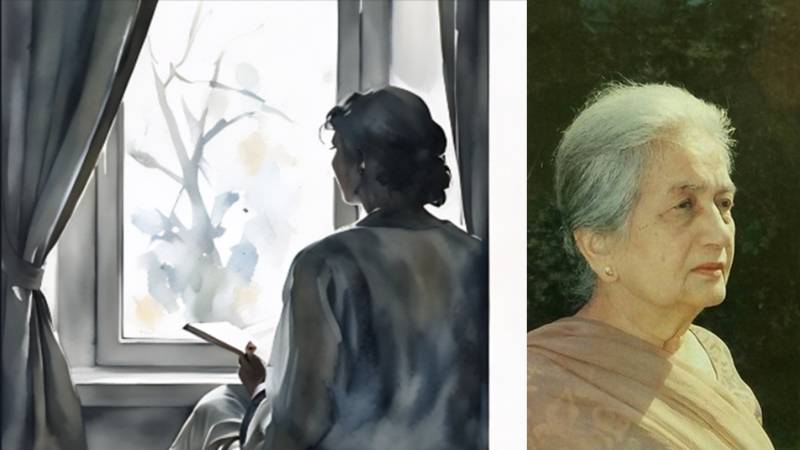
The creator of six poetic collections published in one volume as Mausam Mausam (Every Season), an autobiography Jo Rahi So Be-Khabari Rahi (What Remained Was Unconsciousness) and a research book Ghazal Numa (Ghazal Exhibit) Ada Jafri – who died a decade ago in Karachi today – was the beginning of an era in Urdu poetry but not the end. She was born on 22 August 1924 in Badayun. She was named Aziz Jahan. She started composing poetry at the age of thirteen at a time when the girls of noble families were expected to remain silent. In these circumstances Ada Jafri displayed such courage in that she not only made her existence felt but also adopted the tone which was revealing new impressions upon the canvas of history. Her first collection Main Saaz Dhoondhti Rahi (I Remained in Search of Musical Instruments) was published in 1950.
One finds such a combination of a consciousness of tradition and a new manner of feeling in the poetry of Ada Jafri which distinguished her among contemporary writers. Readers felt that her poetry is a bit different despite conforming to all the prevalent styles and traditions of poetry. Her poetry made clear that whatever poetesses are writing has a kind of freshness. This freshness has been created on the basis of their own feelings, circumstances and experiences, not from some experimental tricks. They have added various meanings and subjects to poetry along with simplicity and spontaneity. Though despite simplicity there is such depth in the poetry of Ada Jafri which is obtained with the skill and ability of expression along with depth of thought.

Ustad Amanat Ali popularized her ghazal Honton pe kabhi un ke mera naam hi aaye (Pray only my name comes upon his lips sometimes) among high and low by casting it into music. This popularity and the participation of Ada Jafri in mushairas encouraged women to enter the purely masculine box of literature in a dignified manner. This popularity though was limiting her identity to a poetess of the ghazal but those who have studied her poetry seriously know that Ada Jafri has also written such poems which along with harmonizing with contemporary needs are also somewhat different in their subjects and qualities.
Ada Jafri is the first poetess who explained the feminine identity in Urdu literature. Her autobiography Jo Rahi So Be-Khabari Rahi confirms that she was not only acquainted with the literature of women but also had a deep study of feminine expression. In her autobiography she has written a detailed chapter on two English poetesses Emily Dickinson and Sylvia Plath. Both these poetesses are the best examples of feminine poetry. She has read them with full understanding and has analysed them beautifully. She writes:
“One finds a familiar Easternness in both the poetry and life of Emily Dickinson. Her poetry can be said to be a diary of her life. Sylvia Plath’s poetry carries the status of her confessions which though was the representative of her own feelings and experiences but her manner of narration did not keep her sorrows limited to only herself.”
One finds a consciousness of tradition and a new manner of feeling in the poetry of Ada Jafri - which distinguished her among contemporary writers
The prose of Ada Jafri too has the appeal which is present in the writing of a creative artist, especially a poet. This skill of her creation can be seen in the preface to Ghazal Numa. Ghazal Numa is Ada Jafri’s research work compiled by her, consisting of introductions and ghazals of the masters, with whose name and work one was acquainted but their poetry and introduction was not available in one place. Ada Jafri compiled the poetry of many masters from Quli Qutb Shah to Mir Hasan, Hatim, Taban, Asar, etc alongwith their introduction for the Anjuman Taraqqi-e-Urdu Pakistan with extreme prudence and wrote a very beautiful preface. She writes:
“I am sure that the first poet was born with the first human. Man who has the knowledge of names, how is it possible that he remains unacquainted with the name of feelings. He must have said something to the speaking loneliness after all, and that unknown state of waiting which Adam too had very much tasted originally. That may have been the first moment of verse creation.”
Ada Jafri is thus a poetess who gave poetry the status of worship.
"Gulon si guftagu karen qayamaton ke darmiyan
Hum aise log ab milen hikayaton ke darmiyan"
(We talk like flowers between calamities
People like us are only to be found now in stories)