

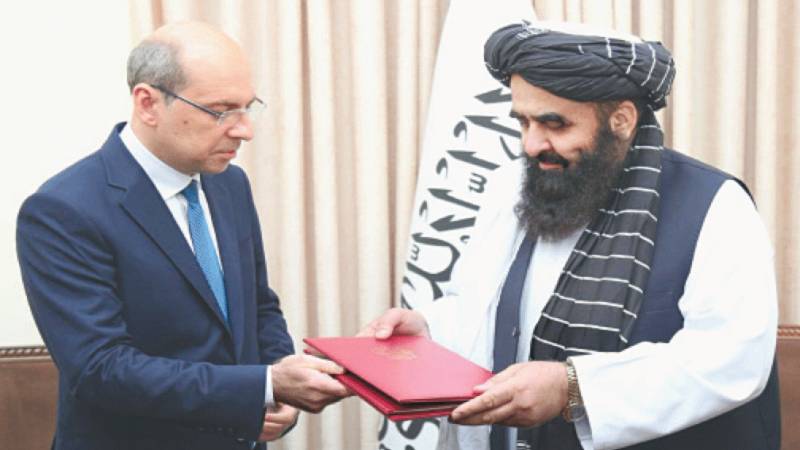
Since the United States (US) withdrawal from Afghanistan in August 2021, the Taliban’s return to power has triggered a significant realignment in regional and global diplomacy. Among the most notable developments is Russia’s growing engagement with the Taliban regime — a move rooted less in ideological affinity and more in strategic pragmatism. On 3 July 2025, Russia officially became the first country to formally recognise the Taliban government. This landmark step, following months of diplomatic overtures and the removal of the Taliban from Russia’s list of banned organisations, marks a dramatic shift in Moscow’s posture and signals a strategic challenge to Western diplomatic norms.
Russia’s decision is driven by a convergence of tactical and geopolitical interests. Its priority has been to contain security threats along its southern flank, particularly the potential spread of jihadist violence from Afghanistan into Central Asia. The Taliban’s fierce opposition to Islamic State–Khorasan (IS-K), which has targeted Russian allies in the region, presents Moscow with a useful partner in counterterrorism, even if ideologically incompatible. For Russia, a stable, authoritarian Taliban-led regime is preferable to a fragmented Afghanistan vulnerable to terrorist infiltration and civil conflict.
This calculus must also be understood within the broader reconfiguration of Russia’s foreign policy following its 2022 invasion of Ukraine. Increasingly isolated by Western sanctions and viewed as a pariah by NATO states, Moscow has deepened its engagement with authoritarian and non-aligned regimes to offset its global marginalisation. Recognition of the Taliban, in this context, is not merely a diplomatic gesture towards Kabul — it is a pointed message to the US-led West. By elevating its ties with a regime still deemed illegitimate by much of the international community, Russia asserts itself as an alternative centre of power willing to defy US-led conditionalities on Afghanistan concerning governance issues and human rights concerns.
Russia’s manoeuvring could inspire China, Iran, and others to accelerate their engagement with Kabul, thus ushering in a new era of competitive diplomacy around Afghanistan’s political and economic future
For the Taliban, Russian recognition is a diplomatic lifeline. Starved of international legitimacy and financial resources, the regime has found in Moscow a powerful partner willing to engage without demanding democratic reforms and accountability. Although Russia’s war expenditures in Ukraine constrain its ability to provide significant economic aid, the symbolic value of its endorsement cannot be overstated. It signals to the Taliban’s neighbours, and to potential allies in the Global South, that normalisation of such a regime is not necessarily a taboo — because this is what the US did itself when it recognised the former Al-Qaeda leader Ahmed al-Sharaa (aka Julani)-led regime in Syria recently.
Nevertheless, the implications of a Russia-recognised regime could be serious for the US. Already wary of Taliban control and reluctant to release frozen Afghan assets, Washington now faces a grim reality in which one of its main geopolitical adversaries has broken ranks and set a precedent for others. Thus, the Trump administration, under pressure to maintain a hard-line stance on authoritarian regimes, will likely view Moscow’s move as part of a broader confrontation. Given the recent failure of Donald Trump’s attempts to mediate a ceasefire in Ukraine and Russia’s renewed airstrikes on Ukrainian cities, US-Russia trust is at a historic low. In such a climate, Moscow’s recognition of the Taliban is bound to provoke intensified scrutiny and possibly countermeasures.
Adding to the complexity is the recent declaration by the International Criminal Court (ICC) implicating senior Taliban figures in war crimes and systematic human rights violations. This development raises the stakes for any (regional) government considering engagement with the regime. By recognising the Taliban, Russia not only challenges the so-called ‘rules-based approach’ to regime recognition but also highlights the inconsistency of the United States, which itself has sidestepped these norms in the case of Syria.
Importantly, the emerging triangular dynamic, Russia seeking strategic inroads, the Taliban pursuing legitimacy, and the United States attempting to preserve normative authority, has resurrected Afghanistan as a stage for great-power rivalry. Nevertheless, unlike in previous eras, this contest is now shaped by competing visions of global order: one anchored in liberal democratic norms and conditional diplomacy, the other in strategic pragmatism and sovereignty-first realpolitik.
In the coming months, the United States and its allies will likely toughen their stance on Afghanistan, possibly through diplomatic isolation of the Taliban, economic sanctions against actors engaging with the regime, as well as renewed investment in regional counterterrorism partnerships, including with Pakistan. Meanwhile, Russia’s manoeuvring could inspire China, Iran, and others to accelerate their engagement with Kabul, thus ushering in a new era of competitive diplomacy around Afghanistan’s political and economic future.
Finally, Russia’s recognition of the Taliban represents more than a bilateral breakthrough. It is a calculated geopolitical act designed to challenge the influence and recast the norms of international engagement with the developing countries of the Global South. The US now faces a difficult strategic dilemma: ignore, resist, or re-engage with the Taliban regime. Whatever the choice, Afghanistan has once again become a pivotal arena in the evolving contest of great powers, and Pakistan ought to rank its choices in a manner that maximises its geoeconomic interest.